
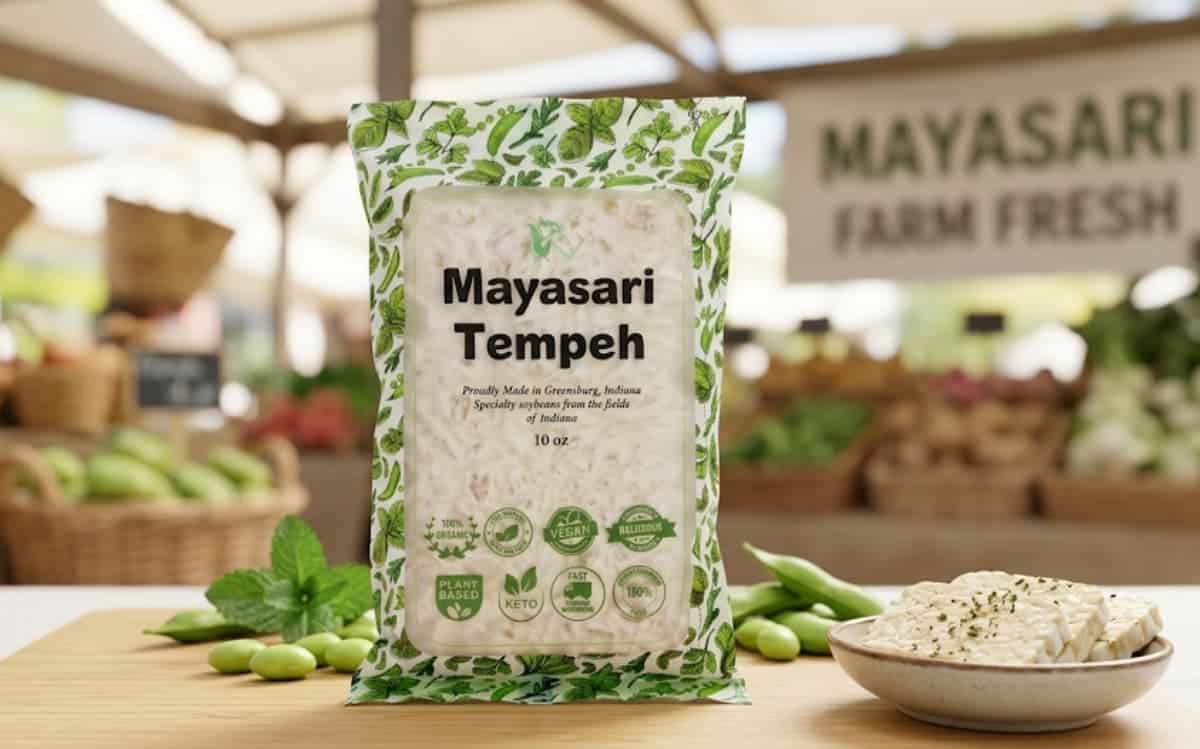
Fermentation moves through clear stages where microorganisms break down sugars without oxygen, yielding small amounts of energy along with acids or alcohol. The process produces about 2 ATP per glucose molecule and follows a steady biological sequence rather than a random change.
Louis Pasteur first showed that microbes drive these chemical shifts. In everyday cooking, including tempeh, small changes in timing or temperature alter the outcome. Understanding these stages removes guesswork and makes results repeatable. Keep reading to see how each step unfolds and how to control it in practice.
Fermentation Stages at a Glance
- Fermentation follows four microbial growth phases that determine yield and flavor.
- Food fermentation adds practical stages like primary, secondary, and maturation.
- Controlled conditions such as pH, temperature, and oxygen directly affect outcomes.
Fermentation Follows Predictable Stages That Control Output and Efficiency
Fermentation moves through lag, exponential, stationary, and death phases. Microbial activity shifts from adaptation to peak production and then declines, shaping both yield and quality.
Soya Maya Fresh Tempeh is made the traditional way — no preservatives, no shortcuts. Delivered to your door.
Order Fresh Tempeh →It begins quietly. Microbes adjust before any visible change, a pattern that becomes clearer when Understanding Tempeh Fermentation through its early-stage microbial shifts.
These phases match the microbial growth curve described in microbiology research.
“The microbial growth curve represents a reproducible pattern of cell growth under defined conditions, including lag, exponential, stationary, and death phases.” – National Center for Biotechnology Information
Each stage reflects changes in ATP production, NAD regeneration, and substrate use. The pattern holds across foods such as yogurt and beer.
Fermentation moves from lag, exponential, stationary, to death phase, each shaping production and flavor in sequence.
In our kitchen, we see this play out in real time. At first, nothing. Just beans sitting there, warm, quiet. Then things shift. A faint smell shows up, not strong, but enough to notice. A few hours later, it is obvious something is happening. The batch warms a bit. The texture starts to change.
Rushing the early stage never works. It looks fine at first, then the final result falls short. Loose texture. Uneven growth. So now, we wait. We let that slow start happen.
Microbial Growth Phases Drive the Core Stages of Fermentation
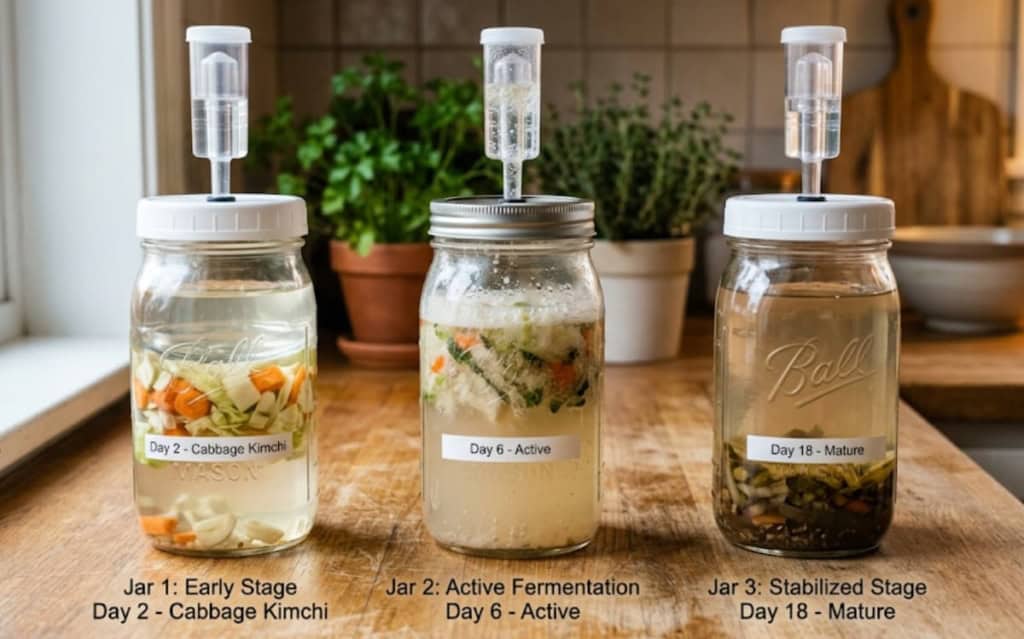
The microbial growth curve shapes how fermentation works. It affects enzyme activity, growth, and what gets produced, like acids or ethanol. Microbes follow patterns. Not perfectly, but close enough that we can plan around them.
During fermentation, glucose moves through glycolysis.
“Glycolysis is a metabolic pathway that converts glucose into pyruvate and generates a small amount of ATP without oxygen.” – Khan Academy
That leads to pyruvate. Then NAD resets so the cycle can keep going without oxygen. Simple idea. But the impact shows up in every batch.
A common example is Saccharomyces cerevisiae. This yeast turns sugar into ethanol using enzymes like alcohol dehydrogenase.
We notice that shift too. Early on, things feel steady. Then suddenly, the smell deepens. It gets richer, fuller.
That is when flavor starts forming, not at the very start, but right after that fast growth phase, shaping what we recognize as fresh tempeh taste in the final result.
Lag Phase Shows How Microbes Adapt Before Production Begins
During the lag phase, microbes get ready. They build what they need to function. Growth stays close to zero, but inside, a lot is happening.
We try not to interfere here. No moving things around. No sudden changes. Just stable conditions. If we mess with it too early, the whole process slows down later. Learned that more than once.
Exponential Phase Drives Rapid Growth and Maximum Production
This is the fast phase. Cells divide quickly. Activity spikes. In yeast systems, most ethanol and CO2 form here.
In tempeh, this is when the mold spreads fast across the beans. You can feel the heat if you hold the batch. Not hot, but warm enough to notice.
Sometimes too warm.
And that is where problems start. If it overheats, growth becomes uneven. Parts move faster than others. So we watch it closely. Adjust when needed. Small moves.
Stationary Phase Balances Growth With Nutrient Depletion
Then things slow down. Nutrients drop. Waste builds up. Growth levels off.
This stage matters more than people think. It is where flavor develops. The smell changes again. Deeper now. Slightly nutty, sometimes even sweet.
We let it sit here, but not too long. Timing feels more like judgment than rules. A few extra hours can improve flavor. Or ruin it. Depends.
Death Phase Marks Decline Due to Toxic Conditions
Eventually, the system breaks down. Waste takes over. Cells start to die.
We avoid this stage as much as we can. If fermentation goes too far, the taste turns. Sharp, sometimes unpleasant, which is also why eating raw fresh tempeh at the wrong stage can lead to off flavors. That is our signal. Stop earlier next time.
Fermentation in Food and Beverages Uses Practical Multi-Step Stages
In real use, fermentation gets broken into simple steps. Primary. Secondary. Then conditioning. Easy to follow. But each step still connects back to those microbial phases.
Most processes run in cycles. One week, maybe two. Depends on the product.
Temperature changes everything. Ranges vary by food: USDA recommends 21-24°C (70-75°F) for vegetables: tempeh needs 30-37°C (86-99°F) for optimal mold growth. Controlled conditions lead to better safety and more stable results.
We see that every day. A small temperature shift can change the outcome. Warmer batches move faster. Sometimes too fast. Cooler ones take longer, but feel easier to manage.
There is always a trade-off.
Primary Fermentation Produces Most Alcohol and Gas
Primary handles ~70-80% sugars to alcohol/CO2 in beer/wine, tempeh uses solid-state mold growth over 24-48 hrs instead.
This stage sets the base. If something goes wrong here, it carries through to the end.
Secondary Fermentation Refines Flavor and Reduces Byproducts
Secondary fermentation slows things down. It clears out unwanted compounds. The taste becomes cleaner.
Not dramatic. But noticeable.
Conditioning Stage Stabilizes Texture, Flavor, and Clarity
Conditioning comes last. Lower temperatures. Less activity.
This stage helps everything settle. Texture improves. Flavors smooth out. The final product feels more complete.
Industrial Fermentation Scales These Stages for Maximum Output
Industrial fermentation follows the same stages, just with tighter control. Bigger systems. More variables. But the core idea stays the same.
Everything gets measured. pH, temperature, airflow. Nothing left to guesswork.
We have seen smaller setups try to copy this approach, sometimes it works, sometimes it feels overdone. In our case, we keep it simple but steady. Control what matters, ignore the rest.
Here is a clear view of how large systems organize the process:
| Stage | Function | Key Outcome |
| Inoculum Preservation | Maintain strains | Genetic stability |
| Inoculum Build-up | Scale microbes | Biomass increase |
| Pre-fermenter Culture | Optimize conditions | Active culture |
| Production Fermentation | Main reaction | Product yield |
Even at scale, the idea does not change. Healthy microbes at the start lead to better results at the end.
Key Fermentation Factors Determine Success Across All Stages
We have had batches shift just from a slight rise in room temperature. Nothing extreme. Still enough to change the flavor. That is how sensitive fermentation can be.
CO2 release helps us read the process. When gas slows down, something is changing. Usually sugar is running low, or the batch is moving into the next stage.
All connected. Miss one, and the rest follow.
pH and Temperature Directly Control Microbial Activity
pH changes vary, lactic ferments drop from around 6.5 to 4.5 for pathogen control, tempeh starts at around 6.5 and rises to 7-8 via ammonia production.
Temperature works the same way. Too high, and things move too fast. Too low, and the process drags.
We aim for balance. Not perfect, just stable.
Oxygen Limitation Enables True Fermentation Metabolism
Low oxygen pushes microbes into fermentation pathways. Below about one percent, they switch fully.
If oxygen leaks in, results change. Sometimes subtle. Sometimes obvious. We try to limit that as much as possible.
Sugar Availability Controls Stage Transitions and Yield
Sugar drives the whole system. As it drops, activity slows. When it gets close to zero, fermentation is almost done.
We do not always measure it directly. But we can tell from smell, texture, even heat.
Experience fills the gaps.
Tempeh Topical Map Shows Real-World Fermentation Stages in Action
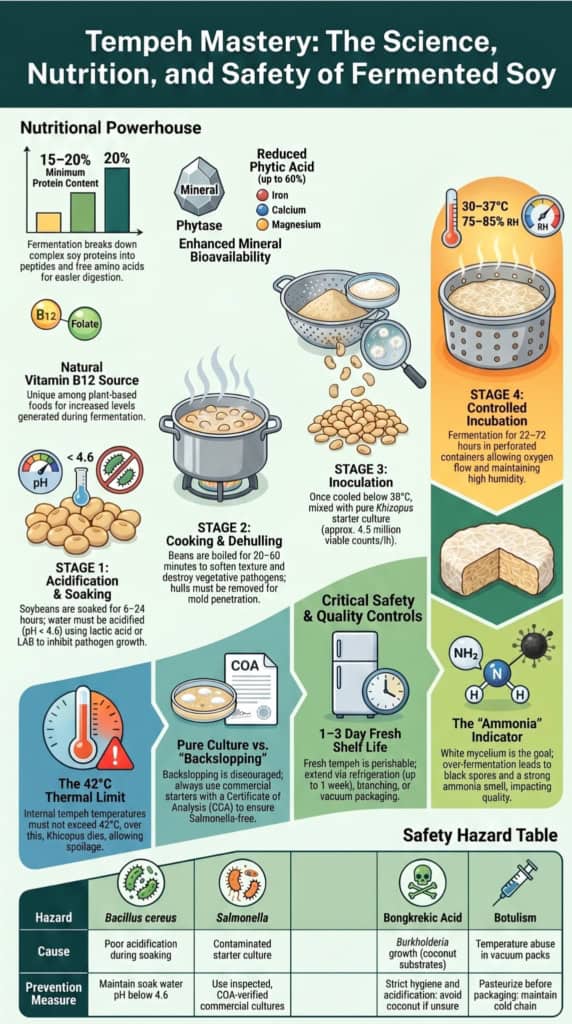
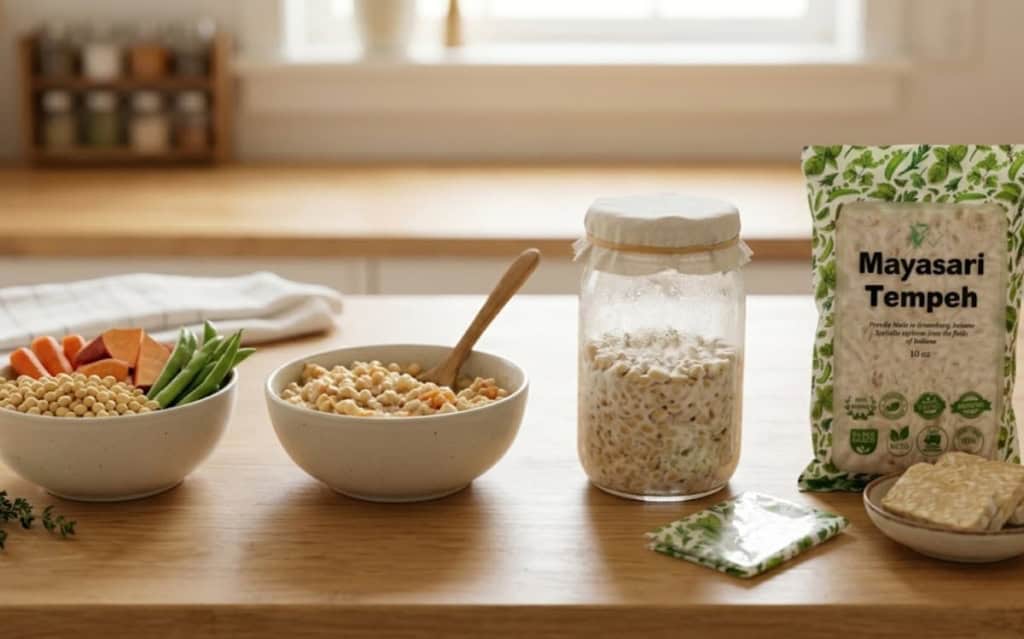
Tempeh shows all of this in a short window. About one to two days, aligning closely with typical tempeh ferment duration in controlled conditions. Fast, but clear.
At first, the soybeans sit loose. Then the mold starts to grow. Slowly at first. Then faster. The beans bind together into a solid cake.
You can see it happen. Not abstract. Real.
The mold Rhizopus oligosporus drives this change. It breaks down the beans and links them together. At the same time, it improves how easy the food is to digest.
We rely on timing here. And temperature. If either one drifts, the batch tells us right away.
FAQs
What happens during anaerobic respiration in fermentation stages?
Anaerobic respiration drives fermentation when oxygen limitation occurs. Microorganisms rely on the glycolysis pathway to produce ATP, followed by NAD regeneration to maintain glucose metabolism. Pyruvate decarboxylation and alcohol dehydrogenase support ethanol production in yeast fermentation systems.
In lactic acid bacteria, homolactic fermentation or heterolactic fermentation occurs depending on environmental conditions and substrate conversion efficiency throughout the microbial growth curve.
How do lag phase, exponential phase, and stationary phase affect fermentation results?
The microbial growth curve includes lag phase, exponential phase, stationary phase, and death phase, and each stage affects fermentation outcomes differently. During lag phase, microorganisms adapt to their environment before growth begins.
The exponential phase drives rapid biomass production, CO2 production, and enzyme synthesis. In the stationary phase, nutrient depletion and waste accumulation slow growth while secondary metabolites, flavor compounds, and aroma development increase.
What is the difference between primary fermentation, secondary fermentation, and conditioning maturation?
Primary fermentation is responsible for most sugar depletion, ethanol production, and CO2 production, especially in beer fermentation and wine fermentation. Secondary fermentation refines flavor compounds and reduces metabolic byproducts such as diacetyl while supporting yeast settling.
Conditioning maturation stabilizes the product by improving foam stability, reducing off-flavor formation, and allowing ester production, diacetyl reduction, and congener formation to complete.
How do pH control and temperature regulation influence fermentation performance?
pH control and temperature regulation directly influence enzyme synthesis, redox balance, and microbial activity during fermentation. Poor control can lead to fermentation inhibitors, bacterial spoilage, or wild yeast contamination.
Temperature changes affect ethanol tolerance, osmotic stress, and thermal shock, while pH levels influence lactic acid threshold and acetic acid tolerance. Stable conditions ensure consistent substrate conversion, aroma development, and fermentation efficiency.
What are upstream processing and downstream processing in industrial fermentation systems?
Upstream processing includes inoculum preservation, inoculum build-up, and pre-fermenter culture preparation before production fermentation begins. These steps ensure strong biomass production and controlled batch fermentation or fed-batch fermentation.
Downstream processing involves harvest separation, centrifugation recovery, filtration methods, and drying techniques. These processes refine the product, remove impurities, and stabilize outputs after bioreactor operation is complete.
Why Fermentation Stages Actually Matter
You can feel it when a batch starts going off, the smell shifts, the texture turns uneven, and suddenly you’re second guessing every step. It gets frustrating fast. Guessing won’t fix it.
When you follow clear fermentation stages, you stop reacting and start controlling the outcome. That’s where SoyaMaya can step in as a steady guide, helping you read the signs and act at the right moment without overthinking it. Stick with a simple process, trust what you see, and you’ll get consistent tempeh that tastes right every time.
References
- https://www.ncbi.nlm.nih.gov/books/NBK224/
- https://www.khanacademy.org/science/biology/cellular-respiration-and-fermentation/glycolysis/a/glycolysis
Relates Articles
Soya Maya Fresh Tempeh
Traditionally fermented, no preservatives, shipped fresh and frozen to your door. The real deal, direct from us.
