
Local soybeans are often non-GMO, especially in Asia. In places like Indonesia, farmers use heirloom seeds and traditional methods. This is different from the United States, where nearly all soybeans are genetically modified.
That regional difference is crucial. It directly impacts what you’re buying, from clean label products to overall food quality. Let’s look at how these local systems operate and what “non-GMO” truly means for your choices.
Quick Read: Are Local Soybeans Usually Non-GMO?
- Local soybeans often non-GMO in traditional farms
- 98% of U.S. soybeans are GMO, non-GMO is niche
- Traceability matters more than “local” claims
Local Soybeans Are Often Non-GMO
We talk to soybean farmers all the time. In a lot of places, especially across Southeast Asia where we work, local soybeans are just regular beans.
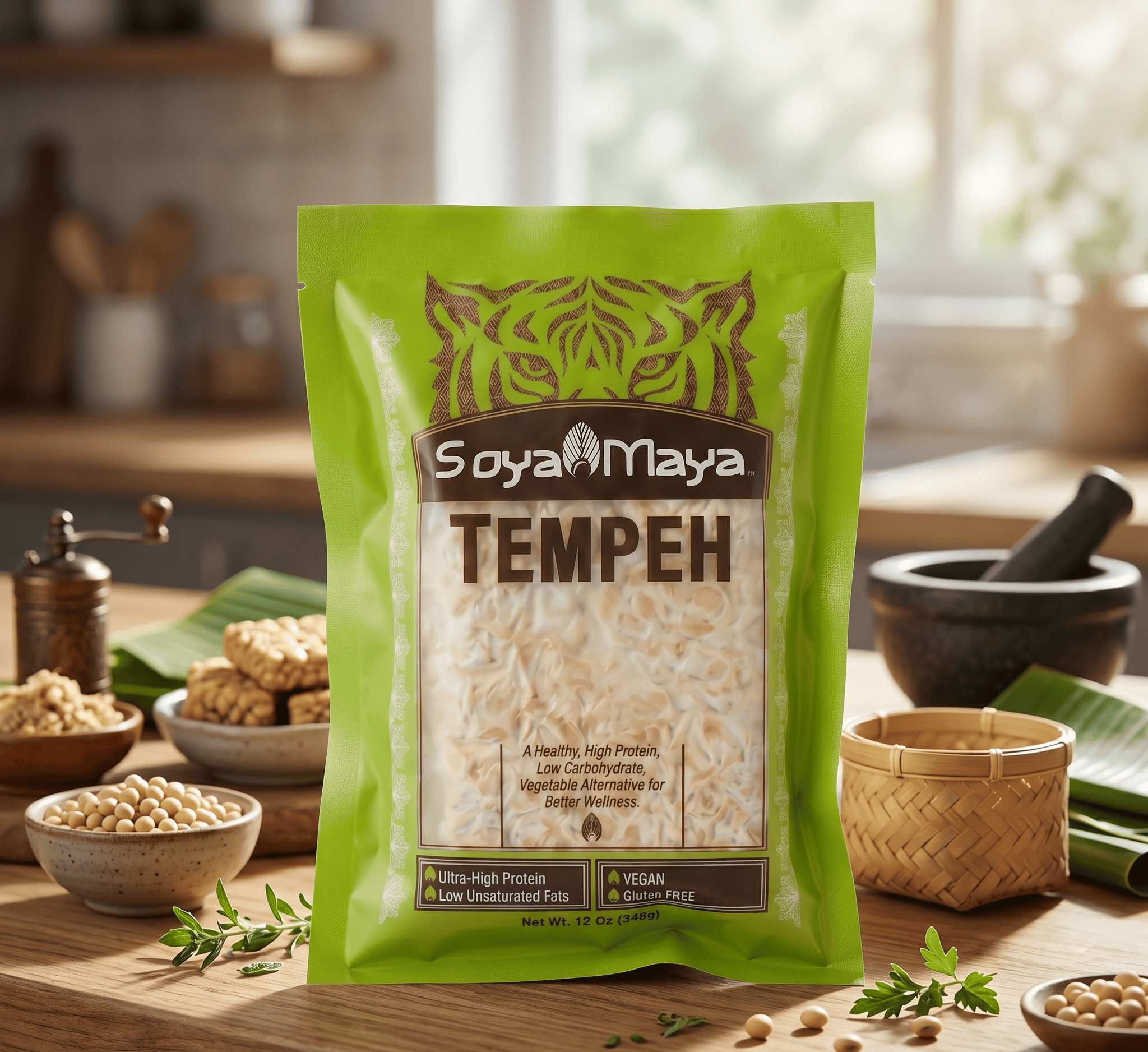
SoyaMaya Fresh Tempeh is made the traditional way — no preservatives, no shortcuts. Delivered to your door.
Order Fresh Tempeh →They’re not GMO because that whole biotech seed industry never really showed up here, which naturally answers what are non-GMO soybeans look like in practice, just conventional seeds grown without engineered traits. Farmers save seeds from last season’s crop and plant them again. They’ve been doing it this way for a long time.
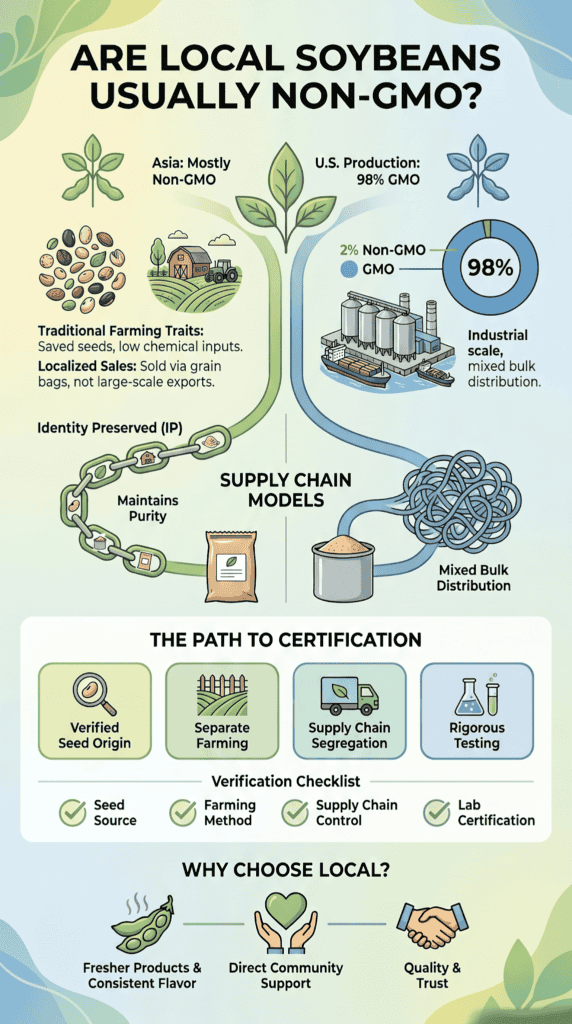
It’s a totally different world from big industrial farming. The U.S. grows almost all GMO soybeans, we’re talking 98% of their crop. Over here, it’s mostly the opposite. Small farms, traditional methods.
A lot of this farming is chemical-free by default, not because of a fancy label. The farmers we know often can’t afford certified non-GMO or organic paperwork.
More importantly, they don’t have easy access to those modified seeds in the first place. They use what they have, and what they have are heirloom seeds passed down.
So what makes a local, non-GMO soybean system? From what we’ve seen:
- Heirloom seeds. These are family varieties, saved and replanted every year.
- Low-input farming. They don’t rely on a lot of store-bought chemicals or engineered seeds, which reflects how non-GMO soybean farming typically works in smaller, traditional systems.
- Local networks. The beans are grown for and sold in nearby communities.
That’s the main reason “local” usually means non-GMO around here. It’s just how things are traditionally done. It’s not a guarantee, things can change, but it’s the most common setup we see on the ground.
The U.S. Soybean System Differ
We’ve seen the U.S. soybean system up close, and it’s built on a very different model. Here, about 98% of the soybeans grown are genetically modified.
Data from USDA Economic Research Service demonstrates
“More than 90 percent of U.S. soybeans are produced using genetically engineered (GE) varieties,” –USDA Economic Research Service
That means non-GMO soybeans are a tiny, specialized niche, what the industry calls “identity-preserved.”
The focus in large-scale U.S. farming is efficiency and yield. Herbicide-tolerant GMO traits dominate because they cut down on labor and boost output per acre. When you farm at that scale, the entire supply chain changes.
It becomes an industrial system where crops from different farms are typically mixed together unless there’s a specific, costly effort to keep them apart.
That’s exactly what happens with non-GMO soybeans in the U.S. They require a completely separate, “identity-preserved” (IP) pipeline from the field all the way to the processor or port. It’s a lot more work.
Here’s a quick breakdown of how the two systems compare in the U.S.:
| Feature | GMO Soybeans | Non-GMO Soybeans |
| Share of Production | ~98% of total output | ~2% niche production |
| Supply Chain | Mixed and bulk-handled | Identity Preserved (IP) and segregated |
| Primary Use | Animal feed, oil, exports | Food-grade and clean label products |
| Certification | Not required | Third-party verification required |
| Cost Structure | Lower due to scale | Higher due to segregation and tracking |
This separation affects price, too. Non-GMO beans usually cost more because of the extra handling and the simple fact there are fewer of them.
The key things that define the U.S. system are:
- A near-total reliance on biotech seeds.
- Massive, centralized processing industries.
- The need for completely segregated supply chains to deliver certified non-GMO soybeans.
Seeing this industrial setup firsthand makes the local, small-farm systems we work with feel much more direct, almost like a true farm-to-table connection, but for beans.
Traceability Determines Non-GMO Status
You can’t tell a GMO soybean from a non-GMO one just by looking at it. We’ve handled thousands of tons, and they all look the same in a sack.
Research from FDA shows
“safety and regulatory assessment” rather than the physical appearance of the crop, evaluating questions like whether food from a new plant variety “contains a new toxin or allergen” or is “nutritionally different from its traditionally bred counterpart” –FDA
The real difference is paperwork, where the seed came from, how it was grown, and how it was handled after harvest. Regulators like the FDA agree; the label is about tracking and documents, not the plant itself.
From our experience, guaranteeing non-GMO comes down to three main things that have to be locked in:
- The Seed: It has to start as a conventional, non-engineered seed.
- The Farm: The farmer has to use methods that prevent GMO crops from mixing in.
- The Trip to Market: The beans must be kept separate during trucking, storage, and processing.
If any one of these steps fails, you can get contamination. It’s that simple.
Here’s a clearer look at what actually matters:
| Factor | What It Means | Why It Matters |
| Seed Source | Uses conventional, non-engineered seeds | The foundation of non-GMO production |
| Farming Method | Prevents mixing with GMO crops | Reduces contamination risk |
| Supply Chain Control | Uses traceability systems | Ensures batch integrity from farm to buyer |
| Storage & Shipping | Keeps soybeans physically separated | Avoids cross-contact during logistics |
| Certification & Testing | Third-party audits and lab checks | Provides proof and buyer confidence |
When you’re sourcing beans, you’re really checking on these systems. The tools that make it work are:
- Identity-Preserved (IP) Systems: A set of rules to keep the non-GMO batch physically separate from start to finish.
- Certification: A third-party company checks that all the rules are being followed.
- Documentation: Lot numbers, certificates, and shipping papers that create a paper trail.
- Testing & Audits: Occasional lab tests and farm inspections to prove everything is clean.
This whole process is especially important for food products like tempeh, where you can’t have any cross-contamination. It’s all about building a verified story for each bean.
Local Non-GMO Soybeans Important for Brands Like SoyaMaya
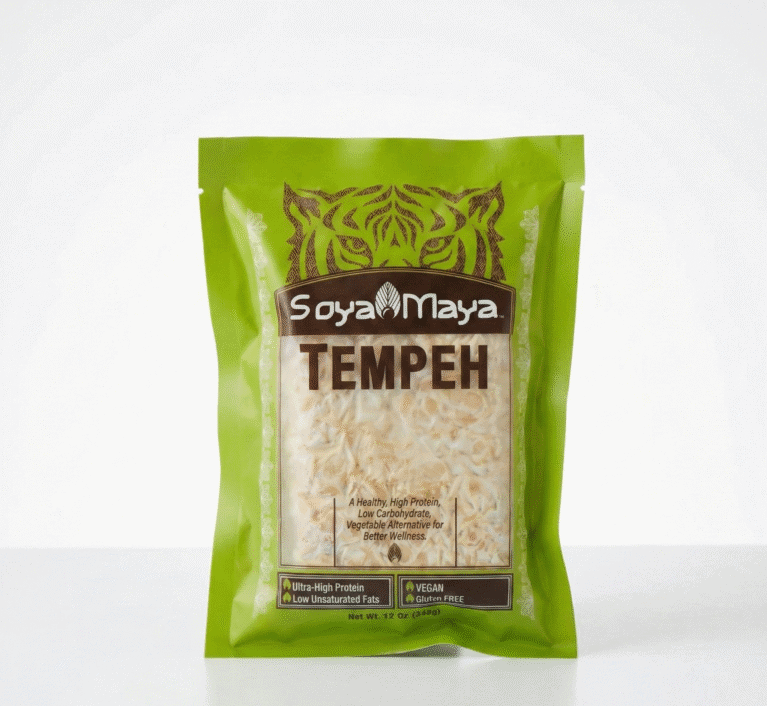
From our work at SoyaMaya, we know local, non-GMO soybeans aren’t just a label. They’re about trust you can actually see.
We visit the farms we buy from. We walk the fields and talk to the growers. That face-to-face connection makes the story of our tempeh real, we know exactly where it starts.
This matters to people. Studies, like ones Harvard Health points to, show most shoppers want “clean” food they can understand. When it comes to plant-based protein like soy, folks want to know what’s in it and where it was grown.
For our tempeh, this isn’t just theory. We’ve found that local, non-GMO beans ferment better. They highlight the real benefits of non-GMO soybeans, giving us a more consistent, better-tasting final product every single time. The quality is just different.
Here’s what we get by sourcing locally:
- Know the source: We know the farmer, so we know the bean’s history.
- Support nearby: It keeps our business tied to the local community and farms.
- Less paperwork: It’s simpler than tracking imported beans through layers of certificates.
- Fresher beans: Beans that travel less distance are simply fresher when they get to us.
All of this adds up to one thing: consistency. Our production relies on getting the same great beans, batch after batch. Sourcing local non-GMO soybeans is how we make sure that happens.
Local Does Not Always Mean Non-GMO
We’ve learned you can’t trust that local soybeans are always non-GMO. It’s a common mistake, but it’s not always true.
In our work, we’ve seen areas that used to grow only traditional crops start planting GMO soybeans. This happens in big farming countries like Brazil and Argentina, where a lot of the soy grown is genetically modified.
Even if the beans are sold nearby, they might still be GMO. International reports, like those from the FAO, show this shift is happening in more places.
We’ve met farmers who are trying new types of seeds to get a bigger harvest. They don’t always know if those new seeds are GMO or not. The information isn’t always clear.
Here are the main times when local soybeans might be GMO:
- Farms using new seeds: Some local farmers are starting to use the same engineered seeds as big industrial farms.
- Seeds without labels: Farmers can buy bags of seed that don’t say “GMO” on them.
- No one checking: In some regions, nobody is really testing or enforcing rules about GMOs.
- No proof: A farmer might honestly believe their crop is non-GMO but has no certificate or test to back it up.
That’s why verification is so important. The word “local” tells you where it’s from, but not what’s in the seed. You have to look deeper.
Verifying Non-GMO Requires Proper Certification
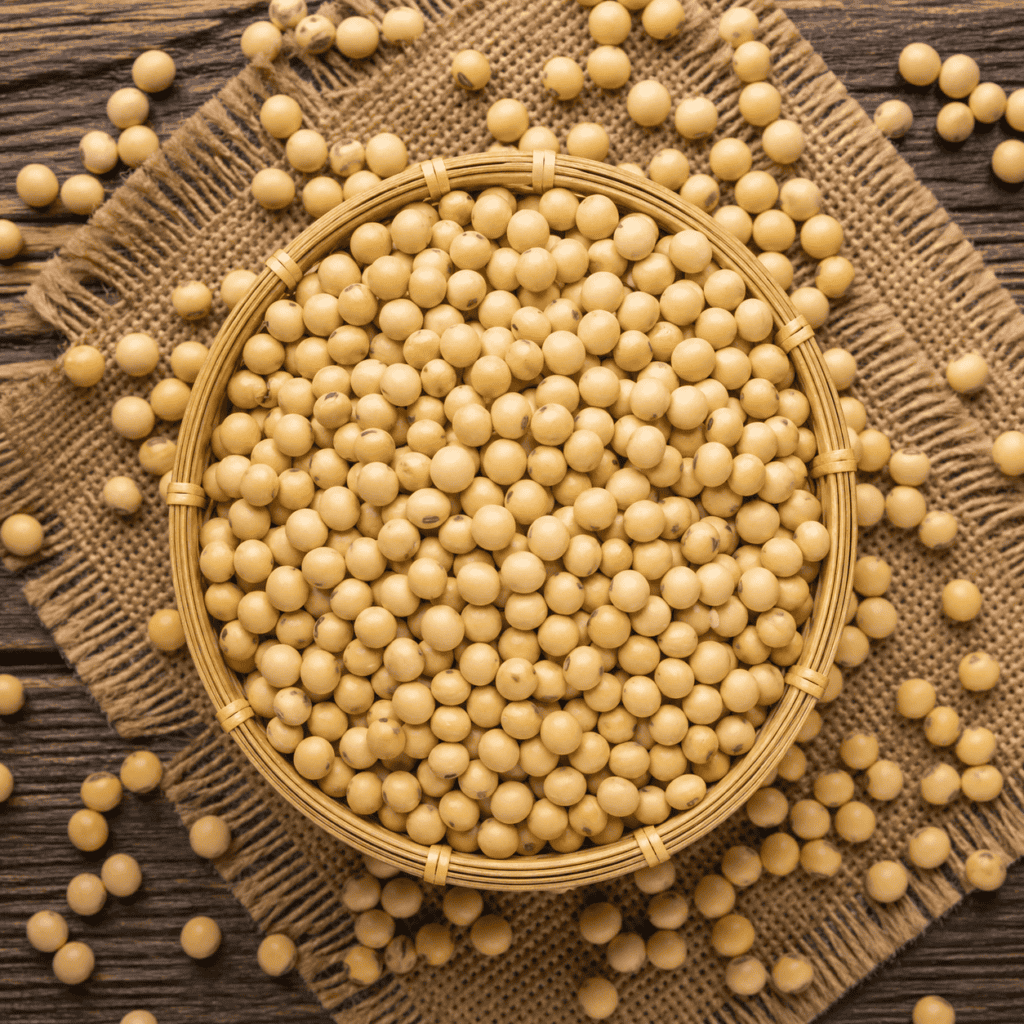
We can’t just take someone’s word that soybeans are non-GMO, even if they’re local.
You need proof. In our work, that proof comes from three things: a real certificate, a clear paper trail, and suppliers who are open with us. Without those, it’s just a claim.
There are good certification programs out there, but not every farmer uses them. To be confident in what we’re buying, we check a few specific things:
- A real certificate: We look for beans certified by an outside organization, not just the farmer or seller.
- A separated supply chain: We buy from systems that keep non-GMO beans physically apart from other crops all the way to us.
- Open suppliers: We work with people who let us see their farms and their records.
- Lab tests: Sometimes we send samples to a lab. It’s the best way to know for sure.
Doing all this reduces our risk of getting the wrong beans. It’s how we make sure our final product is consistent and trustworthy.
FAQ
Are local soybeans GMO free in most regions?
In many regions, locally grown soybeans are often GMO free, especially where traditional soybean farming remains common. Local soybean farmers usually rely on heirloom soybean varieties and natural soybean production methods instead of modified seeds.
However, this is not guaranteed everywhere, so checking soybean origin traceability and soybean labeling standards helps confirm whether local soybeans non GMO claims are accurate.
What makes traditional soybean farming more likely non GMO?
Traditional soybean farming is more likely to be non-GMO because it depends on native soybean crops and small scale soybean farming practices that avoid genetic modification.
Farmers often use saved seeds, sustainable soybean farming methods, and chemical free soybeans approaches. These practices reduce reliance on modified seeds and support soybean biodiversity preservation and long-term local agriculture sustainability.
How can I verify certified non-GMO soybeans locally?
You can verify certified non GMO soybeans by checking for non GMO certification soybeans labels and clear soybean origin verification on packaging or supplier information. Reliable sources provide soybean supply chain transparency and identity preserved soybeans documentation.
You can also ask about soybean traceability systems or farm direct soybean sourcing to ensure soybean authenticity verification and reduce soybean contamination risks GMO.
Are organic soybean farming and non GMO the same thing?
Organic soybean farming and non GMO certification soybeans are related but not the same. Organic soybean certification focuses on pesticide free soybeans and chemical free soybeans, while non GMO certification ensures the soybeans are not genetically modified.
Some producers meet both standards, but not all. Understanding soybean organic vs non GMO differences helps you choose suitable clean label soybeans.
Why do people prefer local vs imported soybeans over non-GMO?
People often prefer local vs imported soybeans because they offer better soybean supply chain transparency and easier farm to table soybeans access. Local crop reliability soybeans usually means fresher harvests, better soybean processing quality, and clearer soybean origin traceability.
Choosing locally also supports domestic soybean supply, strengthens local food systems soybeans, and aligns with rising non-GMO soybean demand and soybean consumer preferences.
Why Local Soybeans Still Make a Real Difference
You notice it when soybean quality isn’t consistent, the texture feels off, the flavor falls flat, and it leaves you second-guessing what you’re actually getting. It’s frustrating. SoyaMaya keeps things grounded by working with local non-GMO sources, helping processing and fermentation stay steady without added doubt. It’s a simple way to choose products that feel reliable from start to finish. That consistency matters for anyone who values quality, transparency, and dependable results in every batch consistently.
Explore reliable, non-GMO tempeh with SoyaMaya
References
- https://ers.usda.gov/topics/farm-practices-management/biotechnology
- https://www.fda.gov/food/food-new-plant-varieties/programs-food-new-plant-varieties
Related Articles
- https://mayasaritempeh.com/what-are-non-gmo-soybeans/
- https://mayasaritempeh.com/non-gmo-soybean-farming/
- https://mayasaritempeh.com/benefits-of-non-gmo-soybeans/
SoyaMaya Fresh Tempeh
Traditionally fermented, no preservatives, shipped fresh and frozen to your door. The real deal, direct from us.
