
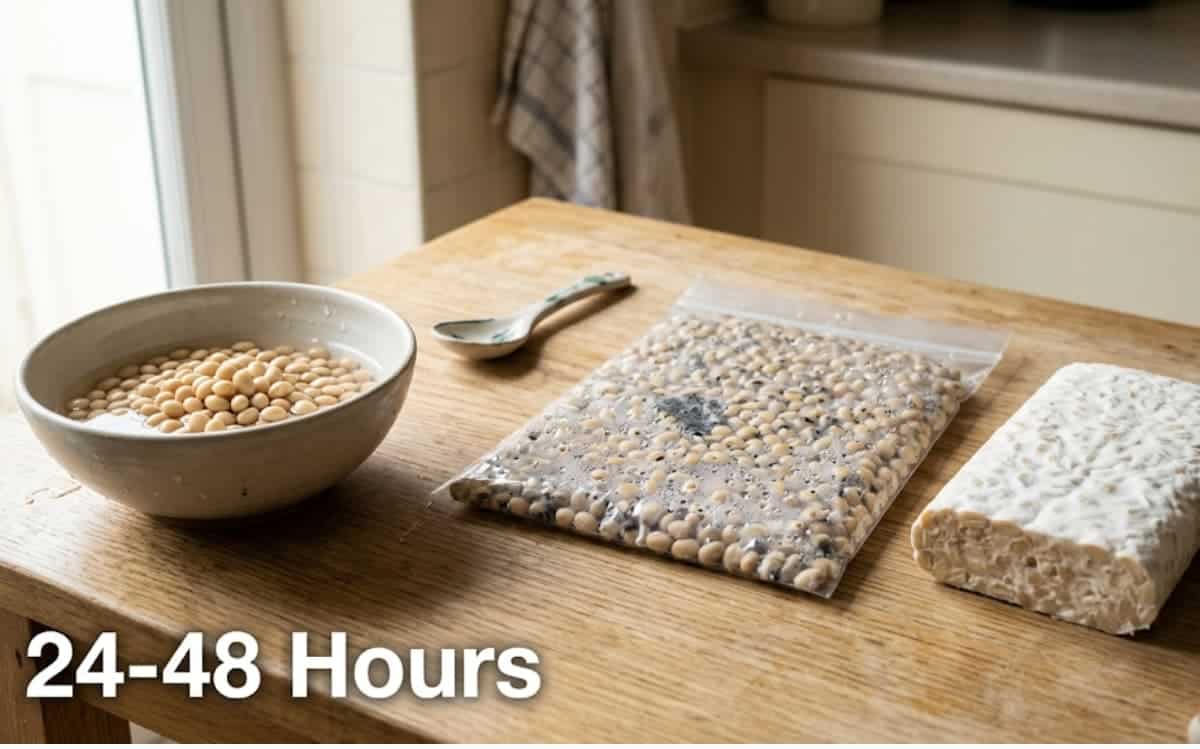
Tempeh ferments in about 24-48 hours as Rhizopus oligosporus grows at 30-32°C, binding soybeans into a firm, white cake with a nutty aroma. That timeframe holds steady when the beans are cooked, dried, and inoculated with care.
Minor shifts in temperature or airflow can nudge the timing, but they rarely change the outcome in a major way. What matters more is how evenly the culture spreads and how well the beans knit together. When those conditions line up, the result is consistent, both in structure and flavor. Keep reading to understand what signals show it is ready.
Tempeh Timing at a Glance
- Tempeh ferments in 24-48 hours under optimal conditions, with Rhizopus oligosporus forming a firm, white, nutty-smelling cake.
- Temperature, airflow, and moisture control matter more than time alone in determining successful fermentation.
- Going beyond 48 hours increases umami but risks over-fermentation, leading to ammonia smell and texture changes.
Temperature, Moisture, and Airflow Directly Control Fermentation Speed
Tempeh fermentation speed depends on temperature, humidity, airflow, and bean dryness, with 86-90°F (30-32°C) producing the most reliable 24-48 hour results as part of consistent tempeh processing in our batches.
Soya Maya Fresh Tempeh is made the traditional way — no preservatives, no shortcuts. Delivered to your door.
Order Fresh Tempeh →Tempeh is an aerobic process, so oxygen directly affects how the mold develops.
“Tempeh fermentation requires aerobic conditions, and oxygen availability directly influences mold growth and product quality.” – Journal of Food Science
From our own batches, temperature has the strongest effect. When we hold it close to 30-32°C, fermentation stays on track. If it drops even a few degrees, we notice the process slow down. A cooler room often adds another 12-24 hours.
Humidity plays a quiet but important role. We aim for 80-100% so the beans stay hydrated long enough for the mycelium to spread. If the surface dries too soon, the mold struggles to connect the beans into a solid cake. We have had batches where the outside dried first, leaving the center underdeveloped.
Airflow is easy to overlook. Early on, we packed beans too tightly without enough holes, and the result was uneven growth. Now we always use perforated bags or containers. That small change improved consistency right away.
We keep track of four main factors:
- Temperature sets how fast the mold grows
- Humidity keeps the surface from drying too soon
- Airflow supplies oxygen and releases excess moisture
- Bean dryness reduces the chance of unwanted bacteria
Here is a quick reference we use:
| Factor | Optimal Range | Effect on Time |
| Temperature | 86-90°F (30-32°C) | 24-48 hours |
| Temperature | Up to 95°F | 16-24 hours |
| Temperature | Below ~75°F | 48-72+ hours |
| Humidity | 80-100% | Even mold growth |
| Airflow | Perforated setup | Prevents spoilage |
| Bean dryness | Dry to touch | Limits bacteria |
If we skip proper drying, problems show up fast. Excess moisture can invite unwanted microbes like Bacillus cereus. That is one mistake we do not repeat. For general food safety, the U.S. Food and Drug Administration outlines risks tied to improper fermentation.
Preparation Explains Why Timing Varies
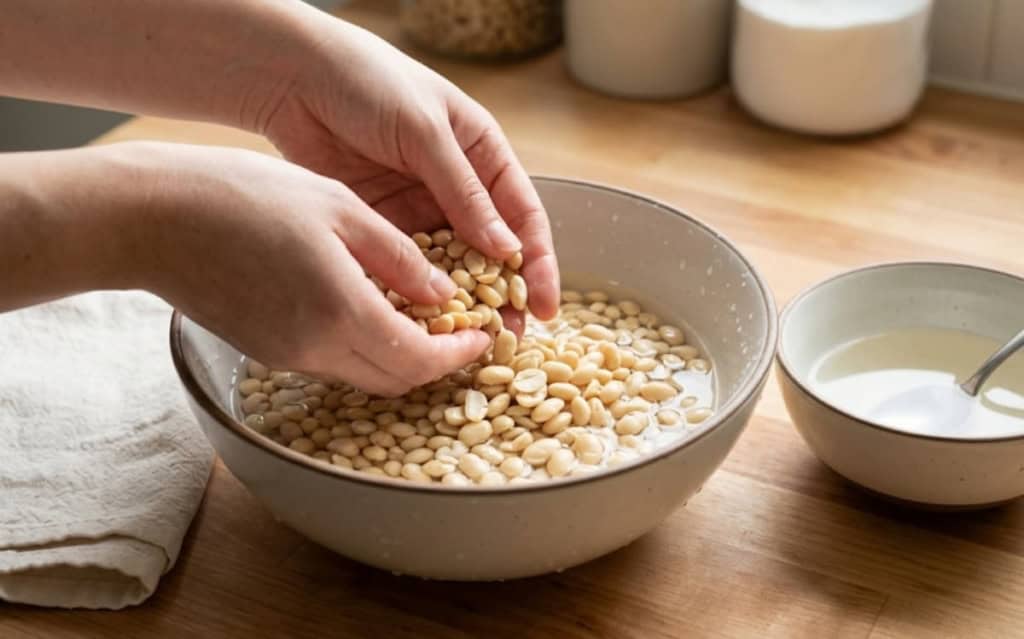
Tempeh timing varies because fermentation starts only after proper preparation. Soaking, cooking, drying, and inoculating all happen before Rhizopus oligosporus begins binding the soybeans.
We spend a good amount of time on prep. It often takes longer than the fermentation itself.
Preparation Sets the Clock (Before Fermentation Starts)
Our usual steps:
- Soaking: 12-24 hours
- Dehulling: helps texture and mold spread
- Cooking: about 30-40 minutes
- Drying: until beans feel dry on the surface
Drying is where many batches go wrong. If beans are still damp, the starter struggles to take hold, which can affect the final texture we expect from fresh tempeh.
We learned this through trial and error. Slightly over-drying is safer than leaving them wet.
Once the beans are ready, we mix in the starter. We also add a small splash of vinegar to bring the pH down to around 4.5-5. This step helps limit unwanted bacteria while giving the mold a better environment to grow.
“Acidification of cooked soybeans before inoculation helps suppress undesirable microorganisms and supports Rhizopus growth.” – Food and Agriculture Organization.
Even distribution matters. If the starter is not mixed well, some areas grow faster than others. That leads to patchy tempeh, which is harder to fix later.
Incubation Is Where the 24-48 Hours Happens
After that, we move to incubation:
- Around 12 hours: early signs begin
- At 24 hours: beans start sticking together
- By 48 hours: a firm cake forms
The 24-48 hour fermentation only works because these steps are done carefully.
Tempeh Develops in Clear Stages From 12 to 48 Hours
Tempeh moves through clear stages from 12 to 48 hours. We rely on these stages more than the clock.
Early Stage (0-12 Hours)
At this stage, the beans look almost the same. Inside, heat begins to build.
- No visible mold
- Slight warmth
- Early activity
Growth Stage (12-24 Hours)
This is when we first see change.
- White strands appear
- Beans begin sticking
- Light nutty smell
Binding Stage (24-36 Hours)
The structure forms quickly here.
- Stronger binding
- More even mold
- Noticeable heat
Final Stage (36-48 Hours)
This is where most batches finish.
- Fully compact cake
- Clean aroma
- Ready to cook or store
When conditions shift, these stages help us decide what to do next. Timing alone does not tell the full story.
Fully Fermented Tempeh Has Distinct Texture, Aroma, and Appearance

Tempeh is ready when soybeans are tightly bound by white mycelium, forming a firm cake with a nutty aroma and no ammonia smell, usually around 48 hours.
Signs Tempeh Is Ready
We check doneness by sight, touch, and smell.
What we look for:
- Dense, firm structure
- White mold covering most beans
- Mild, clean scent
A finished batch slices cleanly and holds its shape, and when stored properly right after this stage, it helps maintain quality and extend how long tempeh lasts before the flavor starts to shift.
Signs Something Is Wrong
When something is off, it is usually easy to spot:
- Ammonia smell means it has gone too far
- Slimy texture points to excess moisture
- Uneven mold suggests poor airflow
Small gray or black spots can appear as part of the mold’s life cycle. We do not worry about them unless the smell changes.
Over-Fermentation Happens Quickly After the 48-Hour Mark
After 48-72 hours, tempeh can become over-fermented. It develops a sharper smell, darker patches, and a heavier taste.
Tempeh does not stop on its own. As long as it stays warm, the mold keeps working. We have tested longer batches out of curiosity, and the change is easy to notice.
What Changes After 48 Hours
- Flavor becomes stronger and more intense
- Texture turns firmer and slightly dense
- White mold starts showing gray patches
Some people enjoy the deeper flavor, but it moves away from the clean, balanced taste most expect.
When It Becomes Undesirable
When it goes too far:
- Ammonia smell becomes clear
- Taste turns bitter
- Risk of contamination increases, including Bacillus cereus
We avoid that by moving tempeh into the fridge as soon as it reaches peak condition. Cooling stops further fermentation and keeps the flavor stable.
Controlling Fermentation Time at Home Is Easier Than Most People Think
You can control fermentation by keeping temperature steady at 86-90°F, allowing airflow, and using simple tools to hold conditions in place.
We used to think we needed special equipment. Over time, we found that simple setups work just as well if they stay consistent.
Simple Methods That Work
What we have used:
- Oven with the light on
- Yogurt maker
- Dehydrator
- Insulated box
Each setup creates a warm space where the mold can grow without interruption.
What Actually Makes the Biggest Difference
What matters most in our experience:
- Stable temperature without big swings
- Beans spread in an even layer
- Enough holes for airflow
When those are in place, timing becomes predictable. We can usually tell early on if a batch will finish at 24, 36, or closer to 48 hours.
FAQs
How long tempeh ferments at room temperature without equipment?
Tempeh ferment time at room temperature depends on how warm the space is. In a steady warm environment, tempeh fermentation duration usually reaches 24-48 hours.
If the room is cooler, the tempeh incubation period can extend closer to 72 hours. Because soybean fermentation relies on stable heat, inconsistent conditions often slow tempeh mycelium growth and make results less predictable.
What happens if tempeh ferments longer than 48 hours?
Overfermentation tempeh changes both texture and aroma. After 48 hours, the tempeh ferment time may extend toward 72 hours, which leads to a stronger and sharper taste. You may notice a clear tempeh ammonia smell, darker patches, and firmer texture changes.
At that stage, quality declines, and the risk of tempeh bacterial contamination increases if hygiene and temperature are not controlled.
Can I use other beans in the tempeh making process?
You can use other legumes in the tempeh making process besides soybeans. Soybean fermentation is traditional, but tempeh chickpea tempeh, grain tempeh, and other legume variations also work.
The tempeh starter culture, which contains Rhizopus oligosporus mold, binds the ingredients together. However, tempeh fermentation duration, structure, and moisture balance may differ depending on the type of bean used.
Why is vinegar used during tempeh bean preparation?
Tempeh vinegar acidification plays an important role during tempeh bean preparation. Adding vinegar lowers tempeh pH levels to create conditions that support Rhizopus oligosporus mold growth.
This step also helps reduce the risk of harmful bacteria, including Bacillus cereus tempeh contamination. Although the vinegar does not significantly affect flavor, it improves consistency and safety in tempeh home fermentation.
How do I store tempeh after fermentation is complete?
After fermentation is complete, proper tempeh refrigeration storage helps slow further changes. You should place the tempeh in the refrigerator once the tempeh firm cake forms to maintain stable tempeh flavor development.
For longer storage, freezing is effective, and following basic tempeh freezing tips helps preserve quality. Always cook tempeh before eating to ensure proper tempeh safety cooking and reduce food safety risks.
Why Timing Your Tempeh Fermentation Really Pays Off
You can feel it when a batch goes off, the texture turns uneven and the smell isn’t quite right. It’s frustrating after waiting a full day or more, especially when small changes in temperature or airflow throw everything off. That’s the reality.
If you’d rather avoid that guesswork, SoyaMaya offers a simple way to get consistent results without the stress. It’s a practical step when you want reliable flavor and texture without watching every detail, so you can focus on enjoying tempeh instead of fixing it.
References
- https://ift.onlinelibrary.wiley.com/journal/17503841
- https://www.fao.org/4/x2184e/x2184e00.htm
Related Articles
- https://mayasaritempeh.com/what-is-fresh-artisanal-tempeh/
- https://mayasaritempeh.com/how-long-does-tempeh-last/
- https://mayasaritempeh.com/understanding-tempeh-processing-methods/
Soya Maya Fresh Tempeh
Traditionally fermented, no preservatives, shipped fresh and frozen to your door. The real deal, direct from us.
