
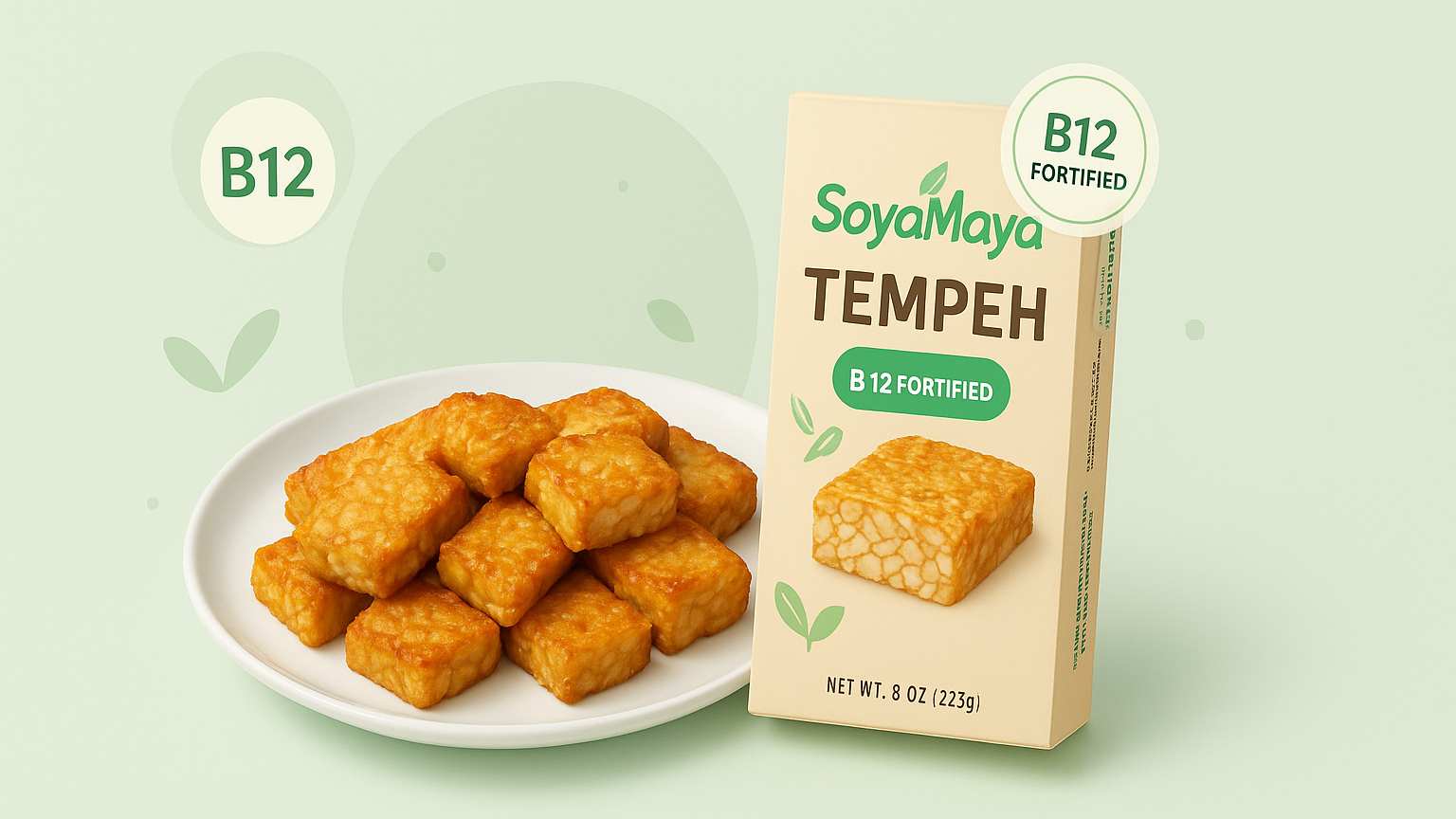
Yes, tempeh can be a real B12 source, but only when it’s clearly labeled as fortified with vitamin B12. That means the producer adds a known form of B12, like cyanocobalamin or methylcobalamin, either during fermentation or right after, so each serving actually delivers what the label promises. Traditional tempeh, by contrast, has B12 levels that are tiny and unpredictable, so you really shouldn’t treat it as your main supply. For people eating mostly or fully plant-based, fortified tempeh can quietly close that one stubborn nutrient gap. Keep reading to learn how to find it, use it, and trust it.
Key Takeaways
- B12 fortified tempeh provides a consistent, reliable source of the vitamin, unlike unfortified versions.
- It helps prevent deficiency risks common among vegans, supporting nerve function and energy.
- Reading labels for “% Daily Value” and the type of B12 is crucial for ensuring effectiveness.
The Real Deal on B12 Fortified Tempeh
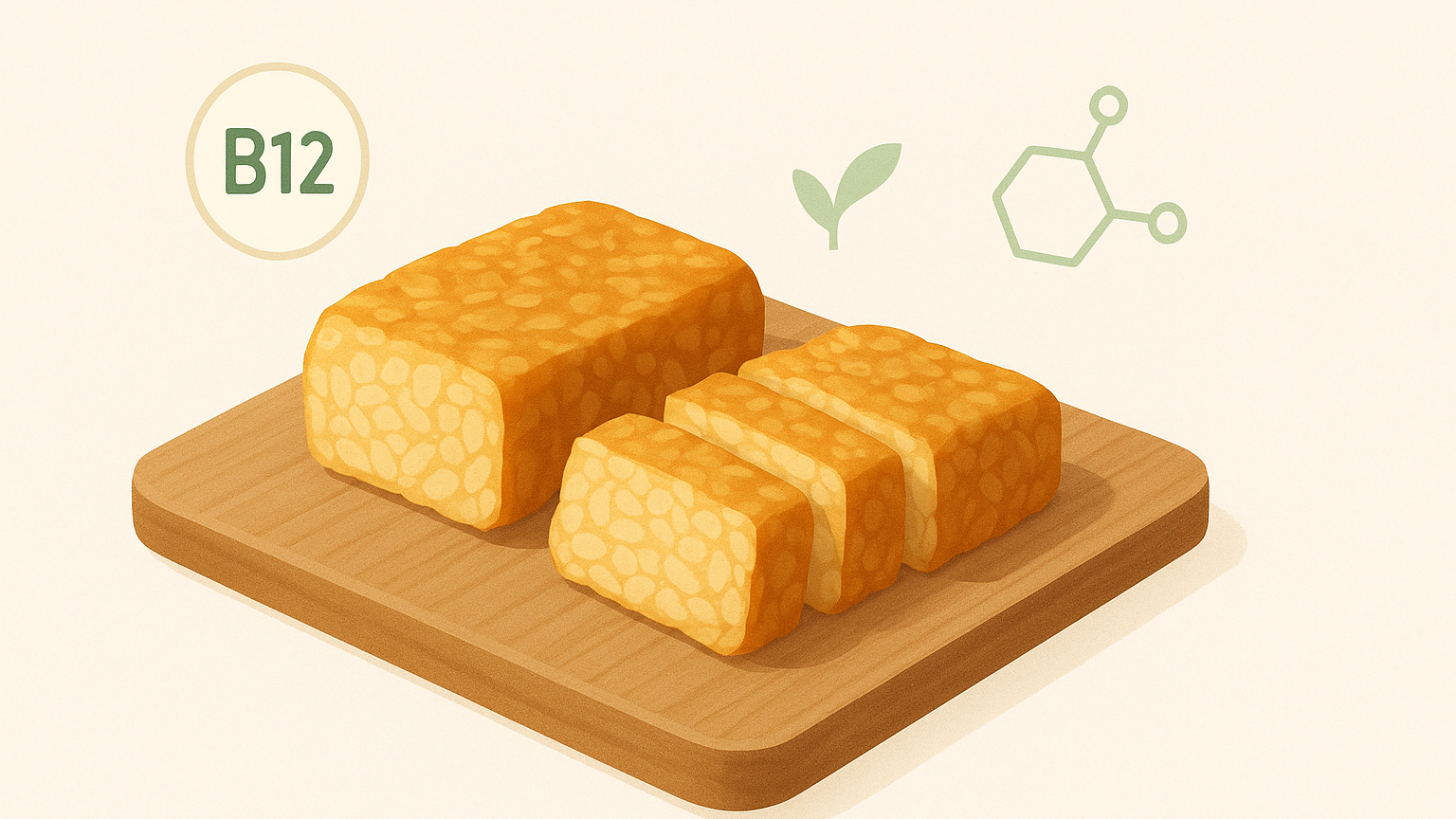
You notice it only if you’re looking for it, usually low on the shelf, wrapped tight in plastic, a plain brick of soybeans laced with white mycelium. Tempeh doesn’t beg for attention. It just waits. But anyone who’s cooked it a few times knows how solid it is, dense with protein, firm enough to sear, with that quiet, nutty flavor that soaks up whatever sauce you throw at it.
Lately though, some of those simple bricks carry a small extra line on the label: vitamin B12 added, a quiet nutritional upgrade that turns the block into what food technologists now call B12 tempeh That one sentence changes what you’re holding. This isn’t just fermented soy in a neat block, and it’s definitely not some magical “fermentation gives you all the B12 you need” myth.
Soya Maya Fresh Tempeh is made the traditional way — no preservatives, no shortcuts. Delivered to your door.
Order Fresh Tempeh →Vitamin B12 is a strange nutrient. Plants don’t make it. Animals don’t make it. Fungi don’t make it. Bacteria do. In older, less sanitized times, humans got B12 from soil on vegetables or from drinking water with bacterial contamination (not exactly something we want back). Modern hygiene and water treatment almost wiped those sources out, which is fantastic for infectious disease, but not great for B12 status if you’re vegan and not paying attention.
So if you eat a strict vegan diet and skip both B12 supplements and fortified foods, the odds are not in your favor. Studies generally put low B12 status among unsupplemented vegans somewhere between 40 and 80 percent. That’s not a fringe concern. That’s “most people in this group, over time, are going to have a problem.”
The unsettling part is how quietly it builds. At first, you might just feel worn out, even when you’re sleeping enough. Maybe you get pins and needles, or your hands feel a little numb now and then. Those signs are easy to brush off. But B12 plays a central role in red blood cell formation and nerve health, so when it runs low for too long, anemia and even permanent nerve damage can follow. Your body can store B12 for years, which hides the issue. You can feel fine while the tank is slowly draining. Then one day, you’re not fine.
A quiet risk like that needs a loud, boring, practical solution. B12-fortified tempeh is one of those. Not flashy, just smart.
The process usually looks like this:
- First, soybeans are cooked and inoculated with a Rhizopus mold, which knits them together as it ferments.
- After fermentation is done, the manufacturer adds a stable form of B12, often cyanocobalamin, sometimes methylcobalamin, in a measured dose.
That timing is crucial. You’re not crossing your fingers and hoping random bacteria in the fermentation tank will “gift” you some B12. You’re adding a known amount, in a controlled way, after the mold has done its job.
So each serving carries a predictable B12 dose. You’re no longer relying on lucky contamination or quirky microbes. You’re getting a repeatable amount every time you eat it. That simple move turns tempeh from a standard protein source into something closer to a “functional” food, still humble, still everyday, but now quietly doing two jobs at once: feeding your muscles and backing up your nervous system.
What Exactly Is B12 Tempeh?
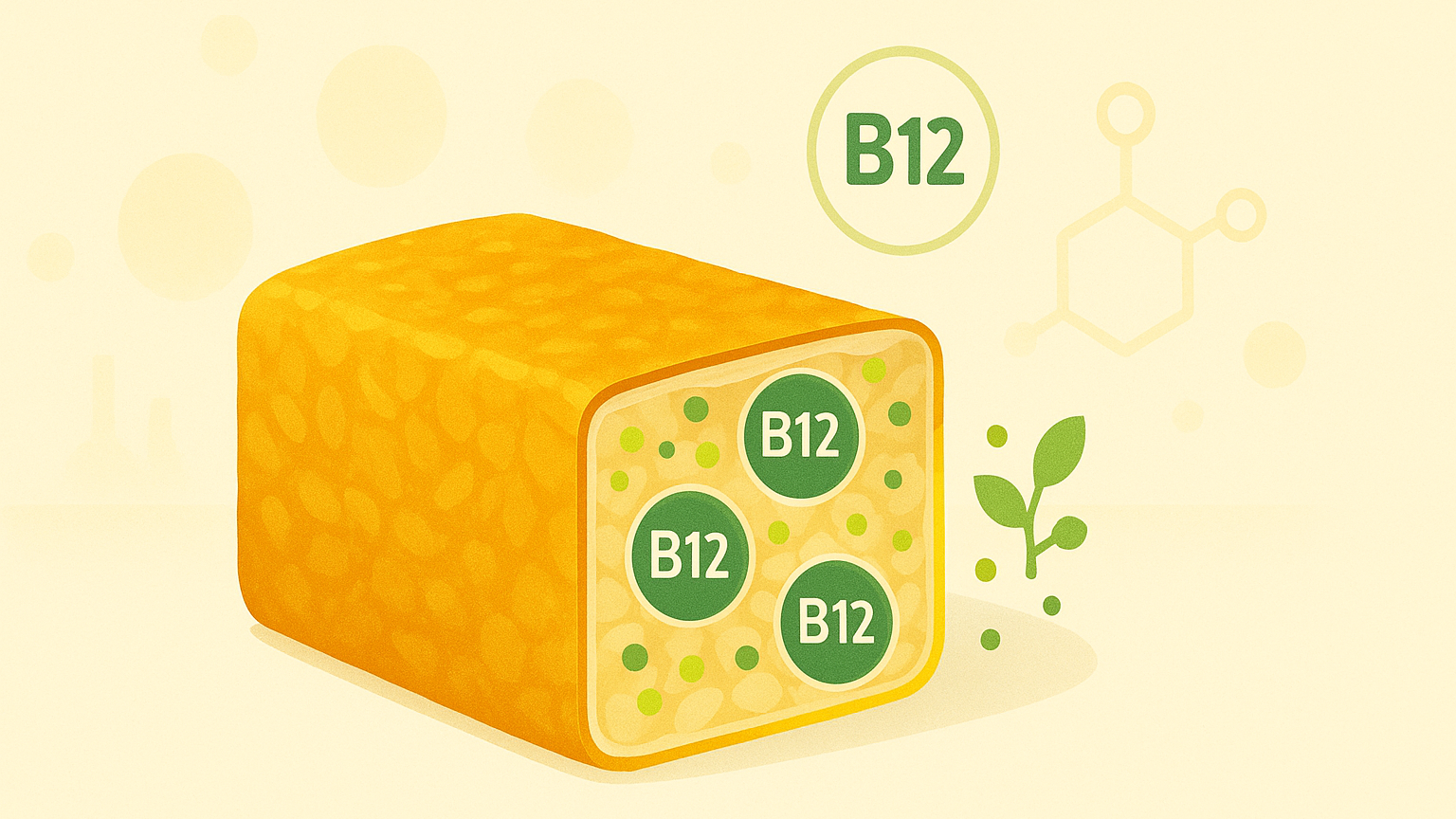
Think of it as tempeh 2.0. The base hasn’t changed: about 16-19 grams of protein per 100 grams, a decent amount of fiber, iron, and the usual perks of fermentation. You still get that nutty, slightly earthy flavor and the sturdy, chewy bite that holds up in a skillet, on the grill, or in a sandwich. It browns the same, marinates the same, fries the same. On your plate, it looks and acts like regular tempeh.
What’s different lives in the fine print on the back.
Traditional tempeh can sometimes contain tiny amounts of B12 from stray microbes involved in fermentation or from environmental contamination. But when researchers actually measure it, the numbers are all over the place: often 0 to 0.7 micrograms per 100 grams, and sometimes literally zero. That range is useless if you’re trying to plan a diet around it. You can’t bet your long-term nerve health on chance bacterial visitors.
Fortified tempeh is built to fix that. Brands typically target a consistent B12 content per serving, often enough to meet or beat the 2.4 mcg adult RDA in one standard portion. Some go higher to hedge against absorption limits, especially for people who rely mostly on fortified foods instead of supplements. The core idea is simple: reliability.
Because of that unreliability, food scientists have developed ways to deliberately boost B12 during fermentation. For example:
- A study using a mixed starter, the usual mold plus a food-grade, B12-producing bacterium Propionibacterium freudenreichii, managed to raise B12 content to ~0.97 µg per 100 g (in “lupin tempeh,” an analog to soy-tempeh) without affecting the tempeh’s texture or flavour. [1]
- In some older reports (less rigorous, sometimes including non-bioavailable analogues), values as high as 1.5-6.3 µg per 100 g (dry tempeh) are mentioned, high enough in principle to cover the typical adult RDA (~2.4 µg/day).
The difference isn’t in the taste or texture. It’s in how much you can trust it. You can actually plan your B12 strategy around it instead of hoping your diet “sort of covers it.” That small habit, reading the label, choosing the fortified version, putting it into your rotation once a day or a few times a week, can quietly add up over years into real protection for your brain, your energy, and your nerves.
You’re not just eating tempeh for protein anymore. You’re making a deliberate choice to cover a nutrient your body can’t afford to miss. That’s a small action with long shadows.
B12 for Vegans: A Non-Negotiable Need
Your body leans hard on vitamin B12 for two core jobs:
- Keeping your nervous system intact so signals can move cleanly along your nerves.
- Helping build DNA in every cell that divides, especially red blood cells.
When B12 is low, those systems wobble. Red blood cells get large and misshapen, oxygen delivery drops, and you feel worn out. Nerves start misfiring, leading to tingling, numbness, balance problems, even cognitive changes if it goes on long enough.
Because your liver can store a decent reserve of B12, deficiency doesn’t slam you overnight. It feels like a slow leak. You can eat what looks like a perfect whole-foods vegan diet, lots of legumes, whole grains, seeds, vegetables, and still slip into deficiency, not because the diet is “bad,” but because plants just don’t make or use B12. It’s the one puzzle piece that isn’t on the table unless you put it there on purpose.
The data is blunt. Long-term vegans who ignore B12, no supplements, no fortified foods, almost always become deficient sooner or later. This isn’t about discipline or “trying harder.” It’s pure biochemistry. You either:
- According to a systematic review, average B12 intake among vegans was often 0–0.9 µg/day, well below the commonly recommended ~2.4 µg/day for adults. [2]
- In the Norwegian study, a substantial portion (18%) of vegans remained below recommended B12 intake, even when supplements or fortified foods were considered.
- The consistent finding across many studies: vegans who don’t supplement or consume fortified B12 rich foods are far more likely to show B12 deficiency (biochemically) than those who do.
Thus, “hoping plants cover it” is unreliable; deliberate strategy (supplementation or fortified foods) is prudent.
B12-fortified tempeh lives squarely in that second group. It gives you a food-based way to cover your needs. For a lot of people, that feels more natural than taking a pill every day. You’re already cooking dinner, adding a serving of fortified tempeh to that meal isn’t a huge extra step. One portion at lunch or dinner can cover, or at least heavily support, your daily B12 requirement, depending on the brand and serving size, a quietly effective strategy highlighted across practical nutrition guides for B12 for vegans.
When people consistently use reliable B12 sources, whether fortified foods, supplements, or both, research suggests the risk of deficiency can drop by more than 80 percent. That’s not a minor tweak at the edges of a diet. That’s the cornerstone of safe vegan nutrition.
So choosing B12 tempeh isn’t just about today’s protein craving. It’s about protecting your future self: your memory, your mood, your ability to think clearly and move smoothly. That’s one less serious worry to carry.
How Much Do You Actually Need?
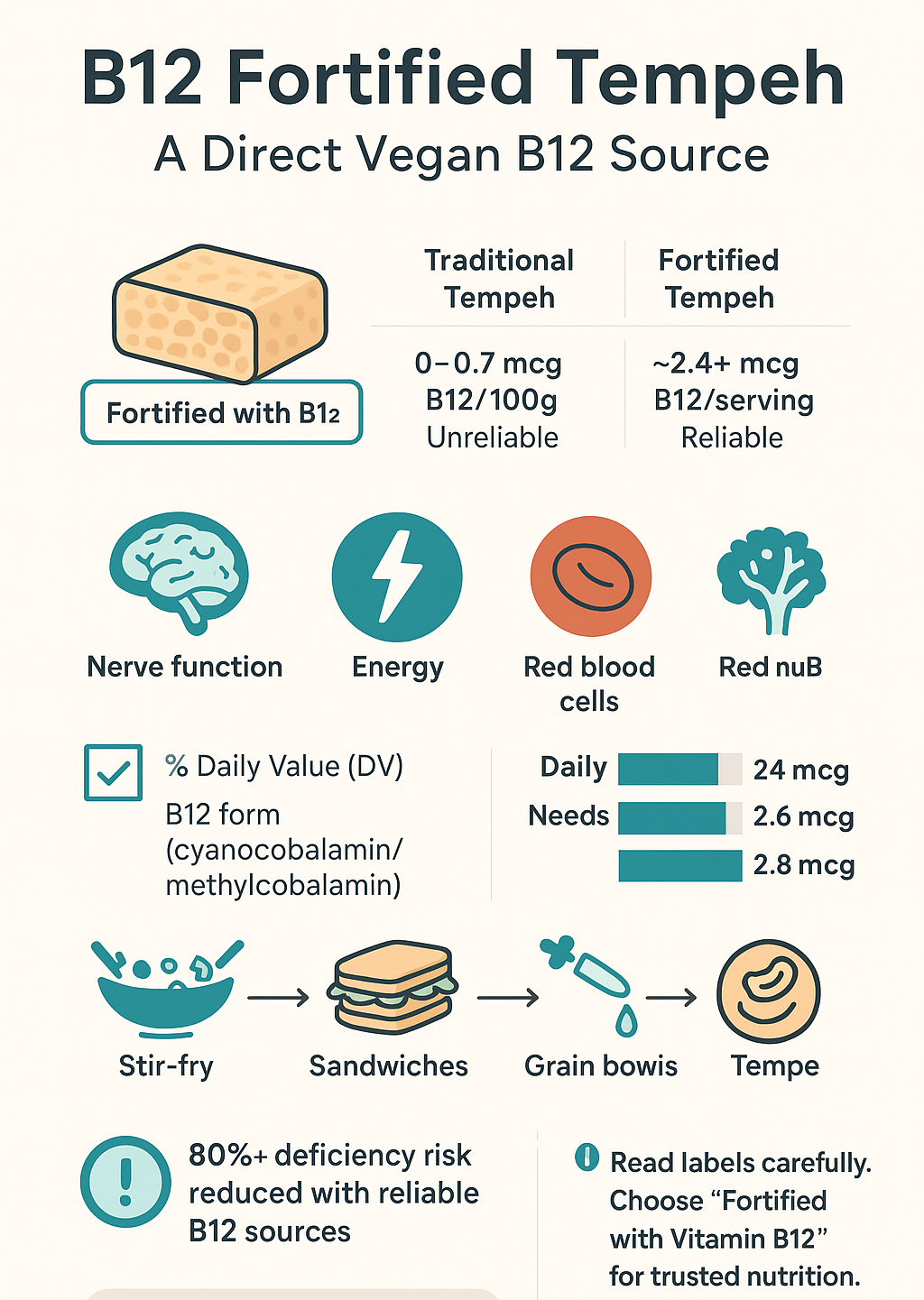
The National Institutes of Health (NIH) sets the daily B12 requirement at levels that align with independent dietary references for recommended B12 intake:
- Adults: 2.4 micrograms (mcg) per day
- Pregnant women: 2.6 mcg per day
- Lactating women: 2.8 mcg per day
On paper, those numbers look tiny, almost too small to matter. But B12 absorption has some quirks.
Your gut uses a special protein called intrinsic factor, made in the stomach, to actively absorb B12. This system works well but has a limit. It can take in only about 1.5-2 mcg at a time. Anything beyond that has to sneak in through passive diffusion, which is weak, only a small percentage gets through.
That’s why many vegan nutrition experts recommend higher-dose supplements:
- Around 250 mcg daily, or
- Around 2000-2500 mcg once a week
With doses that high, most of the B12 is wasted, but that’s intentional. Even if just a small fraction gets absorbed passively, it’s still enough to meet your needs and top up your stores.
When your main B12 source is fortified tempeh, the math feels a little more grounded, because you’re thinking in terms of meals:
- Read the label.
- Check how many micrograms of B12 are in one serving.
- Look at what they call a “serving size” (often 75–100 grams, but it varies).
- Compare it to the Daily Value (DV).
- The DV for adults is based on about 2.4 mcg.
- If the label says, for example, “120% DV per serving,” that means one serving gives you roughly 2.9 mcg.
- Decide on a pattern that fits your life.
- If one serving gives you 100% DV or more, eating it daily is a straightforward way to cover your base requirement, especially if you also get smaller amounts from plant milks or nutritional yeast.
- If your tempeh has less, you might treat it as one piece of a B12 puzzle, along with other fortified foods or a modest supplement.
Some people like making B12 tempeh their main daily anchor: one serving almost every day, plus a little extra from plant milk or yeast flakes here and there. Others prefer using tempeh a few times a week, and backing that up with a low-dose supplement. Both styles can work as long as the total weekly intake is enough.
The key is not leaving it to chance. Look at the numbers, choose a habit you can stick to, and let that habit run quietly in the background. Your future nervous system will be grateful, even if it never sends you a thank-you note.
Fortified Foods vs. Supplements: What’s Better?
Credits: Anfa Pedia
You see this question pop up again and again in vegan circles, almost like clockwork: Is it better to rely on fortified foods or just take a B12 supplement? It sounds like a simple either-or choice, but in real life, most people end up somewhere in the middle.
Supplements give you precision. You pick the dose, 100 mcg, 250 mcg, 1000 mcg, and you know exactly what you’re swallowing. That’s especially helpful if:
- You’ve already tested low in B12 on a blood test.
- You have known absorption problems (like pernicious anemia, gastric surgery, or certain gut diseases).
- You need therapeutic doses because your doctor is trying to refill your B12 stores quickly.
In those cases, a pill (or even a sublingual or injection) isn’t optional, it’s central. Supplements are direct, measurable, and easy to track. You can set a reminder on your phone, check the bottle, and know you’ve hit your target. For some people, that level of clarity is very calming.
Fortified foods, though, bring something else to the table: habit. They attach B12 to daily routines you already have. You don’t have to sit there thinking, “Did I take my vitamin this morning?” You just have to pour your usual fortified plant milk over oatmeal, stir nutritional yeast into a sauce, or toss B12 tempeh into a pan. You’re already eating; the nutrient just rides along.
Research so far suggests that B12 from fortified foods is absorbed about as well as B12 from supplements, as long as the dose and form (like cyanocobalamin) are comparable. The gut doesn’t really care whether the B12 came from a pill or from a fortified soy product; it cares about the amount, the form, and how often it shows up.
That’s where B12-fortified tempeh fits so nicely. It doesn’t feel like medicine, it just feels like dinner. You can:
- Stir-fry it with bok choy, peppers, and rice.
- Marinate and bake it for grain bowls.
- Crumble it into pasta sauce or chili.
- Slice it into sandwiches or wraps.
Every time you do that, you’re not only covering protein, you’re quietly bumping up your B12 intake. No pill box, no ritual, just food doing double duty.
For a lot of people, the most realistic, sustainable approach is a blend of both methods:
- Use fortified tempeh and other fortified foods (plant milks, nutritional yeast, fortified cereals) often enough that B12 shows up in your week, over and over.
- Layer a low-dose daily or weekly supplement on top, as a safety net, especially if you know you have days where you barely touch any fortified products.
That combination gives you the comfort of food-based nutrition plus the backup of a known, labeled dose. You’re not stuck choosing a single “perfect” strategy. You’re building a system that still works when you’re busy, traveling, or eating randomly for a week.
If tempeh is already part of your routine, your go-to for stir-fries, sandwiches, salads, switching to a B12-fortified version is a low-effort upgrade. Same recipes, same cooking methods, same flavor profile. The only real difference is invisible and long-term: better odds of keeping your nervous system, blood health, and energy level where they belong.
Finding Reliable B12 Tempeh Brands
Here’s where the story gets a little less straightforward. You can’t just walk into every store, grab any block of tempeh, and assume it’s going to take care of your B12 needs. The market isn’t quite there yet.
Right now, B12-fortified tempeh is more common in areas where tempeh is already a major staple, like parts of Indonesia and some other Asian countries. Researchers and manufacturers in those regions have been experimenting with either:
- Adding B12 after fermentation, or
- Using specific B12-producing bacteria (like certain Propionibacterium strains) during fermentation to try to build the vitamin into the product more naturally.
Some of these approaches are still being tested in labs and pilot-scale production, so what you see on the shelf depends a lot on where you live and how progressive your local brands are.
For now, the best strategy is simple but strict: read labels carefully.
- Don’t assume any tempeh has B12 just because it’s fermented.
- Look for clear wording like “fortified with Vitamin B12”, “source of Vitamin B12”, or “excellent source of B12.”
- Then confirm that claim against the Nutrition Facts panel.
If you can’t find a clearly fortified tempeh brand near you, don’t panic. Other fortified foods can stand in:
- Nutritional yeast often provides huge amounts of B12 in a spoon or two.
- Plant milks (soy, oat, almond, etc.) are frequently fortified.
- Some breakfast cereals and meat alternatives also carry meaningful B12 doses.
Tempeh’s unique advantage, when you can get the fortified kind, is that it’s a whole food that combines:
- Solid protein,
- Useful fiber,
- Iron and other nutrients,
- And a predictable B12 dose in the same chunk of food.
That blend makes it easy to build real meals around it instead of treating B12 like a separate project.
How to Read a B12 Label Like a Pro
This part isn’t optional if you want to rely on fortified foods. The front of the package is marketing. The back is where the truth lives.
Start with the Nutrition Facts panel:
- Find Vitamin B12 on the list.
- Look at the “% Daily Value” (%DV).
- For adults, 100% DV usually corresponds to about 2.4 mcg of B12.
If a serving of tempeh gives you around 100% DV, and you eat that serving most days, you’re in a good position for your baseline needs, especially if you also get B12 from plant milk or yeast now and then. If it’s only 20–30% DV, that product can still help, but it shouldn’t be your only B12 source.
Next, move to the ingredient list. This is where you check the form of B12 they’re using. You want to see specific names like:
- Cyanocobalamin – the most common synthetic form, very stable, well studied, widely used in fortification.
- Methylcobalamin – an active form found in the body, also used in some fortified foods and supplements (though it’s sometimes less stable in certain conditions).
Both can work, but cyanocobalamin has the longest track record in fortified products.
Be cautious with vague phrases, especially on unfortified tempeh or “traditional” products, like:
- “Natural source of B12”
- “Contains B12 from fermentation”
- “Rich in B12 analogs”
Those phrases can be misleading. Fermentation can create B12 analogs, compounds that look like B12 but don’t actually function like it in your body. In some cases, these analogs may even interfere with absorption of true B12 by competing for the same binding sites. Your body isn’t asking for “B12-like” molecules. It wants real, bioactive B12.
So the checklist, when you’re scanning that label in the store, looks like this:
- Check the % Daily Value for B12.
- Aim for products that give you close to 100% DV per serving if you plan to rely on them regularly.
- Verify the ingredient list for a clear B12 form:
- Look for cyanocobalamin or methylcobalamin by name.
- Ignore unverified “natural B12” claims on products that don’t show real numbers or real chemical names. No numbers, no trust.
Once you get used to reading labels this way, the whole process takes maybe 15 seconds. But that 15 seconds can mean the difference between just thinking your tempeh has B12 and actually knowing it does. And for a nutrient as crucial, and as deceptively quiet, as B12, that kind of certainty is worth cultivating.
FAQ
1.How can we tell if B12 fortified tempeh gives active B12 and not B12 analogs tempeh?
Reading B12 labels matters. Look for clear wording like cyanocobalamin tempeh or methylcobalamin fortified tempeh, and check B12 labels DV to see the amount per serving. Active B12 tempeh should list a real form of the vitamin, not vague claims. This helps you judge tempeh B12 reliability and avoid products with mostly inactive compounds.
2.What should vegans check when comparing fortified foods vs supplements for B12 daily requirements?
Vegans often juggle fortified plant foods and B12 supplement alternatives to meet recommended B12 intake. Look at the B12 absorption rates listed, the B12 intake guidelines NIH shares, and the serving size. People may use B12 fortified tempeh, fortified soy products, or fortified cereals B12. Consistent habits support steady B12 serum levels vegans need.
3.Does tempeh fermentation B12 ever happen naturally, and what does research say?
Scientists study tempeh fermentation B12 by testing Propionibacterium tempeh, Lactobacillus tempeh, and hygienic tempeh B12 conditions. Most tempeh B12 research shows natural B12 stays low, so makers explore fortified tempeh production and B12 experimental tempeh methods. These trials help improve vegan functional foods and show why vitamin B12 tempeh usually needs added forms to be reliable.
4.How do B12 tempeh brands affect vegan nutrition gaps and long-term health?
Different B12 tempeh brands offer varied tempeh B12 mcg levels, so checking vegan B12 fortification helps you avoid vegan nutrient deficiency. Foods like nutritional yeast B12, B12 plant milk, and commercial B12 tempeh can support B12 nerve health and B12 DNA synthesis. Vegans who keep steady habits lower B12 deficiency symptoms and B12 anemia prevention risks.
Securing Your B12 the Smart Way with Fortified Tempeh
B12-fortified tempeh blends tradition with modern nutrition, turning an everyday meal into reliable self-care. You get the protein, fiber, and probiotic benefits of real tempeh, plus the essential B12 many plant-based eaters struggle to secure. Choosing a fortified option simplifies nutrient planning and supports long-term wellness. Next time you shop, check the label and choose wisely.
Ready to try it for yourself? Explore SoyaMaya’s B12-fortified tempeh here:SoyaMaya Shop
References
- https://research.vu.nl/en/publications/enhancing-vitamin-b12-in-lupin-tempeh-by-in-situ-fortification/
- https://wrap.warwick.ac.uk/id/eprint/185182/1/dietetics-03-00010.pdf
Related Articles
- https://mayasaritempeh.com/what-is-b12-tempeh/
- https://mayasaritempeh.com/b12-for-vegans/
- https://mayasaritempeh.com/recommended-b12-intake/
Soya Maya Fresh Tempeh
Traditionally fermented, no preservatives, shipped fresh and frozen to your door. The real deal, direct from us.
