
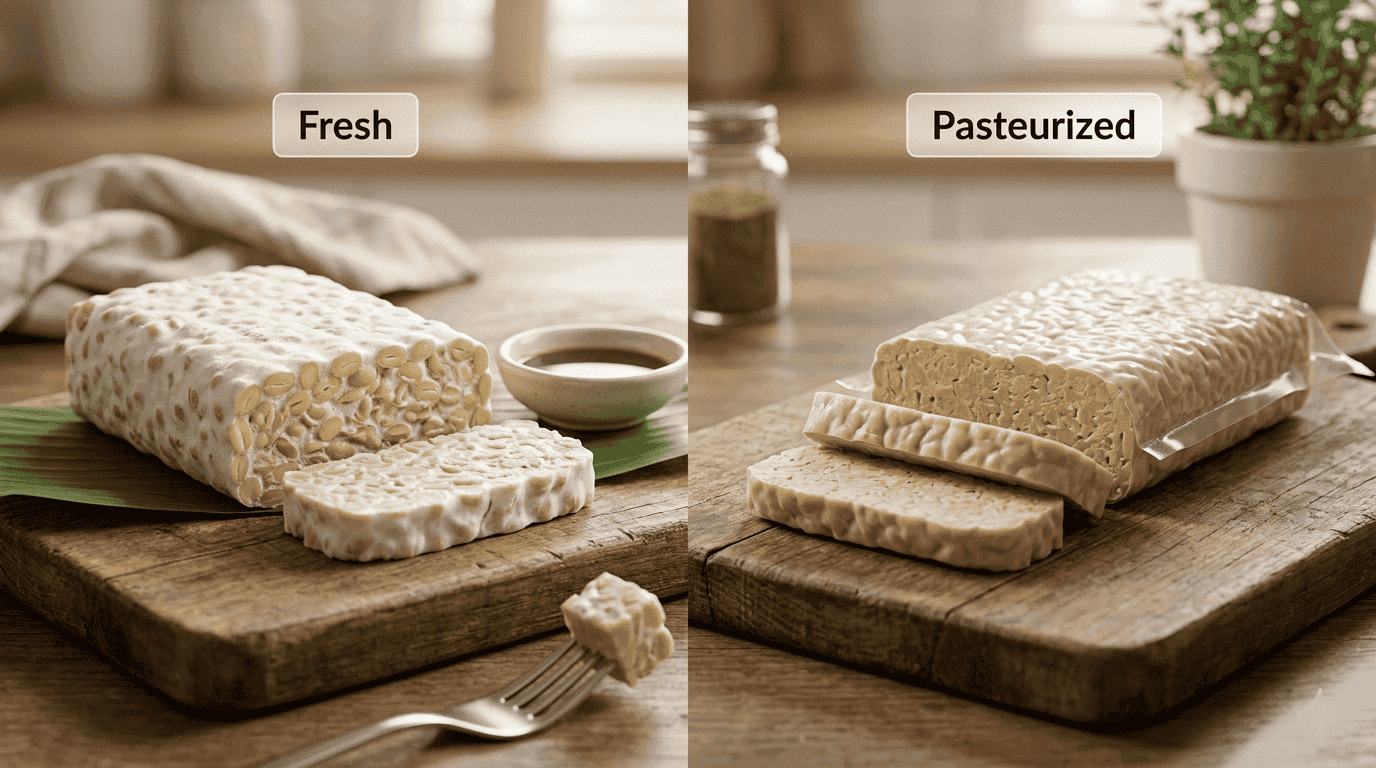
You’re choosing between two different foods. Fresh tempeh is alive, with active cultures and a richer, nuttier taste.
The shelf-stable kind has been pasteurized, stopping that activity for safety and a longer life. One offers probiotic benefits and deeper flavor; the other is about convenience and consistent safety.
Your decision comes down to what matters more in your kitchen: a living, fermenting ingredient or a reliable, ready-to-use protein. To understand what this means for your cooking and health, keep reading.
SoyaMaya Fresh Tempeh is made the traditional way — no preservatives, no shortcuts. Delivered to your door.
Order Fresh Tempeh →Quick Guide: Fresh vs Pasteurized Tempeh at a Glance
- Pasteurization stops live culture, extends shelf life.
- Unpasteurized tempeh has a richer flavor and texture.
- Fresh tempeh found at markets and specialty stores.
Understanding Pasteurized Tempeh
Walk into a big grocery store here in North America. That block of tempeh you pick up, sealed tight in its plastic, is almost always pasteurized.
Here’s how it works at our place. Once the tempeh is fully fermented, we give it a quick, gentle heat treatment. We’re not trying to cook it through for eating; the goal is different.
This heat step knocks out any bad bugs-things like Listeria or E. coli-that might try to hang around in a fermented product. More importantly, it shuts the whole fermentation process down for good.
That white, fuzzy Rhizopus mold network? The one that binds all the soybeans together into that solid cake? It goes dormant. The tempeh isn’t alive anymore. What you get is a consistent, stable product-very different from fresh tempeh that continues to evolve even after production.
That’s the real reason that package can sit in your fridge for weeks, or in your freezer for months, and still be fine when you open it. The clock on it has been stopped.
We’ve found this step is non-negotiable for making a product that’s safe and reliable for the store shelf, even if it means sacrificing a bit of that “living food” character you might get from an unpasteurized batch.
The trade-off, in our experience, is worth it for the consistency and peace of mind it delivers.
Reasons Companies Pasteurize Tempeh
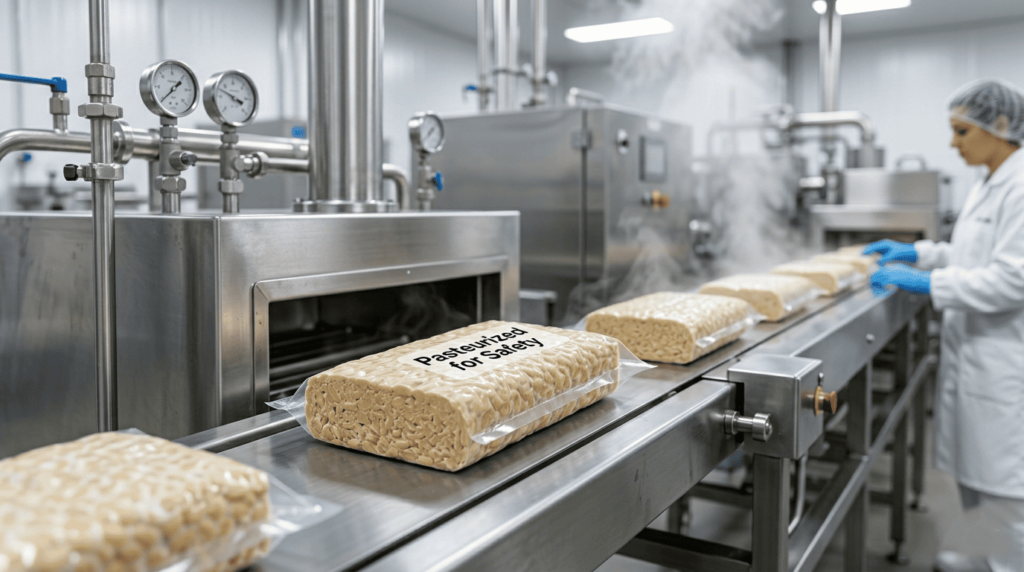
You’re right, they do it for scale and safety. But let’s talk about the “scale” part from our perspective.
Imagine for a second trying to ship a live, actively fermenting product to thousands of stores across the country. That cake wouldn’t just sit still.
It would keep culturing in the truck, maybe developing more of those black spores, probably drying out at the edges during a long haul.
From batch to batch, from one city’s climate to another, the final product on the shelf would be totally different. Consistency would be impossible.
Pasteurization fixes that. It gives us a standardized product. A block that behaves the exact same way in a kitchen in Portland as it does in Miami.
Insights from Edible Austin indicate
“Pasteurization is what makes it that way. For the longest time, food regulators were very skeptical of fermented foods-particularly unfamiliar foods. In order to sell it here, tempeh makers had to pasteurize it.” – Edible Austin
For any operation working at a certain size, that logistical control isn’t just nice, it’s everything.
Then there’s the safety side, which is really about managing risk. We know traditional tempeh consumption in places like Indonesia rarely causes issues.
But modern commercial food standards, and frankly, our own liability, force us to err on the side of extreme caution. Pasteurization is that caution, baked right into the process.
So when we make the choice to pasteurize, it is a business decision. We’re prioritizing a reliable shelf life and nationwide distribution over preserving every nuance of a live culture. It’s a trade-off we’ve had to make to get tempeh into those mainstream stores in the first place.
Identifying Pasteurized Tempeh
The label is our first clue. We look for words like “pasteurized,” “heat-treated,” or “ready-to-eat.” A long shelf life is usually another giveaway, especially when compared to how long tempeh lasts in its fresh, unpasteurized form.
In our experience, if it can sit in the fridge for weeks without changing much, it’s probably been treated to stop the fermentation. That’s not necessarily bad-but it tells us we’re no longer dealing with something alive and active.
The packaging itself is often a sign. It’s usually a tight, non-perforated plastic wrap. Fresh tempeh needs to breathe, so its bags have little holes.
We’ve handled enough fresh batches to know the difference right away. When we pick up a tightly sealed brick with no airflow, we already suspect it’s been pasteurized.
Open a pasteurized package. The tempeh inside will look uniform, often with very little of the distinctive white fuzz. We’re used to seeing that living white mycelium holding the beans together.
In pasteurized versions, it’s often subdued or barely there. There might be some gray or black spots, but they’ll be static-just part of the set appearance, not something that’s actively developing.
It won’t feel warm. Fresh tempeh sometimes carries a gentle warmth from ongoing fermentation. Pasteurized tempeh feels completely neutral to the touch. No life, no activity.
The aroma is another clear difference. Fresh tempeh has that strong, yeasty, almost mushroom-like scent. We’ve opened fresh packs that filled the kitchen with that earthy smell right away.
Pasteurized tempeh smells neutral, maybe a little bland. It doesn’t have that depth.
The texture gives it away too. It’s denser, less chewy. When we slice into fresh tempeh, there’s a slight resilience. Pasteurized versions feel more compact, almost pressed into submission.
At the end of the day, we can feel the difference. One is still evolving. The other has been stabilized. It’s a product, not a process.
Finding Unpasteurized Tempeh
You have to look a little harder, but it’s worth it. Start at farmers’ markets. We’ve had the best luck there, talking directly to small-scale producers who are proud of what they’re fermenting.
Many times, the tempeh is still in its perforated bag, sometimes made just days before. We can usually tell right away by the smell and the slight give when we press on it.
Check specialty health food stores or Asian grocers, particularly those with a focus on Indonesian goods. In our experience, these stores are more likely to carry fresh batches in the refrigerated section.
We’ve learned to ask questions instead of just reading the front label. Staff often know which deliveries are truly fresh and which ones are heat-treated.
Online, a number of small makers now ship fresh or fresh-frozen tempeh directly. We’ve ordered this way when we couldn’t find a local source, and the difference is noticeable.
When it arrives properly chilled and still breathing in perforated packaging, it feels much closer to what we’d get straight from a local kitchen.
You can also make it ourselves. Once we tried fermenting at home, we understood the process on a different level. Starter cultures are easy to find, and home fermentation lets us control everything-from the beans we choose to the timing.
The first time we opened a homemade batch and felt the warmth and smelled that rich, mushroom-like aroma, we knew we’d never look at shelf-stable bricks the same way again.
The key is to look for terms like “raw,” “live culture,” “unpasteurized,” or “fresh.” It will always be refrigerated, never sitting on a dry shelf.
And it will have a short best-by date, usually within 7 to 10 days, because it’s alive and changing. When we see that short window, we don’t see inconvenience-we see proof that it hasn’t been stopped in its tracks.
Health Comparison of Fresh Tempeh
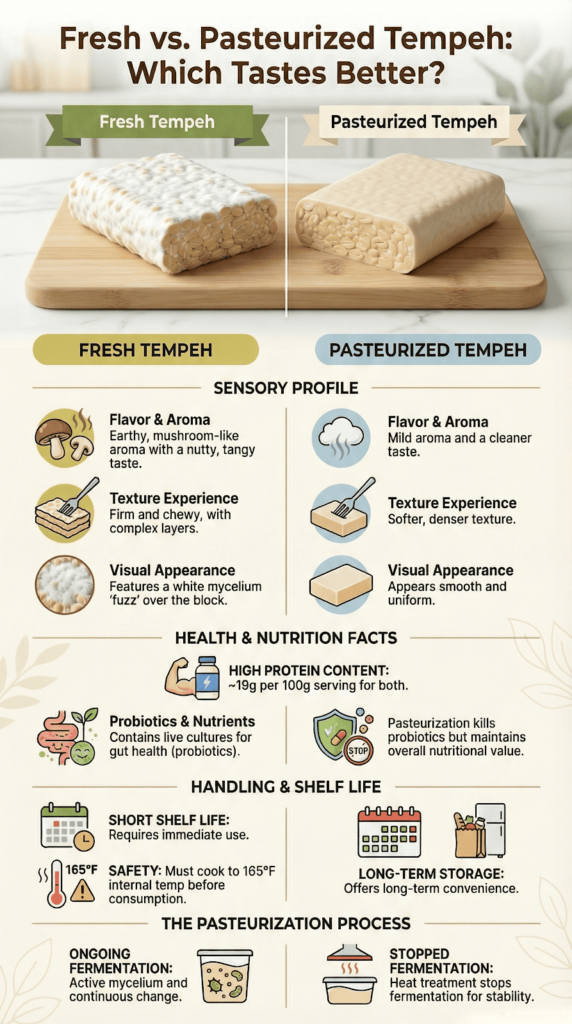
This is the heart of the debate. From a strict nutritional analysis-protein, fiber, minerals-the difference is minimal. Both forms offer around 19 grams of protein per 100-gram serving.
We’ve compared labels side by side more times than we can count, and on paper, they look nearly identical. The core nutrients survive the heat.
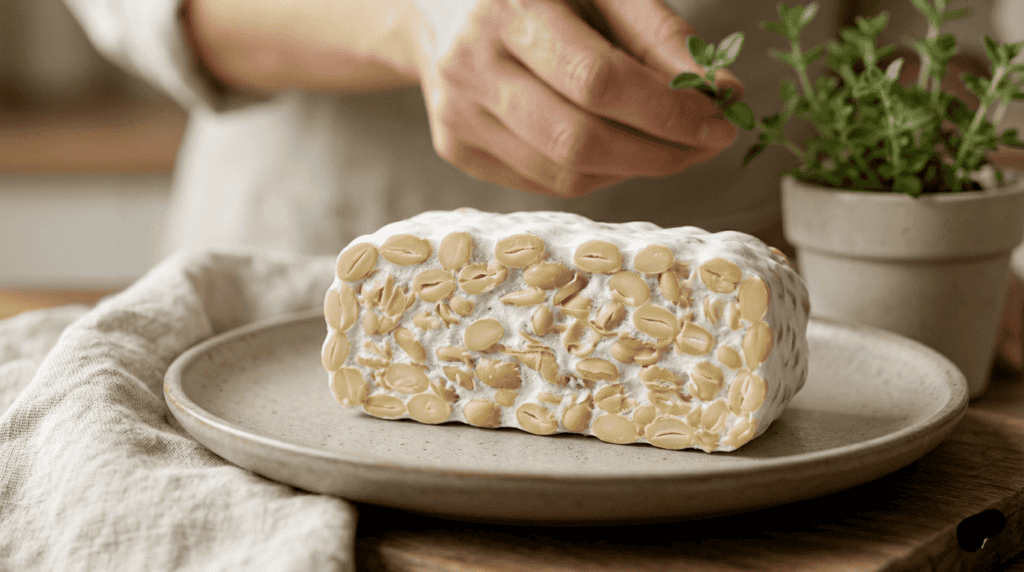
But health isn’t just a spreadsheet. Fresh tempeh contains a live culture, which is why many people look into the benefits of unpasteurized tempeh for gut health and digestion. That white fuzz is active Rhizopus mold.
When we’ve handled truly fresh tempeh, we can see and smell that activity. It’s not just a visual detail-it’s a living fermentation. That means it potentially offers probiotics, beneficial bacteria that can contribute to gut health.
The fermentation process also creates prebiotic fibers, which feed the good bacteria in our digestive system. From our experience eating both regularly, fresh tempeh tends to feel lighter and easier to digest. That makes sense.
Fermentation has already done part of the work for us, breaking down compounds in the soybeans and making nutrients more accessible.
So fresh tempeh might deliver both the probiotic and the food for it. That’s a synergy pasteurized tempeh can’t provide.
Once heat-treated, those live cultures are no longer active. What remains is still nutritious, but it’s no longer dynamic.
However, we keep this in perspective. The probiotic count in tempeh isn’t as high as in something like yogurt or kefir. We wouldn’t rely on it as our primary probiotic source.
Its main health benefit is improved digestibility and nutrient bioavailability from the fermentation itself-which happens before pasteurization. Even heat-treated tempeh keeps that advantage.
For us, the choice comes down to what we’re looking for. If we want something alive and evolving, we reach for freshness. If we want convenience and stability, pasteurized still delivers solid nutrition.
Effects of Pasteurization on Probiotics
Yes, it does. The heat treatment deactivates the Rhizopus mold and any associated lactic acid bacteria. The live culture is gone.
When we’ve compared fresh and pasteurized side by side in our own kitchen, the difference is clear-no warmth, no continued fermentation, no living activity.
But the story doesn’t end there. Some research suggests that even dead microbial cells can still offer benefits, such as supporting immune function. We don’t dismiss pasteurized tempeh as “empty.”
It’s simply different. The fermentation already happened, and that process leaves behind compounds our bodies can still use.
Crucially, the prebiotic fibers created during fermentation remain intact. From what we’ve experienced, even pasteurized tempeh feels easier to digest than plain soybeans. That’s not an accident.
Fermentation breaks things down before heat is ever applied. So while the direct probiotic presence is lost, the tempeh can still support a healthy gut environment in other ways.
Also, pasteurization reduces antinutrients like phytates by about half, making the protein and minerals more accessible to our bodies.
We’ve noticed that tempeh-fresh or pasteurized-tends to sit better and feel more satisfying than other soy products, likely because those minerals are easier to absorb.
It’s a trade-off. We lose the live element, but we gain guaranteed safety and consistency, and possibly better absorption of the core nutrients.
For some of us, that reliability matters. For others, the living culture is the priority. Either way, the foundation built during fermentation is still there.
Benefits of Live Culture Tempeh
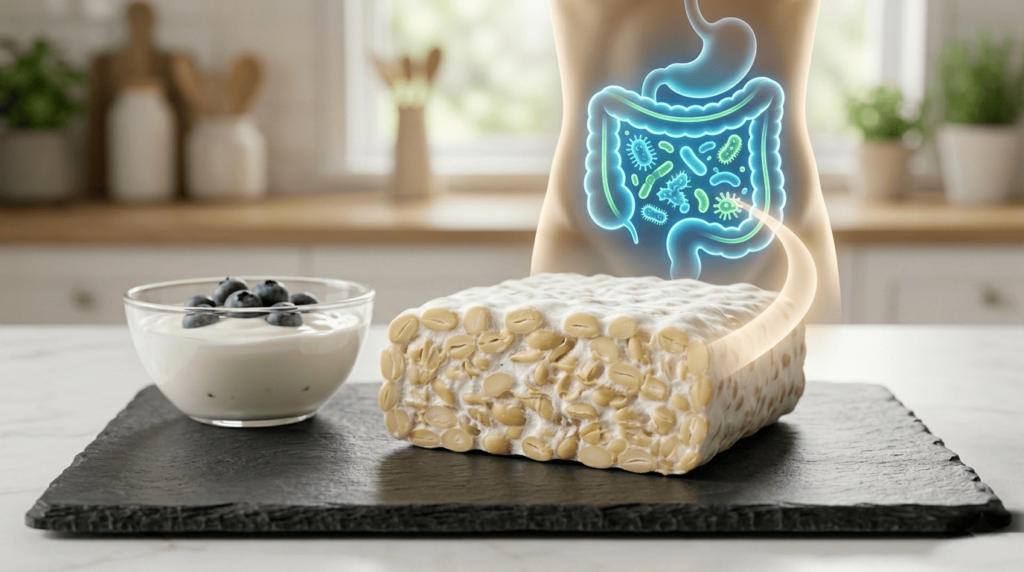
The benefits are tangible, even if they’re subtle.
First, flavor. The ongoing, slow fermentation in our fridge develops deeper, nuttier, more complex tastes over time.
We pulled out a fresh block a few days after buying it and noticed the change-slightly earthier, more mushroom-like, with a depth that just isn’t there in pasteurized versions. It’s not overpowering, but it’s noticeable once we know what to look for.
Second, texture. Fresh tempeh tends to be firmer, with a pleasant chew that holds up well in cooking. When we pan-sear it, it keeps its structure and develops a crisp edge without turning dense or dry.
That resilience makes a difference in stir-fries, grain bowls, or simple slices browned in a skillet.
Third, there’s the potential gut health support from the live probiotics. For those of us who intentionally include fermented foods in our routine, fresh tempeh makes sense.
We’re not relying on it alone, but it becomes part of a broader pattern of supporting digestion through live foods.
There’s also something harder to measure. When we eat fresh tempeh, we know it’s still alive. It’s an active fermentation, not a finished and stabilized product.
That connects us to the traditional way tempeh has been made and eaten for centuries in Indonesia. It feels closer to a kitchen craft than a factory output.
For us, that difference matters. It’s not dramatic. It’s not flashy. But it’s real-and once we’ve tasted it side by side, it’s hard to ignore.
Flavor Differences: Fresh vs Pasteurized
| Aspect | Fresh Tempeh | Pasteurized Tempeh |
| Aroma | Earthy, mushroom-like, nutty | Mild and neutral |
| Taste | Deeper, slightly tangy | Cleaner but less complex |
| Texture | Firm, chewy, resilient | Softer, sometimes dense |
| Cooking Result | Holds structure, absorbs marinade well | Can become slightly rubbery if overcooked |
Table: Flavor and Texture Comparison
It’s noticeable. Pan-fry a slice of each and we can smell the difference almost immediately. The fresh tempeh gives off a distinct, almost nutty aroma as it hits the pan.
Research from The Washington Post shows
“Soft, white fresh tempeh is widely available in Indonesis and from some smaller producers in the States. In American supermarkets, what you’re likely to find is pasteurized tempeh, which is firmer, drier, tan in color and a little more sour.” – The Washington Post
There’s a depth to it that fills the kitchen. We’ve done this side by side more than once, just to be sure we weren’t imagining it.
The taste follows through. Fresh tempeh has a deeper flavor, with a slight tang from the ongoing fermentation. It’s subtle, but it adds character.
The texture is chewy but tender, and it holds marinades beautifully. When we let it sit in a simple soy-based marinade, it soaks it up without losing structure.
The pasteurized version is milder. Its flavor is cleaner, but also blander. It doesn’t have that earthy depth.
When we cook it the same way, it browns fine and works in the dish, but it doesn’t bring the same personality. The texture can be denser, sometimes a little rubbery, especially if we overcook it.
It still works in recipes. We’ve used it in plenty of weeknight meals. But when we serve fresh tempeh to someone who thinks they don’t like tempeh, the reaction is often different.
Many people who dislike it have only tried the pasteurized supermarket version. Switching to fresh can feel like a small revelation.
For us, the comparison is simple. It’s like fresh sourdough bread versus a shelf-stable loaf. One is shaped by a living process. The other is finished and fixed. Both are edible. Only one feels alive.
Eating Fresh Tempeh Safely
The manufacturers themselves say no. Producers of fresh tempeh consistently recommend cooking it before eating. We’ve seen this guidance printed right on the package and confirmed it ourselves when asking questions at markets.
The reason is simple: even with careful production, a live, unpasteurized product carries some risk of bacterial contamination.
Cooking to an internal temperature of 165°F (74°C) ensures safety. When we prepare fresh tempeh at home, we treat it the same way we would any other perishable protein.
A quick steam or a thorough pan-sear takes care of that final step. It’s not about fear-it’s about basic food safety.
This is especially important for vulnerable groups: pregnant individuals, young children, older adults, or anyone with compromised immunity.
When we’re cooking for others, especially kids, we don’t take shortcuts. The extra few minutes of heat gives peace of mind.
Technically, the beans in tempeh are cooked before fermentation, so it’s not “raw” in that sense. We remind ourselves of that when people assume fresh tempeh is the same as eating something completely uncooked. It isn’t.
But the live culture phase does introduce variables. Fermentation is controlled, but it’s still active.
Cooking is the final step that controls those variables. For us, it’s the responsible choice. We can appreciate the living fermentation, the flavor, and the texture-and still finish it properly in the pan before it reaches the plate.
Tempeh Processing Methods Explained
The journey from bean to cake is fascinating. We’ve walked through the process ourselves, and seeing it firsthand changes how we think about what ends up on our plate.
Soybeans are hulled, cooked, and cooled. At that point, they’re ready for the starter culture containing Rhizopus spores. Once mixed in, the beans are spread thin and left to ferment for 24-48 hours at a steady, warm temperature.
We’ve checked on batches during this window and watched the transformation happen. The mold grows visibly, binding everything into a firm, white cake.
At this stage, we have traditional, unpasteurized tempeh. It’s alive and active. It smells earthy and slightly sweet, and it even gives off a bit of warmth from the fermentation.
For commercial pasteurized tempeh, the next step is a heat treatment-often a quick steam or bake-to halt that growth. We’ve seen how quickly this changes the character.
The activity stops. Then it’s vacuum-sealed to keep it stable.
For fresh tempeh, the cake is simply cooled and packaged in breathable material. The small perforations matter.
They allow the culture to remain active, even if it’s slowed down in refrigeration. When we bring it home, that process hasn’t fully stopped-it’s just paused.
The “processing” comes down to that moment. It’s either a pause or a full stop. From our experience, that single decision shapes the flavor, texture, shelf life, and overall feel of the tempeh we buy.
FAQ
Is fresh tempeh healthier than pasteurized tempeh for gut health?
Fresh tempeh, especially unpasteurized tempeh, contains tempeh probiotics and live culture tempeh created during tempeh fermentation. These compounds may support tempeh gut health by producing beneficial tempeh metabolites such as short-chain fatty acids.
However, tempeh pasteurization involves heat that results in tempeh probiotics killed. Both types still provide strong tempeh nutrition and overall tempeh health benefits.
How can I tell if tempeh has gone bad or unsafe?
You can identify tempeh spoilage signs by checking for a strong ammonia smell, slimy texture, or unusual colors beyond normal tempeh white fuzz formed by tempeh mycelium.
Fresh tempeh should have a mild, nutty scent with a slight mushroom aroma tempeh note. Spoiled tempeh may indicate tempeh contamination risks or harmful tempeh pathogens, which increase the chance of tempeh foodborne illness.
What is the difference in taste and texture between the two?
Fresh tempeh offers a firmer bite and tempeh superior texture fresh, along with a deeper tempeh flavor profile that can taste slightly nutty or yeasty. Pasteurized tempeh usually has a softer tempeh texture and a tempeh milder flavor pasteurized due to heat exposure.
These differences influence how each type performs in various tempeh cooking methods and recipes.
How long does tempeh last and how should I store it?
Tempeh shelf life varies based on processing and storage. Fresh tempeh has a shorter tempeh refrigerated shelf life, while pasteurized tempeh lasts longer due to heat treatment.
You can extend storage by using frozen fresh tempeh, although tempeh freezing effects may slightly change tempeh thawing texture. Always follow tempeh packaging labels or pasteurized tempeh labels for proper storage instructions and safety.
Is it safe to eat raw or lightly cooked tempeh?
Raw tempeh safety depends on how the product is processed and handled. Unpasteurized tempeh carries tempeh home kitchen raw risks, including exposure to tempeh pathogens or tempeh bad microbe overgrowth.
Cooking methods such as tempeh steaming vs raw or tempeh boiling significantly improve safety. Proper heat treatment helps reduce tempeh contamination risks while maintaining most of the tempeh nutrition.
Making the Right Pick for Your Kitchen
You can feel the difference when cooking: one is quick and convenient, while the other takes a bit more care but rewards you with richer flavor. It comes down to your time, routine, and what you enjoy eating. If you’re curious, try both and see what fits your lifestyle.
Ready to taste authentic, nutrient-rich tempeh? Discover SoyaMaya‘s high-protein tempeh.
References
- https://edibleaustin.com/people2/food-artisans/team-texas-tempeh/
- https://www.washingtonpost.com/food/2023/02/27/how-to-cook-tempeh/
SoyaMaya Fresh Tempeh
Traditionally fermented, no preservatives, shipped fresh and frozen to your door. The real deal, direct from us.
