
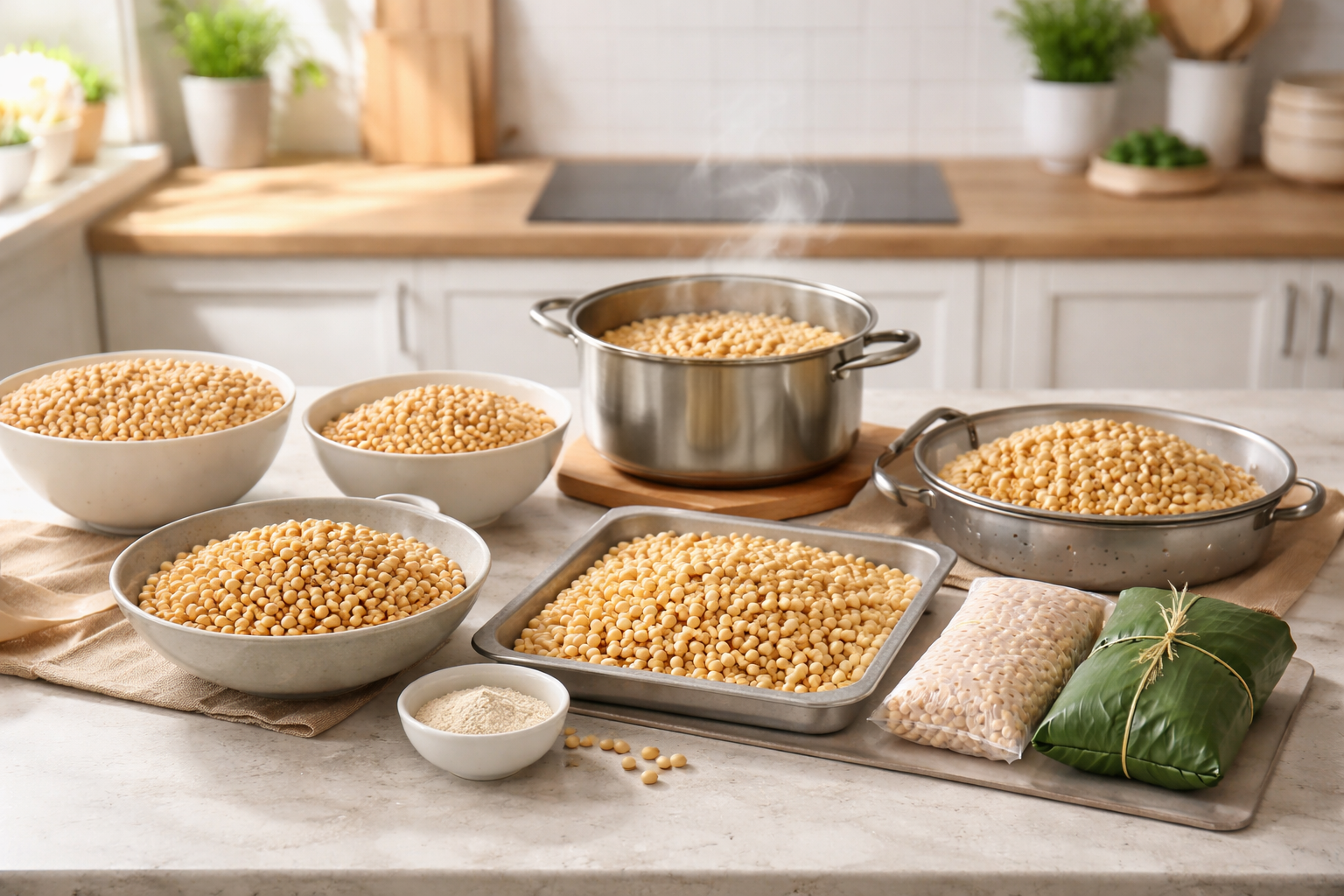
We turn soybeans into tempeh through fermentation. We use a particular culture called Rhizopus oligosporus. It breaks down the beans, making them firmer, boosting the protein you can actually absorb, and giving them that signature, slightly nutty taste.
Our know-how comes from doing it, not just reading about it. The method is rooted in Indonesian tradition, where tempeh is everyday food.
That’s the foundation we still use. We source organic soybeans from farms in Indiana and ferment in small batches.
Soya Maya Fresh Tempeh is made the traditional way — no preservatives, no shortcuts. Delivered to your door.
Order Fresh Tempeh →Learning the feel of it, how long to soak the beans, how dry they need to be, keeping the temperature just so, that was the real lesson. Here’s a clear, step-by-step walkthrough of exactly how we do it.
Fermentation Fundamentals Made Simple
- The tempeh fermentation process uses Rhizopus oligosporus mold to bind soybeans into a solid cake, which enhances its nutritional value and flavor.
- Your preparation steps, soaking, cooking, and drying the beans, have a direct impact on whether the fermentation succeeds.
- The final texture and quality of the tempeh are determined by how you control temperature, airflow, and moisture during the incubation period.
What is Tempeh, and What Makes It Different?
At its simplest, tempeh is a cake made from fermented soybeans. A specific mold, Rhizopus oligosporus, grows through the beans, binding them tightly into a firm, sliceable block.
This fermentation does two important things: it makes the beans’ protein and nutrients much easier for your body to use, and it develops a distinct, savory nuttiness.
We handle it regularly, and its construction still impresses us. You can see the individual beans held together by a network of white fungal threads.
This isn’t just for looks. As noted by the UN’s Food and Agriculture Organization, this biological process breaks down compounds like phytic acid that can block nutrient absorption.
Nutritionally, it’s a powerhouse. A 100-gram serving packs around 20 grams of complete protein. This sets it apart from tofu, which is made from soybean milk. Tempeh uses the whole bean, so you get all the natural fiber and structure, too.
The feel of it is crucial. A well-made tempeh block is dense and firm, with beans clearly visible and a clean, earthy smell. It’s not mushy or bland.
The whole package, the intact beans, the reduced antinutrients, the natural binding, is why it has remained a staple for so long, both in its traditional home and in kitchens today.
To understand the best soybeans for tempeh and why it matters, see what kind of soybeans for tempeh.
How Did Tempeh Originate and Why Does It Still Matters?
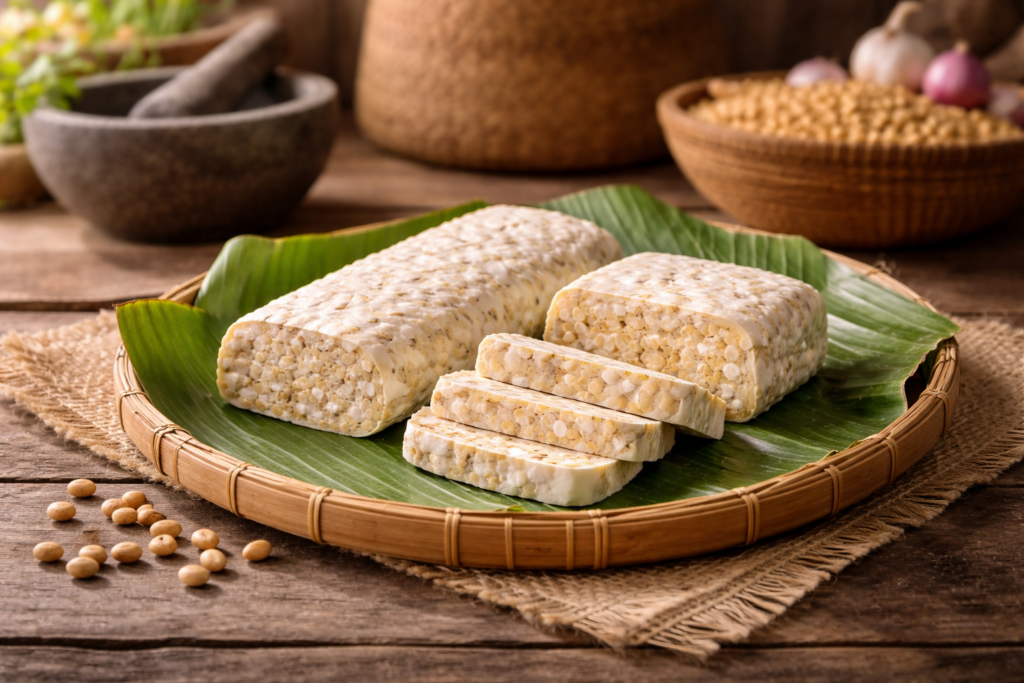
Tempeh began centuries ago on the island of Java in Indonesia. It was likely a discovery by accident. Cooked soybeans, wrapped in banana leaves or hibiscus leaves, would naturally catch wild Rhizopus spores from the environment.
Over a couple of days, these spores would grow, weaving the beans into a solid, edible cake. Historical records mention it as a food long before the 1600s.
In Indonesia, it became a cornerstone of the diet. It was, and still is, an accessible, affordable, and satisfying source of protein. It’s officially recognized as a staple food by the country’s own Ministry of Agriculture.
For us at SoyaMaya, that history isn’t just a footnote. It’s the reason we do what we do. We follow that same small-batch, hands-on approach.
We’ve integrated modern food safety standards, of course, but the core of the process, the patient fermentation that transforms simple beans, remains unchanged.
Knowing that lineage, that this method has nourished communities for generations, gives a tangible weight to our work. It connects each batch we make to a much longer story.
What Ingredients and Preparation Steps Are Required?
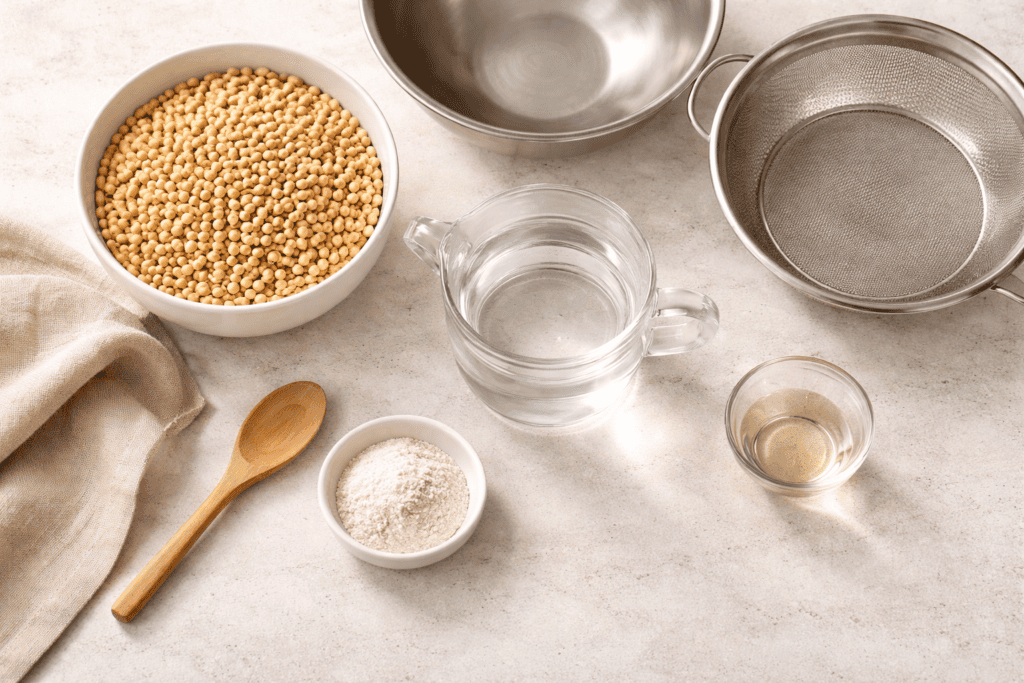
The ingredient list is short: dried soybeans, a Rhizopus oligosporus starter culture, and a bit of vinegar.
The process is straightforward but demands attention: soaking, dehulling, cooking, and drying the beans before fermentation. To understand how soybean type affects fermentation and texture, see whole vs split soybeans tempeh.
As highlighted by University of British Columbia (UBC) Wiki
“The production of tempeh starts off by soaking whole soybeans overnight. The soaking process allows to not only cleanse the soybeans, but most importantly rehydrate it in order to develop a softer texture that makes dehulling easier. So that the culture can colonize the heart of the legume.” – University of British Columbia (UBC) Wiki
We stick to a simple formula, but we’re exact about how we do it. For a standard batch, we use 400 grams of organic, whole soybeans, one teaspoon of tempeh starter spores, and one to two tablespoons of vinegar.
The vinegar isn’t just for flavor; it lowers the bean pH to approximately 4.5 to 5.0. This acidic environment, as the USDA points out, is crucial for keeping unwanted bacteria at bay and letting the right mold thrive.
Our preparation follows a clear sequence we’ve dialed in through practice:
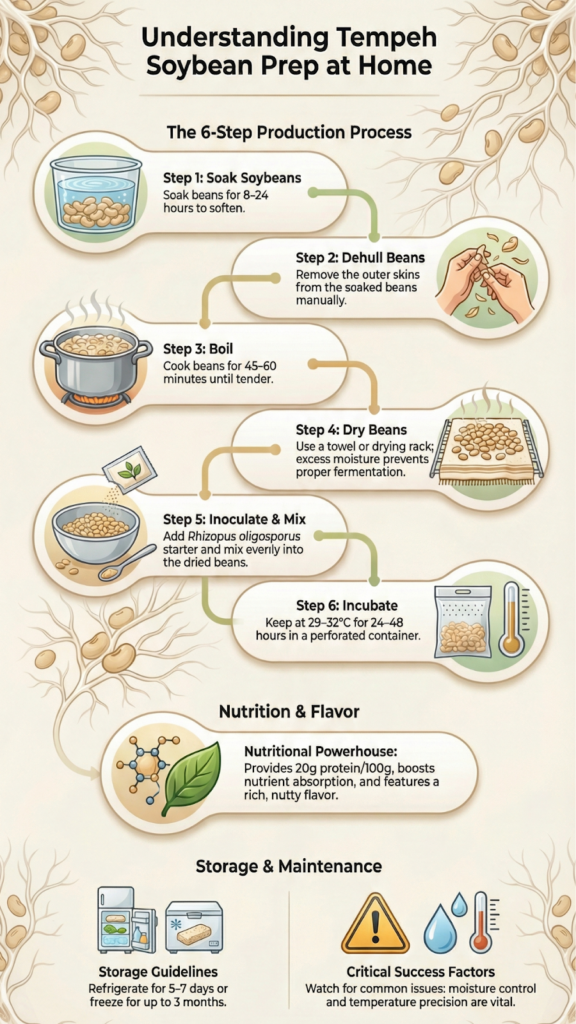
- Soak: Submerge the beans for 8 to 24 hours. This rehydrates and softens them.
- Dehull: Remove the loose skins. This step gives the mold more surface area to grab onto.
- Cook: Boil the beans for 45 to 60 minutes until they’re tender but not mushy.
- Dry: Spread the beans out and let them dry completely. Surface moisture must be gone.
Getting the beans dry enough is the make-or-break point. If they’re too wet when you add the starter, you’ll likely end up with a slimy, failed batch. Once the beans are cool and dry to the touch, they’re ready for the culture.
How Does Inoculation and Fermentation Work?
This is the stage where the beans truly transform. Cooled, cooked soybeans are mixed with the starter culture and held at a specific warmth.
Over 24 to 48 hours, the mold grows a network of white threads, the mycelium, that binds everything into a solid cake.
Insights from ResearchGate / Journal of Ethnic Foods indicate
“Tempeh is produced via a two-step fermentation process, which involves a soaking process and solid-state fermentation. Soybeans are softened by soaking, dehulled, then partly cooked. The soybeans have to cool down to allow spore germination and abundant growth of mycelium.” – ResearchGate / Journal of Ethnic Foods
We pay close attention here. Consistency at this point defines the final product. Once the beans have cooled below 35°C (95°F), we inoculate them.
We mix the powdered starter culture thoroughly into the beans. If the mixing is uneven, you’ll see patchy growth, some spots dense with mold, others barely touched.
The beans then go into containers that let air in. We use perforated plastic bags or traditional banana leaves. We keep the layer of beans about an inch to an inch and a half thick. Any thicker, and the center can’t get enough oxygen.
The fermentation itself requires strict control:
- Temperature: We maintain a steady 29–32°C (85–90°F).
- Time: The process takes between 24 and 48 hours.
- Oxygen: The containers must be perforated. The mold needs to breathe.
This microbial activity isn’t just about structure. As Harvard Health Publishing notes, the live cultures in fermented foods like tempeh can contribute to a healthier gut microbiome.
You can watch it happen. A fine, white fuzz appears and grows thicker, weaving the beans together.
By the end, you have a dense, firm block that holds together when sliced, with that characteristic mild, nutty smell. For tips on identifying fresh tempeh with intact beans, explore fresh tempeh.
What Are the Nutritional and Storage Benefits of Tempeh?
The fermentation process does more than bind the beans. It makes their nutrients more available for your body to use, lowers compounds that can block absorption, and, when stored correctly, gives it a decent shelf life.
For us, it’s a staple not just for its flavor, but for its balanced nutrition.
- It provides about 20 grams of protein per 100-gram serving.
- Fermentation can reduce phytic acid levels by 40 to 60 percent.
- It’s a good source of B vitamins and contains prebiotics.
- The live cultures contribute to gut health, a noted benefit of fermented soy.
Research supported by the National Institutes of Health (NIH) confirms that fermentation enhances the bioavailability of beneficial plant compounds in soy, like isoflavones.
How you store it directly affects quality. Fresh tempeh will keep for 5 to 7 days in the refrigerator and up to 3 months in the freezer.
- Refrigerate it immediately after the fermentation cycle ends.
- Freeze it if you won’t use it within a week.
- A strong ammonia smell is a clear sign it’s past its prime.
You might sometimes notice dark gray or black spots. These can form from over-fermentation or spore development and aren’t necessarily harmful, but they do indicate the product is aging. Proper storage is the best way to preserve both its taste and its safety.
What Are Common Tempeh Problems and How Do We Fix Them?
Most failures come down to a few basic things: the temperature was off, the beans were too wet, or the starter wasn’t mixed in evenly.
We’ve run into our share of troubleshooting over the years. Nearly every issue fits into one of these patterns.
| Problem | Likely Cause | Our Fix |
| No growth | Temperature too low, or starter was old/weak. | Check and maintain a steady 29–32°C (85–90°F) incubation environment. |
| Patchy growth | Starter culture was not mixed evenly into the beans. | Take time to mix the powdered starter thoroughly until every bean is coated. |
| Slimy texture | Beans had too much surface moisture before inoculation. | Dry the cooked beans more completely after draining; they should feel dry to the touch. |
We also see other issues, like a bitter taste or signs of over-fermentation (a strong ammonia smell, dark spores). These usually happen if fermentation goes too long or the temperature spikes too high.
Keeping everything clean, your tools, your hands, your workspace, is non-negotiable. It cuts down on contamination and makes each batch more predictable.
After a while, you start to recognize the signs early. Making these adjustments stops being a fix and just becomes part of how you do it.
FAQ
What defines whole soybean tempeh in traditional tempeh preparation?
Whole soybean tempeh uses intact, dehulled soybeans that are bound together by Rhizopus mold during the tempeh fermentation process. It forms a firm tempeh block with even white mycelium growth and a compact texture.
This structure reflects traditional tempeh preparation and traditional Indonesian tempeh methods. It also produces a clean, nutty flavor and shows consistent tempeh mycelium coverage quality.
How do soybean soaking and boiling affect fermented soybeans quality?
Soybean soaking for tempeh, including soaking soybeans overnight, softens the beans and supports even fermentation. Boiling soybeans for tempeh helps remove hulls during the soybeans dehulling process and reduces harmful bacteria.
Proper soybean draining and drying soybeans before inoculation are essential steps. These steps create the right moisture level, which supports healthy mold growth conditions and stable fermentation results.
What is the right tempeh inoculation method and starter culture use?
The tempeh inoculation method requires mixing cooled, dry soybeans with tempeh starter culture evenly. You can use tempeh starter spores or tempeh starter powder, but you must follow the correct tempeh starter dosage.
Acidifying soybeans with vinegar helps control unwanted bacteria. This step supports Rhizopus oligosporus fermentation and ensures the mold grows evenly across all beans.
How do incubation temperature and time affect tempeh fermentation?
Tempeh incubation temperature and fermentation time determine the final texture and flavor. A warm place for tempeh fermentation, with stable heat, allows steady mycelium growth. A proper tempeh incubation setup or DIY incubator helps maintain control.
Poor temperature control can cause uneven mold growth, sticky tempeh, or signs of overfermentation, which affect both safety and taste.
How can I spot fresh tempeh and avoid contamination issues?
Fresh tempeh has a firm texture, full white mold coverage, and a mild, slightly nutty smell. Small black spots can be safe, but strong or unpleasant odors indicate spoilage. You can reduce risks by following clean fermentation practices and proper wrapping methods.
Banana leaf wrapping or plastic bags with air holes both support airflow and help prevent contamination during fermentation.
Small Details Make the Difference
Small details make the difference. You can feel it when tempeh goes wrong; it turns too soft or smells off, which is frustrating after all that effort. It usually comes down to moisture or temperature being slightly off, and once that balance slips, the whole batch suffers.
For consistent results, try SoyaMaya for clean-tasting, firm tempeh made with care. It saves time, reduces guesswork, and delivers reliable texture every single batch you make.
References:
- https://wiki.ubc.ca/Course:FNH200/Projects/2023/Tempeh_and_Fermentation
- https://www.researchgate.net/publication/379058337_A_review_on_health_benefits_and_processing_of_tempeh_with_outlines_on_its_functional_microbes
Related Articles:
- https://mayasaritempeh.com/fresh-tempeh/
- https://mayasaritempeh.com/whole-vs-split-soybeans-tempeh/
- https://mayasaritempeh.com/what-kind-of-soybeans-for-tempeh/
Soya Maya Fresh Tempeh
Traditionally fermented, no preservatives, shipped fresh and frozen to your door. The real deal, direct from us.
