

Tempeh fermentation originated in Central Java, Indonesia. It did not have a single inventor. The process developed gradually through long-standing food practices involving soybeans, natural molds, and warm tropical conditions.
Historical evidence and food studies indicate that tempeh emerged from household soybean preparation methods. Cooked soybeans were often wrapped in local leaves and stored in warm environments. Naturally occurring molds, including Rhizopus species, began fermenting the beans under these conditions.
Over time, people observed that fermented soybeans formed a firm, edible block. This process was repeated and refined as a reliable food preparation method. Tempeh became part of everyday diets in Central Java, especially in agricultural communities.
Soya Maya Fresh Tempeh is made the traditional way — no preservatives, no shortcuts. Delivered to your door.
Order Fresh Tempeh →Quick Facts About Tempeh Fermentation Origins
- Tempeh does not have one inventor
- It comes from Central Java, Indonesia
- It likely started more than 400 years ago
Tempeh Fermentation Did Not Come From One Person
Tempeh was not created by anyone in particular. It came from daily food habits in Central Java, shaped through understanding tempeh fermentation practices over time.
We look at it as something that slowly formed in kitchens over time. People were cooking soybeans, storing them, and noticing changes when the weather was warm and humid.
At some point, those changes stopped being seen as random. They became useful. That is when people started repeating the process on purpose.
Old Javanese writings already mention tempeh as part of regular meals. That tells us it was already common long before modern food science existed.
- Early use: around the 1500s
- Place: Central Java, Indonesia
- Pattern: shared household knowledge
There is no record of a single inventor. It developed through many small steps across generations.
Tempeh Likely Started From Simple Storage Mistakes
From what we understand, early tempeh probably began by accident.
Cooked soybeans were often wrapped in leaves and left in warm places. The leaves were not sterile. They carried natural molds from the environment, a process connected to early stages of fermentation.
After a day or two, something changed in the beans. They became firm and stuck together. Instead of throwing them away, people tried eating them.
That moment mattered. It turned a “mistake” into a repeatable food.
Conditions that made this possible:
- Warm temperatures around 30°C
- Humid air common in tropical regions
- Leaf wrapping like teak or similar plants
- Cooked soybeans left for 24-48 hours
We think of this stage as learning through observation, not planning.
Rhizopus Mold is What Makes Tempeh Work
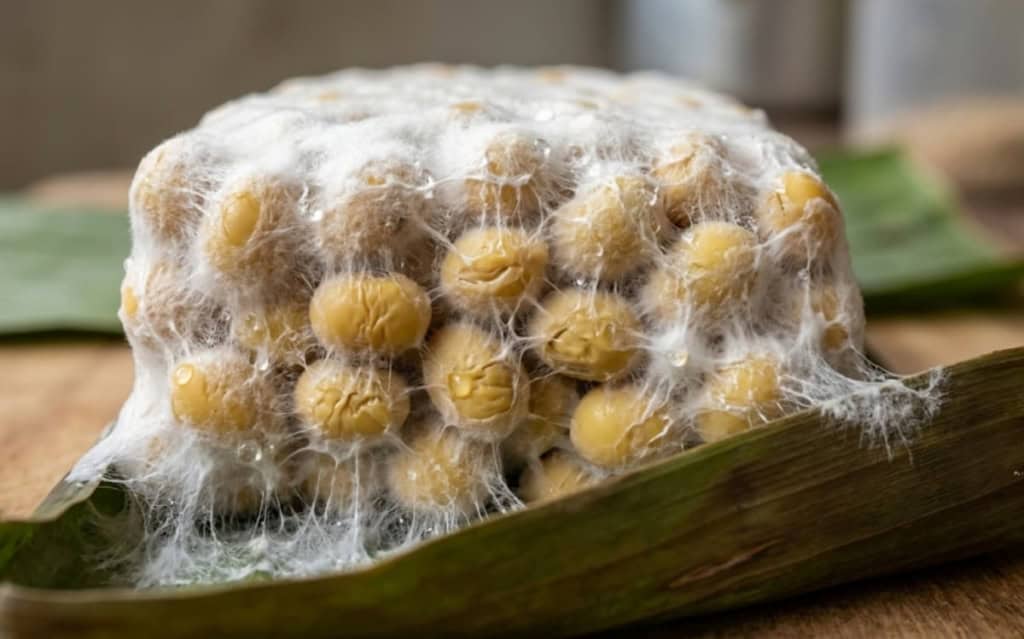
The change in soybeans is caused by a fungus called Rhizopus oligosporus. It grows through the beans and binds them together.
“Fermentation has been used for thousands of years to preserve foods.” – Food and Agriculture Organization
We describe it simply as a natural glue made by growth, not added ingredients.
The fungus spreads through the soybeans and forms a tight network. That network is what gives tempeh its firm shape.
- Fermentation time: 24-48 hours
- Temperature: around 30°C
- Result: solid soybean block
What Changes Inside The Soybeans
To make tempeh, soybeans are soaked, cooked, and then inoculated with a special culture before they’re left to ferment. The process is pretty simple, but it creates some significant changes in the beans themselves.
First, the texture changes completely. Instead of staying soft and mushy, the beans bind together into a solid, cake-like block. It’s firm to the touch but not hard or brittle. You can slice it or cube it easily.
More importantly, the fermentation makes the beans much easier for our bodies to process. The natural compounds in soybeans that can sometimes cause digestive discomfort start to break down.
At the same time, the protein in the beans changes. The fermentation process pre-digests the proteins, in a way, making them simpler for our bodies to absorb and use. This nutritional upgrade is a big deal.
These changes, better texture, easier digestion, and more accessible protein, are the main reasons tempeh became such a staple. It wasn’t just another food: it was a reliable, nutritious, and versatile source of sustenance that could be stored and used in countless everyday meals.
Its firm texture holds up in soups and stir-fries, and its mild flavor acts like a sponge, soaking up spices and sauces. This practicality secured its place as a fundamental protein source, especially in regions where meat was less available or affordable.
Tempeh in Early Written Records
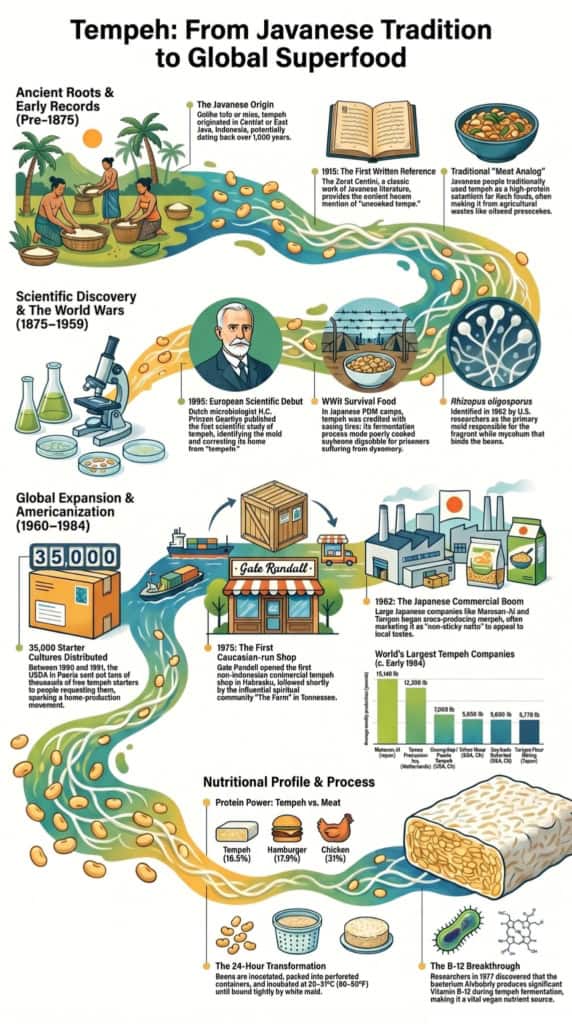
Tempeh shows up in old Javanese writings and later in early foreign records.
“Tempeh is a traditional fermented food produced from soybeans using Rhizopus species.” – peer-reviewed food microbiology research
We use these sources to confirm that tempeh was not new even hundreds of years ago. It was already part of daily eating habits.
- Early records appear around the 1600s
- Later mentions appear in the 1800s
- Region often recorded: Central Java areas
In those times, tempeh was simple food. It was used mainly as a source of protein in farming communities.
It was not treated as something special. It was just part of normal meals.
Modern Tempeh Still Follows The Same Basic Process
Today, tempeh is made in more controlled spaces, but the process itself has not changed much.
We still rely on the same fungus, the same soybeans, and the same timing. What changed is how carefully we manage each step.
In our work, we use controlled fermentation rooms so temperature and humidity stay steady. This helps reduce inconsistency between batches.
Traditional vs Modern Process
Here is a simple comparison of how things changed over time:
| Aspect | Traditional method | Modern method |
| Starter | Natural leaf molds | Starter culture of Rhizopus |
| Soybeans | Local soybeans | Selected non-GMO soybeans |
| Environment | Kitchen or home storage | Controlled rooms |
| Time | 24-48 hours | 24-48 hours |
| Scale | Small household batches | Larger batch production |
Even with these changes, the core process is still the same.
Why Soybean Choice Matters
The type of soybeans you start with matters a great deal. It’s the main ingredient, so its quality and characteristics directly shape the final tempeh.
Not all soybeans are the same. Different varieties can behave quite differently during the fermentation process. Some types have a higher oil content, which can influence flavor.
Others might have a thicker skin, which affects how well the mycelium, the white, fuzzy mold that binds everything together, can penetrate and grow through the beans. This growth is what gives tempeh its signature texture. Some beans simply produce a denser, more cohesive cake, while others might ferment more quickly or evenly across the whole block.
For consistency, many modern producers, including us, choose to use non-GMO soybeans. Using a consistent, high-quality bean source helps ensure that each batch of tempeh ferments reliably. The mycelium grows at a predictable rate, and the final product has a uniform texture and firmness every time.
This consistency is important not just for quality control, but also for anyone cooking with it, as they can rely on it behaving the same way in their recipes.
Tempeh Today and Why It Still Matters
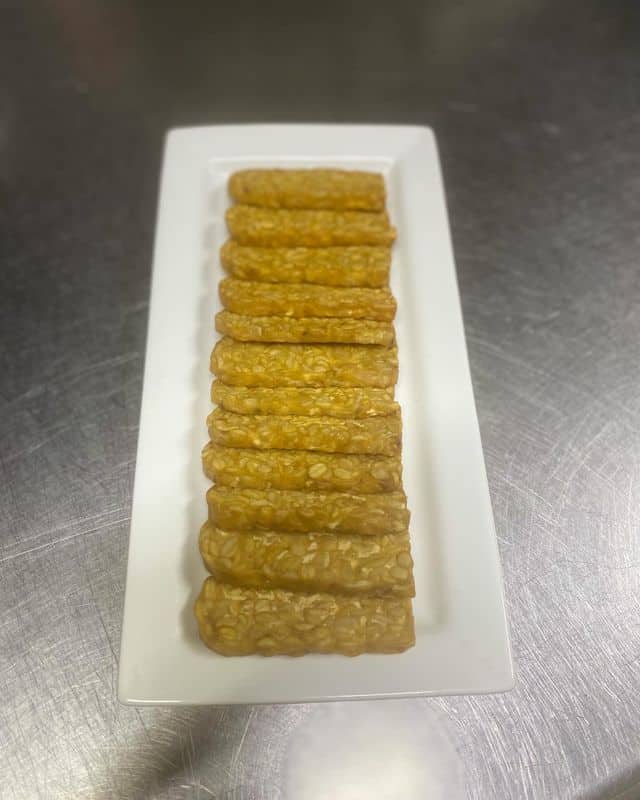
Tempeh has stayed around for centuries because the process works.
It turns soybeans into something easier to eat and more useful as food, especially in the form of fresh tempeh prepared for modern consumption.
That’s exactly it. The method is so straightforward it almost seems obvious in hindsight. You need the right beans, the right starter culture, a bit of warmth, and some patience. Those four elements interact to create something entirely new from the original ingredient.
We keep using this specific fermentation process because it’s dependable. It doesn’t require complex machinery or chemistry; it relies on a natural biological process that, when managed correctly, is remarkably consistent. This consistency is what allows it to bridge traditions.
It means that a cooking technique developed generations ago still works perfectly in a modern kitchen. You don’t have to alter the fundamental process to make tempeh viable today.
The traditional approach already provides everything needed: a nutritious, preservable, and adaptable protein source. When a system is that effective and that resilient, the most practical thing to do is to maintain it, respecting the original ingenuity while applying it to current scales and standards.
FAQs
Is tempeh fermentation linked to a single inventor in Indonesia?
Tempeh fermentation is not linked to a single inventor. The tempeh fermentation origin comes from Central Java, where soybean fermentation developed gradually through household food practices.
There is no verified record of a tempeh inventor Indonesia, because the process formed over generations rather than being created by one person at a specific time or place.
How did tempeh fermentation start in early Javanese culture?
The history of tempeh Java shows that tempeh likely began through tempeh accidental discovery during soybean storage in warm and humid conditions. Cooked soybeans were left in leaves, and natural fermentation occurred.
This practice became part of Javanese tempeh culture and later developed into traditional tempeh making that was repeated and refined across households in Central Java.
What role does fungus play in tempeh fermentation?
The fungus Rhizopus oligosporus tempeh is responsible for binding soybeans during fermentation. It grows through the beans and creates tempeh mycelium growth, which forms a firm structure.
Traditional production often relied on natural sources of ragi tempeh spores, sometimes supported by materials like usar tempeh leaves and tempeh teak leaves, which helped maintain fungal activity.
Why is tempeh considered an important traditional food?
Tempeh is important because tempeh soybean fermentation improves nutrition and digestibility. The process increases tempeh digestibility benefits, reduces tempeh oligosaccharides reduction, and supports tempeh B vitamins production.
It is also valued for tempeh gut health and its high protein content, which makes it a reliable tempeh plant-based meat source in everyday diets.
How did tempeh spread beyond Indonesia historically?
Historical records show tempeh 16th century usage in Java and later references in tempeh Europe 1896 through foreign traders. This is part of broader Indonesian tempeh history. In the 20th century, it spread further through tempeh US immigrants 1961, leading to research such as tempeh variety trials MSU and the growth of tempeh modern production methods.
Tempeh Fermentation: Tradition That Still Shapes Modern Food
Tempeh fermentation was never created by a single person. It grew from household soybean practices in Central Java and persisted because it consistently worked. Today the same biological process is still used, with better control of temperature, hygiene, and production scale, while the core fermentation science remains the same.
SoyaMaya continues this tradition through carefully crafted tempeh made with clean ingredients and controlled fermentation rooted in heritage and purpose.
References
- https://www.fao.org/4/x0560e/x0560e00.htm
- https://pmc.ncbi.nlm.nih.gov/articles/PMC3551449/
Related Articles
- https://mayasaritempeh.com/fresh-tempeh/
- https://mayasaritempeh.com/understanding-tempeh-fermentation/
- https://mayasaritempeh.com/what-are-the-stages-of-fermentation/
Soya Maya Fresh Tempeh
Traditionally fermented, no preservatives, shipped fresh and frozen to your door. The real deal, direct from us.
