
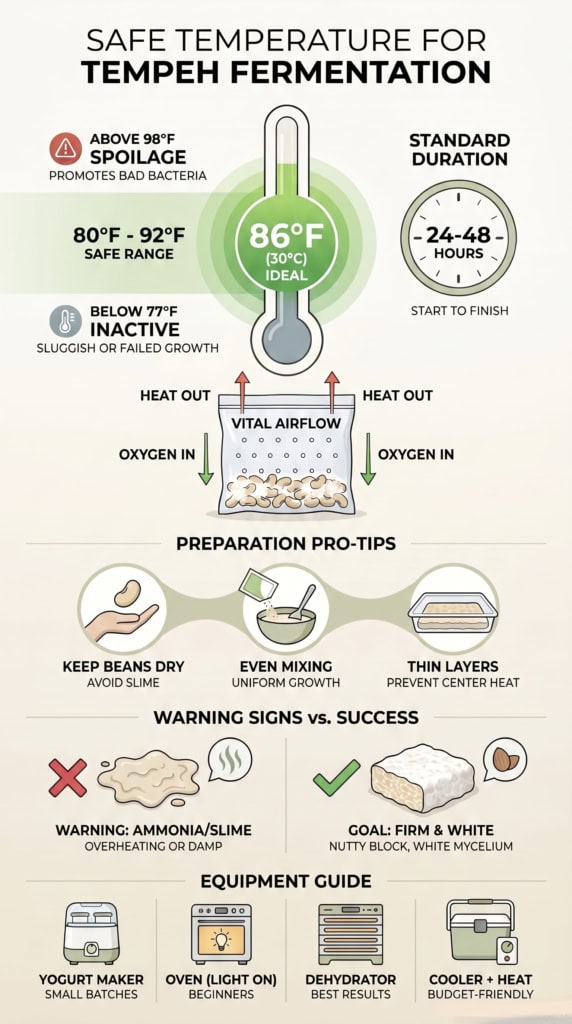
Tempeh ferments best between 80°F and 92°F (27°C to 33°C). The sweet spot is 86°F (30°C), which encourages strong mycelium growth in about a day or two. We’ve tried making it in warm rooms, insulated boxes, dehydrators, and even ovens with the light on.
The best batches, the ones that turned out firm and nutty with a clean white mold, consistently hit that 86°F mark. If it gets too cold, the process stalls. Too hot, and the beans start to sweat and spoil. Controlling temperature is the single biggest factor for success. For a complete guide on timing, airflow, and simple home setups, keep reading.
Quick Fermentation Reads: Best Temperature for Reliable Tempeh
- Best tempeh fermentation: 80°F-92°F, ideally 86°F
- Most tempeh batches finish in 24 to 48 hours
- Above 98°F can ruin tempeh starter culture
Quick Fermentation Facts
Getting good tempeh is about two things. Heat and air. That’s it.
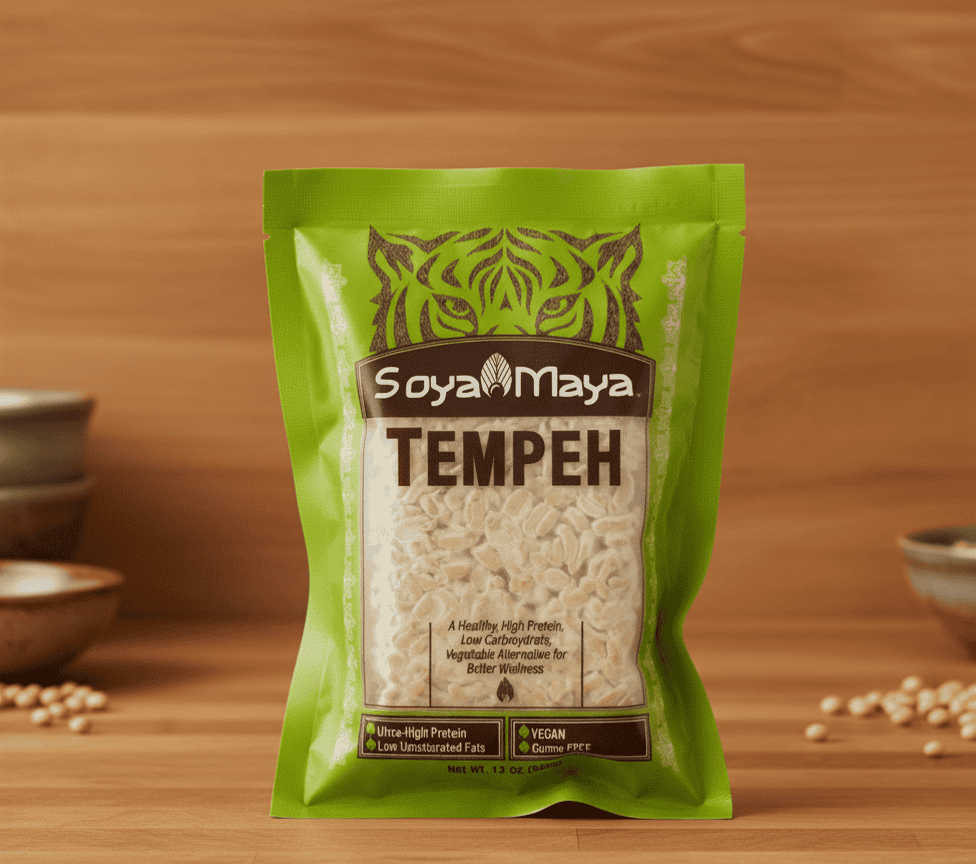
Soya Maya Fresh Tempeh is made the traditional way — no preservatives, no shortcuts. Delivered to your door.
Order Fresh Tempeh →Getting the heat just right
We keep things warm. Steady is the key. Try to stay between 80 and 92 degrees Fahrenheit. If you can keep it at 86, that is perfect. Go over 98 degrees and you will probably kill it. The whole thing takes about a day or two.
But here is the catch. The tempeh makes its own heat as it grows. Once it gets going, the middle of the block can get very hot. We have seen it go over 95 degrees inside.
If that heat gets stuck, it ruins everything. We learned to keep the outside temperature stable. Let the tempeh do its own work. Do not blast it with high heat and stress it out.
Letting it breathe is everything
The tempeh mold needs oxygen. It will not grow without air moving around it. This is why small loose batches work better than big dense bricks.
You should never wrap it up tight. Good airflow stops bad smells. It stops the wrong bacteria from growing.
Why batches fail, from what we have seen
We have seen many failed batches. It is almost never the starter’s fault. The real problems are wet beans, no airflow, or overheating.
If the beans are damp when you start, they get slimy. The tempeh mold hates that.
Using a sealed container or thick plastic will suffocate it. Every time.
Letting the tempeh’s own heat build up too much is bad. This happens if you wrap it too tight or the incubator is too hot.
Our way is simple. Consistent gentle warmth. Plenty of air. It is a slower method. But it works. You get firm tempeh with a clean, nutty flavor. Every time.
Best Temperature for Tempeh Fermentation
We shoot for 86°F (30°C) when making tempeh. That’s the number where the mold really kicks into gear without cooking itself.
The stuff we use, Rhizopus oligosporus, is picky about temperature, which is why understanding how tempeh fermentation works becomes so important once the beans start generating their own heat.
Research from Sparringa et al., Journal of Applied Microbiology (2002) shows
“The fastest hyphal extension rate (1.7 mm h⁻¹) was predicted to occur at 42 °C, pH 5.85, a_w approximately 1.0 and 0.03% CO₂.” – NIH/PubMed
If it drops below 77°F, it basically goes to sleep. Let it climb past 98°F, and it starts to panic, that’s when other, nastier microbes can move in.
Our best batches always happen right in that sweet spot. When we keep the beans hovering around 86°F, we get a solid white fuzz covering everything between 20 and 30 hours in.
The tempeh comes out firm, cuts clean, and smells like mushrooms and nuts, not ammonia or wet socks.
The whole process has a kind of handoff:
- First, we provide the warmth to get it started.
- Then, the fermentation itself starts generating heat.
That second part catches a lot of people off guard. If you don’t expect it, your tempeh can overheat from the inside out.
What we do to make it work
After a bunch of failed batches and some great ones, we stick to a short list of rules. Skip one, and the whole thing gets shaky.
- Dry beans are non-negotiable
Before we add the starter, the beans have to be bone-dry on the surface. Even a little dampness is asking for trouble.
- Mix the starter like your life depends on it
Sprinkle that powder evenly and mix it until every bean has a chance. Clumps mean bald spots in your final cake.
- It needs to breathe
We poke holes all over the bag or container. The mold needs oxygen to grow, and those holes also let excess heat and moisture escape.
- Keep it thin
We never pack the beans more than two inches deep. Thicker than that, and the middle gets way too hot while the edges stay cool.
- The temperature tango
This is the tricky bit. You’re not just setting a dial; you’re babysitting a living thing that makes its own heat.
What happens at different temps
Here’s the plain truth from our countertop:
| Temperature Range | Fermentation Result | Common Problems |
| Below 77°F (25°C) | Fermentation slows down or stops | Weak mold growth, beans do not bind |
| 80°F to 92°F (27°C to 33°C) | Ideal fermentation range | Strong white mycelium and firm texture |
| Around 86°F (30°C) | Best overall results | Balanced heat and consistent mold growth |
| Above 98°F (37°C) | Fermentation becomes unstable | Ammonia smell, slime, overheating, contamination |
The worst combo is no airflow plus high heat. That’s a guaranteed way to ruin a batch.
Hitting the right temp isn’t just about making it faster, it’s about making it safe to eat and actually good for you. When the mold is comfortable, the tempeh turns out right.
Typical Tempeh Fermentation Time
Tempeh is usually ready in one to two days. If it’s cold where you’re making it, add another day. It can take up to three days total.
The first 12 hours are the most important part. The starter spores need to be kept warm to wake up. If they start off slow, you’ll get weak, spotty mold later. It’s tough for the batch to catch up.
In our kitchen, we start seeing the first white fuzz on the beans around 16 to 22 hours in. That’s when we know it’s working. Once that fuzz gets thicker, the beans stick together into one solid block.
Here’s what normally happens hour by hour in our batches:
- First 12 hours (0-12)
We’re in charge of the heat. We just keep it warm so the spores can get going.
- Next 12 hours (12-24)
The white mold spreads like crazy. It covers all the beans.
- Day one to day one-and-a-half (24-36)
The tempeh makes its own heat now. The middle of the cake gets warmer.
- Finishing up (36-48 hours)
The block gets firm all the way through. You can slice it.
Because it makes its own heat, the inside can get really hot. We’ve seen it hit 95°F to 100°F. That’s why the holes you poked are so important later on.
They let that extra heat and moisture out. Without them, the middle gets soggy and too hot.
When it’s done, it should smell good, like nuts or mushrooms. If you see some dark gray or black spots, especially near the holes, don’t worry. That’s often just the mold making spores, which happens when the tempeh is fully formed. It doesn’t mean it’s bad.
Why Tempeh Produces Heat During Fermentation
Tempeh fermentation is an exothermic process. In simpler terms, the live mold culture generates its own heat as it works through the soybeans.
You’ll usually notice this heat buildup around the 12 to 18 hour mark. The center of a tempeh block will feel distinctly warm to the touch, warmer than the air in your incubator.
With larger batches, the internal temperature can spike significantly. We’ve recorded temps pushing 100°F inside a block while our incubator held steady at 86°F.
We learned this lesson through a mistake. One time, we packed a dehydrator tray too full. The outer layer of tempeh looked perfect, nice and white.
But overnight, the core overheated. By morning, the whole batch smelled sharply of ammonia. The mold in the center had essentially died from the heat it created.
That’s why airflow is critical. It’s not just about oxygen for the mold; it’s a heat management system. Small perforations in your bags or containers let that excess warmth escape and prevent moisture from getting trapped. Stagnant, warm, humid air is a problem.
We follow USDA food safety guidelines, which note that warm, low-oxygen conditions can promote unwanted bacterial growth, like Bacillus cereus, if the fermentation gets out of balance.
As noted by Nout, Beernink, & Bonants-van Laarhoven
“Soyabean acidification, either by biological or by chemical means, is essential to inhibit B. cereus growth during the tempeh fermentation.” – International Journal of Food Microbiology
The goal isn’t to push for the highest heat possible. It’s about maintaining a stable, balanced environment where the Rhizopus mold can do its job without literally cooking itself from the inside out.
Effects of Incorrect Tempeh Fermentation Temperature
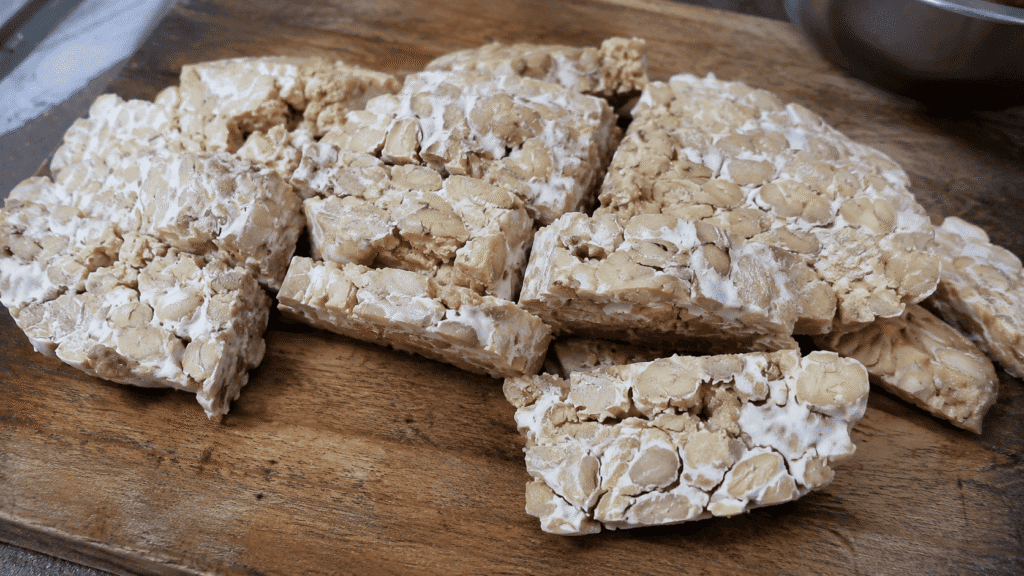
Getting the temperature wrong is the most common way to mess up a tempeh batch. It usually leads to weak mold, a sour smell, slimy beans, or contamination.
If it’s too cold, the fermentation drags on and grows unevenly. If it’s too hot, the mold grows wildly fast and then burns itself out. We’ve dealt with both scenarios, especially when trying to ferment during unpredictable weather swings in our own kitchen.
Here are the signs we look for when a batch is underheated:
- The soybeans refuse to knit together.
- You only see patchy, sparse white fuzz.
- The process takes more than three full days.
- Bean surfaces stay wet or damp.
- The smell is faint, just a weak earthy scent.
And here’s what happens when it overheats:
- A sharp, overwhelming ammonia smell hits you.
- The beans turn soft or mushy in the center.
- Internal temps climb past 37°C (about 98.5°F).
- Yellowish liquid pools at the bottom.
- Black spore patches appear very quickly, sometimes within hours.
A quick note on color: seeing some gray or black spots isn’t an automatic failure. Mature tempeh naturally develops spores. The real red flags are a slimy texture or a genuinely foul odor, not just a strong, nutty smell.
In our experience, one of the simplest fixes for beginners is to make thinner cakes. Thick, dense blocks hold heat like a furnace, which stresses the fermentation and makes everything more fragile. A thinner spread gives heat a chance to dissipate.
Maintaining Proper Tempeh Fermentation Temperature at Home
Most people making tempeh at home get creative with their incubation setup. The usual suspects are an oven with just the light bulb on, a dehydrator, a yogurt maker, or even a basic insulated cooler with a gentle heat source.
We’ve tested a bunch of these small-scale methods ourselves. The gear that gave us the best results wasn’t the priciest. What made the real difference was a combination of steady, gentle heat and decent air circulation, not a ton of digital controls.
If you’re aiming for a stable temperature, here are the practical steps we follow:
- Use a probe thermometer to check the temperature inside the bean mass, not just the air around it.
- Try to keep that internal temperature between 80°F and 90°F.
- Never use a fully sealed, airtight container.
- If you’re using a dehydrator or stacked trays, rotate them halfway through if one spot seems hotter.
- Dial back any external heat source once you see a solid white mat forming (usually after 18-24 hours).
- Always leave space around your tempeh for air to move.
An oven with only the interior light on is a classic trick. In a cooler room, that single bulb can often keep the interior right around the perfect range. If you live somewhere warm, you might find your room temperature is already suitable for most of the process.
We like using dehydrators for this because their built-in fans provide consistent airflow over the beans, which helps manage moisture and heat.
Here’s a breakdown of the common options from our testing:
Best Equipment for Maintaining Tempeh Temperature
| Equipment | Temperature Stability | Best For |
| Yogurt maker | High | Small batches |
| Oven with light | Medium | Beginners |
| Dehydrator | High | Consistent results |
| Cooler with heat source | Medium | Budget setups |
One tip we always give newcomers: don’t pack or stack your tempeh batches too close together. Even in a well-ventilated incubator, trapped heat can build up between them faster than you’d expect and spoil the fermentation.
How Soybean Quality Affects Fermentation Control

Bad beans ruin the batch. We learned that the hard way.
Good soybeans soak up water evenly. After we cook them, they dry out nicely. Old beans are different. They crack in odd places and stay too wet inside, which completely changes the way tempeh soybean prep behaves during fermentation.
That extra moisture is where bad mold likes to grow, sometimes before our good culture can even start working.
We use specific non-GMO beans. Why? Because in our tests, they just work better. They’re handled more gently from the field to our door, so fewer are broken or damaged. Broken beans don’t ferment right.
Our own fermentation room tells the story. With top-quality beans, the white fungal mat grows thick and strong, holding everything together like a blanket. The heat inside the batch builds steadily.
With poorer beans, the growth is patchy and the heat jumps around. That’s when we get nervous.
Here’s what we watch for with every shipment of beans:
- How fresh they are: We check harvest dates. Older beans lose their oomph.
- How they soak: They all need to drink the same amount of water. Uneven soaking causes big problems later.
- How dry they are: Before we add the culture, the beans must feel dry on the outside. A wet surface lets germs in.
- Whole or split: We prepare them differently depending on what we’re making. It changes how they behave.
- How they’re cooked: They need to be tender all the way through, but not mushy.
The whole goal at SoyaMaya is to get the water content just right. If some beans are soggy and others are dry, the temperature goes crazy during fermentation.
One corner gets too hot, another stays too cold, and the batch can fail. We nail the first step so the last step works.
Safe Tips for Consistent Tempeh Fermentation Results
Keeping tempeh safe is about control. We manage three things: acidity, air, and heat. Get those right, and contamination risk drops fast.
For us, food safety isn’t just about the incubation stage. It starts the moment the beans arrive. How clean our tools are, and especially how we manage moisture, are just as critical as watching the thermostat.
Our safe fermentation checklist looks like this:
- Acidify the soak: We keep the soaking water’s pH under 4.6. It creates an environment where bad bugs struggle to grow.
- Dry beans completely: Before the starter spores go on, the bean surface must be dry. Any dampness is an invitation for trouble.
- Sanitize everything: Every container, tray, and tool gets cleaned thoroughly. No shortcuts.
- Watch the core temperature: We check the internal temperature of the batch often. It tells us how the fermentation is progressing.
- Prevent overheating: We never let the temperature climb above 98°F (37°C). Too much heat kills the culture and encourages bacteria.
- Cool it down fast: Once fermentation is complete, the tempeh goes straight into the refrigerator to stop the process.
- Allow air to move: The culture needs oxygen. We make sure air can circulate around the beans during the entire incubation.
We’ve also learned not to overstuff the fermentation bags. Packing beans too tightly traps humidity and creates isolated hot spots. Thin, even layers ferment more consistently and safely from edge to center.
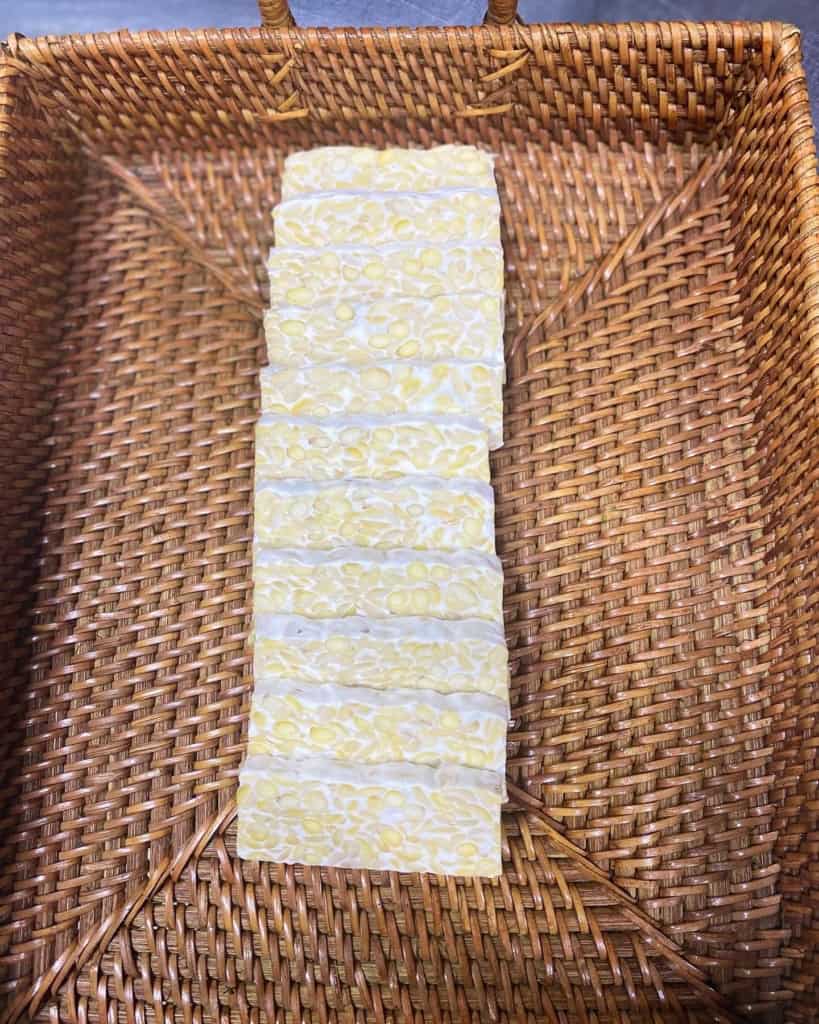
You can see and smell the difference. Healthy tempeh forms a solid, white cake that smells clean and nutty, like fresh mushrooms, which is usually one of the clearest signs of high quality tempeh during a stable fermentation cycle.
If we ever catch a strong, rotten odor or see a slimy surface, we know it’s likely bacterial contamination. That batch doesn’t get packaged.
FAQ
What Happens if Tempeh Fermentation Temperature Gets Too High?
When tempeh fermentation temperature rises above 35°C, the fermentation can become unstable and unsafe. Excess heat often causes ammonia smells, wet soybeans, and uneven white mold tempeh growth.
The ideal tempeh fermentation temp supports healthy Rhizopus oligosporus temperature requirements without overheating the beans. Proper airflow, loose packaging, and consistent tempeh temperature control help maintain safe fermentation conditions throughout the entire fermentation process.
Can You Ferment Tempeh Without a Special Incubator?
Yes, you can ferment tempeh at home without buying expensive equipment. Many people use simple DIY tempeh fermentation setups such as an oven with the light on, an insulated container, or a tempeh heating mat.
The best temperature for tempeh usually stays between 30°C and 32°C. Stable warmth, good airflow, and dry soybean surfaces help homemade tempeh fermentation develop evenly and successfully.
Why Does Tempeh Sometimes Ferment Too Slowly?
Tempeh fermentation often slows down when the environment becomes too cold. Temperatures below the ideal tempeh fermenting temperature range reduce tempeh mycelium growth and delay mold formation.
Weak tempeh starter spores, excess moisture, and poor airflow can also affect the tempeh fermentation duration. A thermometer helps maintain accurate tempeh fermentation Celsius or Fahrenheit readings and improves fermentation consistency during homemade tempeh fermentation.
Does Humidity Affect Tempeh Mold Growth?
Yes, humidity plays an important role in tempeh mold growth conditions. Excess moisture can trap heat, increase condensation, and block airflow around the soybeans. Very dry conditions can slow down white mold tempeh development and weaken fermentation activity.
Proper tempeh fermentation conditions require balanced humidity, stable warmth, and steady airflow. Small ventilation holes in the packaging help support healthy mold growth during incubation.
What Equipment Helps Maintain Stable Tempeh Fermentation Conditions?
Several types of tempeh fermentation equipment can help maintain stable fermentation temperatures at home. A tempeh fermentation chamber, dehydrator, or insulated box can provide reliable warmth during incubation.
Many beginners also use a tempeh fermentation thermometer and heat mat to improve temperature control. These tools help maintain safe tempeh fermentation conditions and reduce common fermentation problems caused by changing room temperatures.
Consistent Heat Makes Tempeh Fermentation Easier
When fermentation temperatures constantly change, tempeh can become soft, slow to grow, or uneven even with good starter culture. Keeping the environment near 86°F helps Rhizopus oligosporus develop firm texture, steady white mycelium, and cleaner fermentation results.
SoyaMaya supports that process with practical fermentation supplies designed for stable temperature control and more reliable homemade tempeh batches without unnecessary trial and error.
References
- https://pubmed.ncbi.nlm.nih.gov/11849362/
- https://www.sciencedirect.com/science/article/abs/pii/0168160587900043
Related Articles
- https://mayasaritempeh.com/how-does-tempeh-fermentation-work/
- https://mayasaritempeh.com/understanding-tempeh-soybean-prep/
- https://mayasaritempeh.com/what-makes-tempeh-high-quality/
Soya Maya Fresh Tempeh
Traditionally fermented, no preservatives, shipped fresh and frozen to your door. The real deal, direct from us.
