
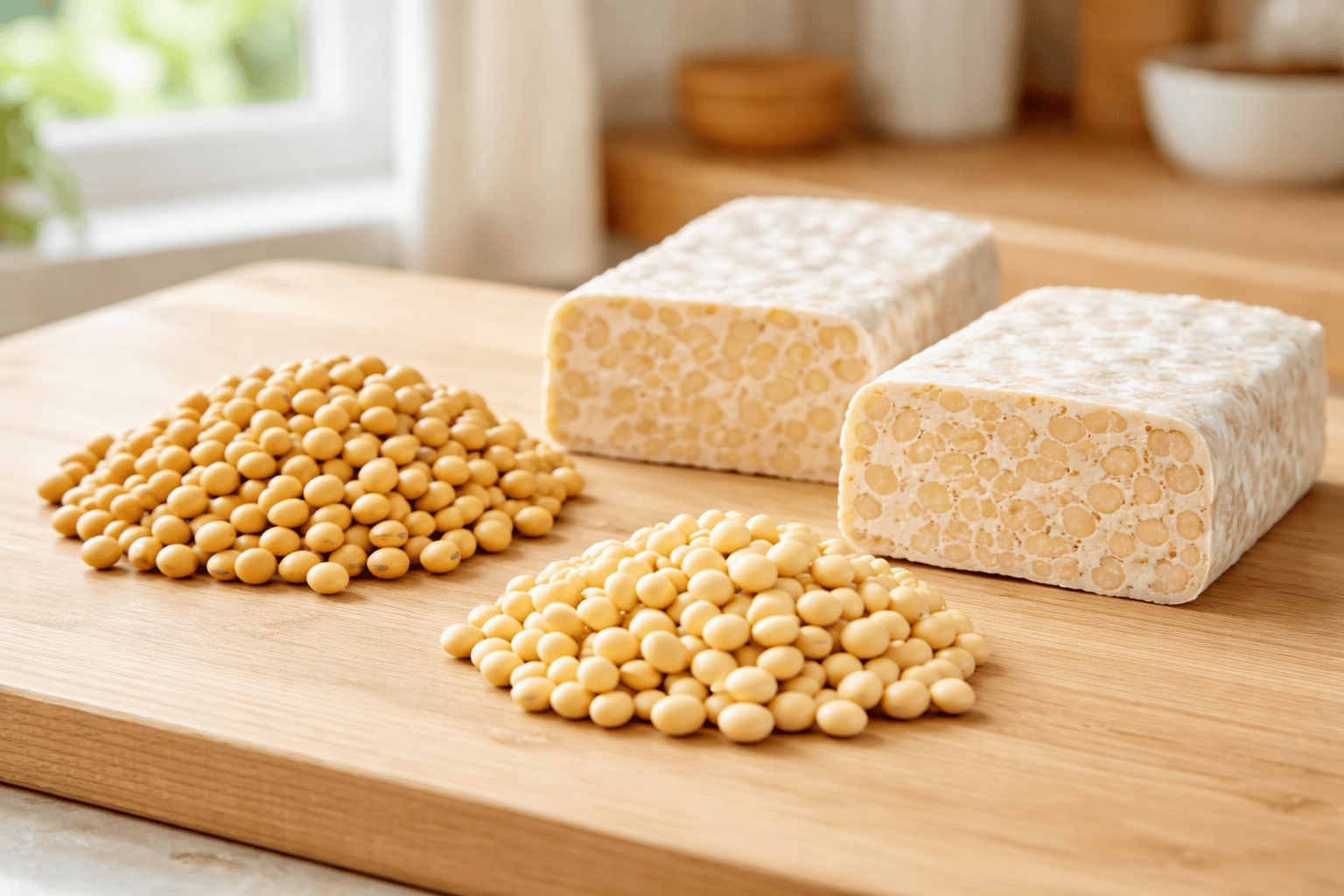
Forget the whole beans. If you want tempeh that slices clean and holds up in the pan, you need to start with dehulled soybeans. We learned this the hard way after too many batches fell apart.
Those thin skins stop the mold from binding the beans together properly. Without them, the mycelium can weave through everything, creating that firm, solid block you’re aiming for.
It’s not a suggestion; it’s the rule for good texture. The difference is night and day. Stick with us to get the full breakdown on why this step isn’t something you can skip.
SoyaMaya Fresh Tempeh is made the traditional way — no preservatives, no shortcuts. Delivered to your door.
Order Fresh Tempeh →Quick Wins: Why Dehulled Soybeans Make Better Tempeh
- Taking the hulls off lets the mold bind the beans completely, giving you a firm, compact cake.
- You get a more even and reliable ferment this way, with fewer failed spots or gaps.
- This is how it’s always been done for traditional tempeh, and it’s what every serious producer does.
Are Dehulled Soybeans Better for Fermentation Quality?
Dehulled beans let the Rhizopus oligosporus mold get deep inside, making a denser, whiter block with fewer problems than whole beans.
The soybean hull reduces surface-to-surface contact between cotyledons, limiting mycelial cross-linking. We’ve tested this ourselves.
When we used whole beans, we’d find grayish, unfermented patches where the white mycelium just couldn’t break through. The spores need to reach the bean’s starchy center directly to weave everything together into a solid cake.
With the hulls gone, fermentation is faster and finishes more completely. The mold spreads evenly, building that classic solid white block. This is the reason traditional producers always dehull, it’s about control, not just tradition.
For producers focused on consistent results, this step matters even more. When fermentation conditions and soybean preparation are controlled carefully, the result is a dense block of fresh tempeh with strong mycelial binding and a clean, uniform structure.
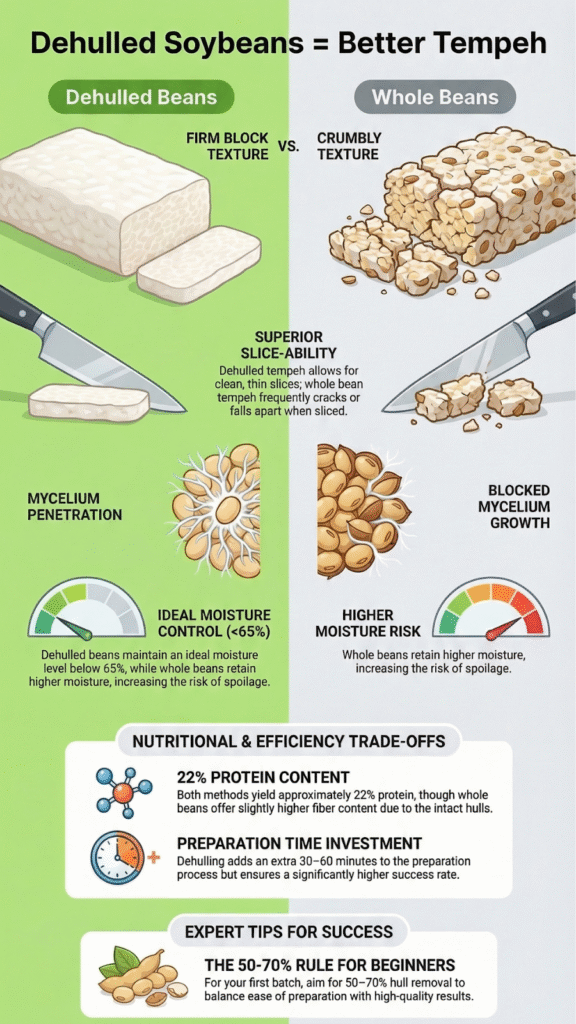
Studies show that dehulled beans achieve a moisture level ideal for mycelium density, typically staying below the 65% threshold required for a firm, safe ferment. That lower number means a tighter, better-bound product.
- Hulls block the mycelium, leading to a crumbly texture.
- Faster, more even colonization means consistent results every time.
- It’s the traditional method because it works for uniform quality.
How Does Texture Differ Between Dehulled and Whole Soybeans?
Dehulled beans make firmer, sliceable tempeh. Whole beans give you a softer, more crumbly block because the hull fiber and extra moisture get in the way.
“Reduction of residue during filtration is effected by dehulling the beans prior to soaking. This modification also permits the grinding of the beans so that the whole endosperm could be made into milk without necessarily affecting the flavor.” – Studies on soybean milk processing. | HERDIN
This is where the choice really matters for cooking. Tempeh from dehulled beans is sturdy. You can get thin, clean slices for a sandwich or neat cubes for a stir-fry, and they hold together.
Whole-bean tempeh behaves differently. The beans stay more intact and the final cake is softer and slightly looser, which is typical in tempeh made from whole soybeans where the skins remain attached during fermentation.
Whole-bean tempeh is softer, almost mealy. It breaks apart easily, which works if you’re crumbling it into a salad but falls short if you want a crisp, pan-fried piece.
The data shows why it feels different. Here’s a simple breakdown:
| Aspect | Dehulled Soybeans | Whole Soybeans |
| Texture | Firm, compact | Softer, crumbly |
| Slice-ability | Clean, thin cuts | Breaks/cracks easily |
| Moisture | Ideal (<65%) | Often higher/trapped |
| Mouthfeel | Rich and dense | Grainy or “mealy” |
That higher fat in dehulled tempeh adds to a richer feel. The firm texture isn’t just nice to have; it’s what lets tempeh work as a meat substitute.
It can handle marinating, frying, and grilling without coming apart. In our own kitchen, we rely on that consistency, so texture is the first thing we think about.
Do Dehulled Soybeans Offer Better Nutritional Value?
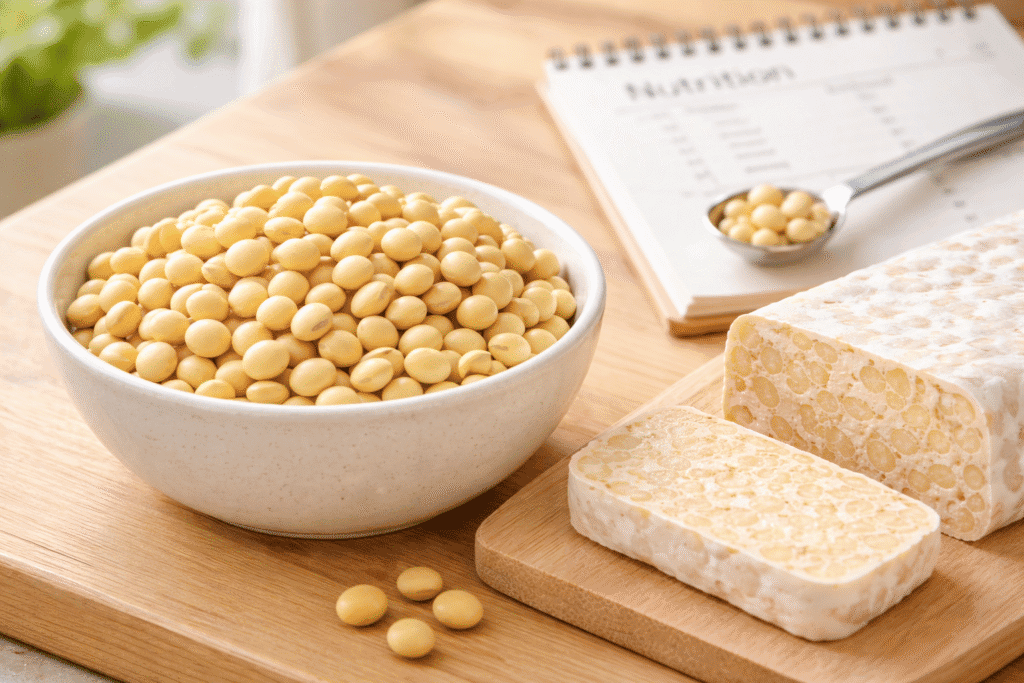
Nutritionally, they’re almost the same. The protein and isoflavone levels are comparable, but dehulled beans have a bit more fat and less moisture, while whole beans keep a little more fiber.
Insights from Wikipedia indicate
“Soy protein isolate. is made from defatted soy flour which has had most of the nonprotein components [hulls] removed. Because of this, it has a neutral flavor and will cause less flatulence than soy flours. Soy isolates are mainly used to improve the texture of meat products.” – Wikipedia
If you’re here for the protein, both are great. The protein content is nearly identical, sitting between 21.78% and 22.18% no matter what you do with the hulls.
The soy isoflavones, which are tied to a lot of the health benefits, aren’t really changed by taking the hulls off either.
The real trade-off is fiber. The hull is mostly insoluble fiber, so you lose a small amount of that when you remove it. For the common yellow soybeans we use, that extra fiber isn’t a huge amount. All the main nutrients are in the bean itself.
- Protein range: The protein content remains high in both versions, generally ranging between 18% and 22%, making tempeh a powerhouse of plant protein regardless of hulls.
- Isoflavone levels stay about the same.
- Whole beans give you slightly more insoluble fiber.
For us, it’s an easy call. Losing that tiny bit of fiber is worth it for the huge improvement in texture and how well it ferments.
You’re still getting an incredibly nutrient-dense food, full of plant protein and probiotics. The real nutritional power isn’t in the hull.
Is Dehulling Worth The Extra Time and Cost?
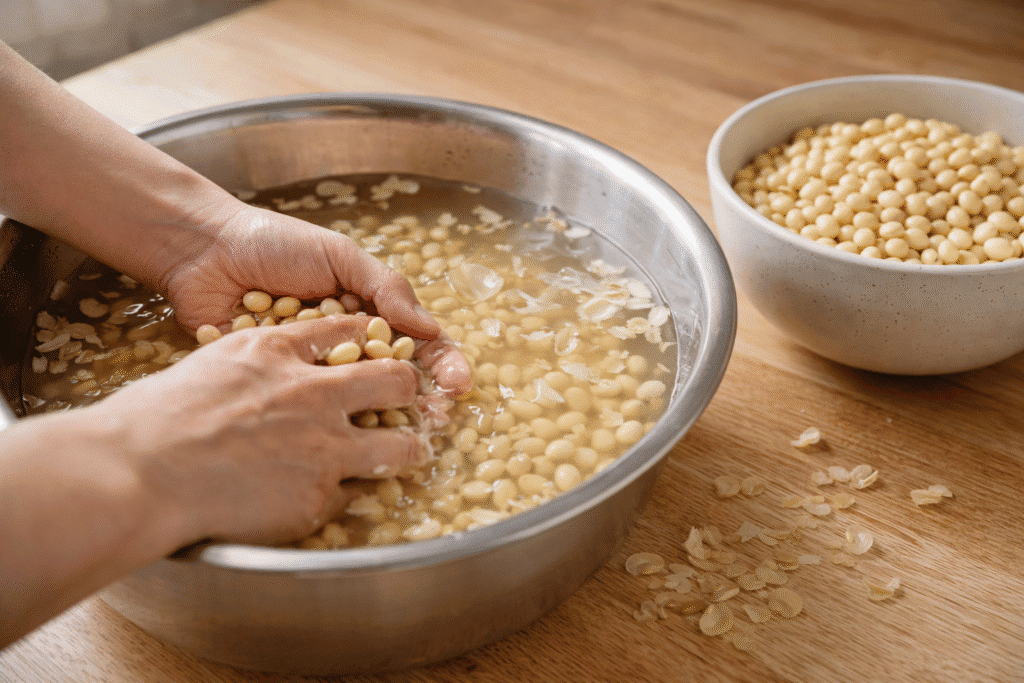
For tempeh that meets a professional standard, the answer is yes. It makes the results more uniform and cuts down on failed batches, but it does add 30 to 60 minutes of work per batch if you don’t have a machine to help.
This is the main practical challenge. Doing it by hand is a process: soak the beans, rub them hard to loosen the skins, then rinse the hulls away.
It’s repetitive and adds a lot of time to your prep. If you’re just making a single batch at home, it can feel like a real chore.
Another question people often explore during this step is whole vs split soybeans tempeh preparation. Splitting or removing hulls increases surface contact between the beans, which helps the Rhizopus mold bind everything into a tighter, more compact cake.
You can use equipment to speed it up. For a home cook, that means you’re planning to make a lot of tempeh. A lot of people starting out try to skip it, using whole beans and boiling them longer to split the hulls.
That can work sometimes, but it’s not as dependable. What you’re paying for is consistency. That extra time or money buys you predictability. Your ferment is much less likely to go wrong.
You won’t open your incubator to find a patchy, crumbly block. For us, making tempeh for others, that reliability isn’t just nice to have. It’s everything. We build that cost into our process so every single block we make meets the same standard.
Should Beginners Use Dehulled or Whole Soybeans?
We think beginners should try to remove at least some of the hulls for more consistent results. Whole beans can work if the hulls split while cooking, but it’s harder to control.
If you’re new to this, we’d suggest aiming to take off 50–70% of the hulls. It’s a good middle ground between the work involved and what you get out of it.
It makes a big difference in getting a solid, firm block compared to using all whole beans. Getting a good result on your first few tries is encouraging, and it shows you what successful tempeh is supposed to be like.
If you want to understand what is the difference in texture between tempeh made with different soybean preparations, the way the mold binds the beans during fermentation is usually the key factor.
We understand the appeal of whole beans, they’re cheaper and faster to prepare. And if you’re very careful with your boiling and incubation, you can make something decent. But “decent” often means a softer block that falls apart.
If you want firm tempeh you can slice and fry, which is what most recipes call for, then starting with hulled beans gives you a much better shot.
Look at it like learning on the right equipment. You’ll see the signs of fermentation more clearly because the mold will grow evenly. You’ll build confidence in the process.
Once you’ve got it down with hulled beans, you can always try whole beans later if you want. But for that important first batch, set yourself up right by giving the mold a clean surface to work with.
FAQ
Are dehulled soybeans for tempeh really better than whole beans?
Dehulled soybeans for tempeh usually produce a firmer and more compact tempeh cake because soybean hull removal allows white mycelium growth to spread evenly.
During the tempeh fermentation process, the mold binds the beans more tightly without the skins. Whole beans can still work, but they often create a looser texture and less consistent structure.
How does hulled vs unhulled soybeans affect tempeh texture?
When comparing hulled vs unhulled soybeans, the main difference is how the soybean hull impact on texture affects binding. Skins can block mycelium binding soybeans together during the tempeh binding process.
Removing the hulls supports clear tempeh texture improvement and results in a firm tempeh texture with better structure and sliceability.
What is the best soybean preparation for fermentation at home?
Proper soybean preparation for fermentation begins with a thorough soybean washing process and correct soybean soaking time, usually 8 to 12 hours. After soaking, boiling soybeans for tempeh until tender but not mushy is essential.
Many people use split soybeans or peeled soybeans for tempeh to promote even tempeh mold growth during tempeh making at home.
Does soybean hull removal improve white mold growth?
Soybean skin removal benefits include stronger white mycelium growth from Rhizopus oligosporus culture. Hulls can slow tempeh white mold coverage because they create a barrier between the beans and the tempeh starter culture.
Removing the skins supports a clean fermentation process and improves overall soy fermentation quality and binding strength.
Which soybeans are best for fermentation and firm tempeh?
The best soybeans for tempeh are yellow soybeans for tempeh with high protein soybeans characteristics and consistent soybean quality for tempeh. Choose non GMO soybeans, organic soybeans for tempeh, and food grade soybeans with uniform size. Fresh Glycine max varieties with high soy protein content help create a firm tempeh texture and reliable fermentation.
The Bottom Line on Better Tempeh
You can taste when tempeh starts with the wrong bean. The texture feels weak, the flavor falls flat, and the block falls apart in the pan. Great tempeh begins with fresh, high-protein soybeans grown and handled with care. At SoyaMaya, we use trusted Indiana beans to craft firm, satisfying Fresh Frozen Tempeh that cooks beautifully and tastes right every time. Ready to taste the difference? Shop SoyaMaya
References
- https://www.herdin.ph/index.php?view=research&cid=11305
- https://en.wikipedia.org/wiki/Soy_protein
Related Articles
- https://mayasaritempeh.com/fresh-tempeh/
- https://mayasaritempeh.com/whole-vs-split-soybeans-tempeh/
- https://mayasaritempeh.com/tempeh-made-from-whole-soybeans
SoyaMaya Fresh Tempeh
Traditionally fermented, no preservatives, shipped fresh and frozen to your door. The real deal, direct from us.
