
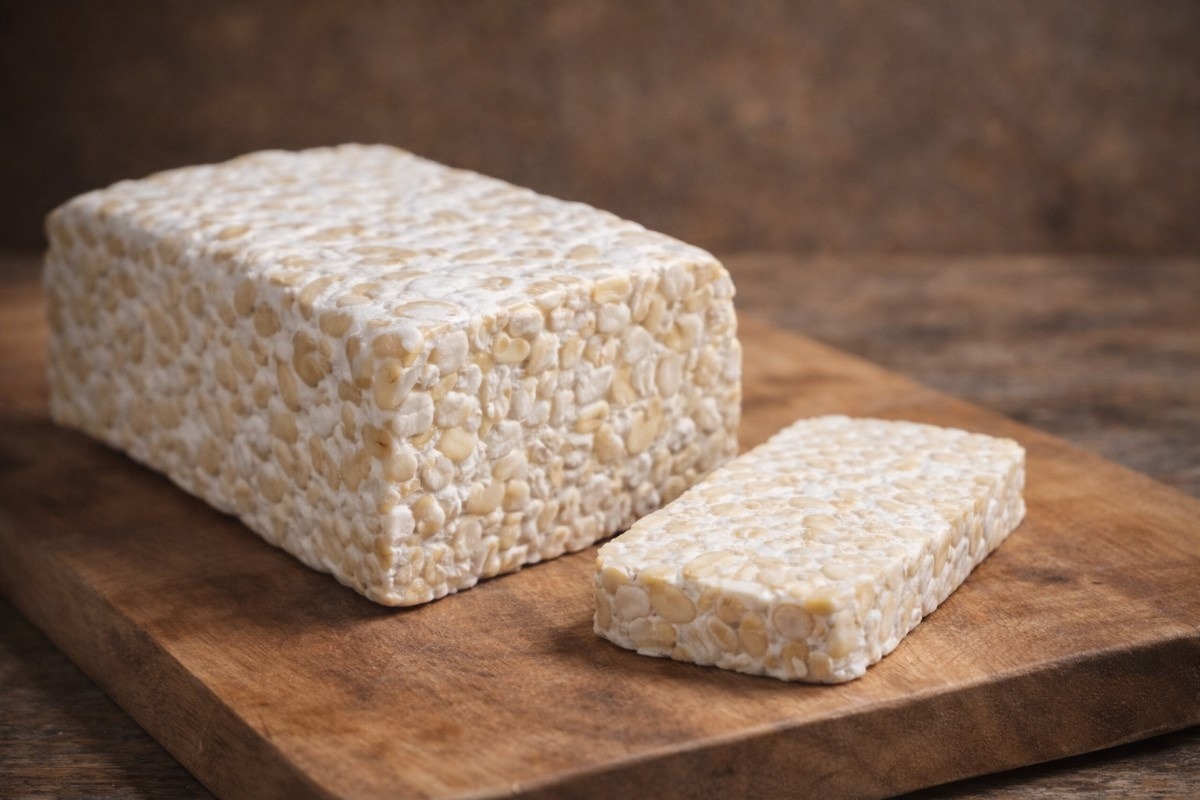
You can feel the difference before you even take a bite. Fresh tempeh has this solid, compact feel to it, a whole cake of soybeans bound tight by a white, cottony mold. It’s dense, but it gives a little when you press on it, a good kind of resistance. That’s the mycelium doing its job, knitting everything together into one firm block.
That structure is the whole point. It’s why a good slab of tempeh won’t crumble in the pan. It holds up, giving you something substantial to sink your teeth into, a real chew that makes it stand in for meat. Want to know what makes that perfect texture, and how to pick it out every time? Stick around, we’re getting into that next.
Key Takeaways
- The ideal texture is a firm, cohesive block held together by dense, white mycelium.
- A clean, nutty smell and dry surface signal quality, while sliminess or an ammonia scent means spoilage.
- This sturdy structure is what makes tempeh so versatile for slicing, marinating, and high-heat cooking.
The Feel of Authentic Fermentation
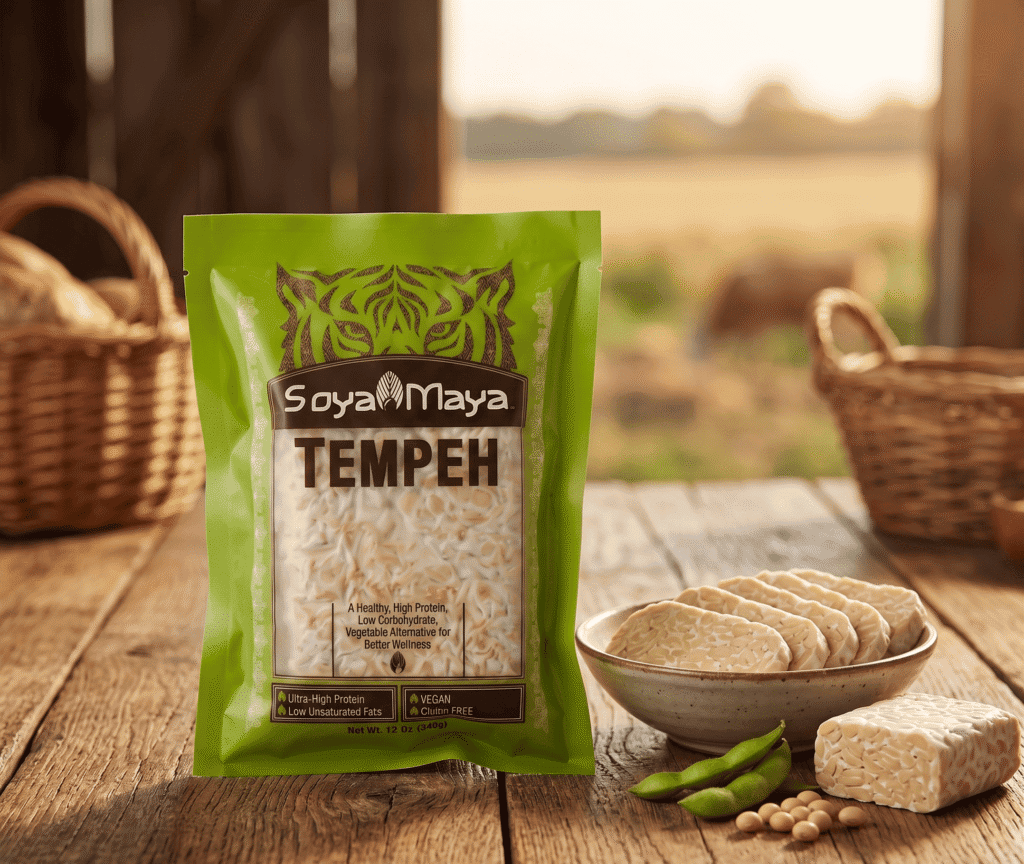
I remember the first time I cut into a block of our own SoyaMaya tempeh. The knife met a firm but giving resistance, it didn’t mush or crumble. The slice came away clean, showing a tight network of beans bound by that creamy-white mycelium.
SoyaMaya Fresh Tempeh is made the traditional way — no preservatives, no shortcuts. Delivered to your door.
Order Fresh Tempeh →That moment, for us, was a quiet confirmation. The texture told the whole story of a careful, traditional fermentation process done right. It’s a tactile quality you come to recognize, a certain heft in the hand that promises a chewy, substantial bite.
This firmness isn’t an accident. It’s the direct result of the Rhizopus mold doing its work over 24 to 48 hours in a warm, humid environment. The mold’s filaments, the mycelium, grow through and around each individual soybean.
They act like a living net, stitching the beans into a unified, solid cake. If the conditions are off, if there’s too much moisture or not enough acidity, that net won’t form properly.
This deep care reflects what is artisanal tempeh, a blend of tradition and precision that results in that perfect firmness and flavor.
You’ll get a crumbly, loose block where the beans don’t hold together. A firm texture means every step, from cooking the beans to incubating the cake, was balanced.
How Fermentation Builds a Solid Structure
So how does a vat of soft, cooked soybeans transform into something so sturdy? It’s a quiet biological process.
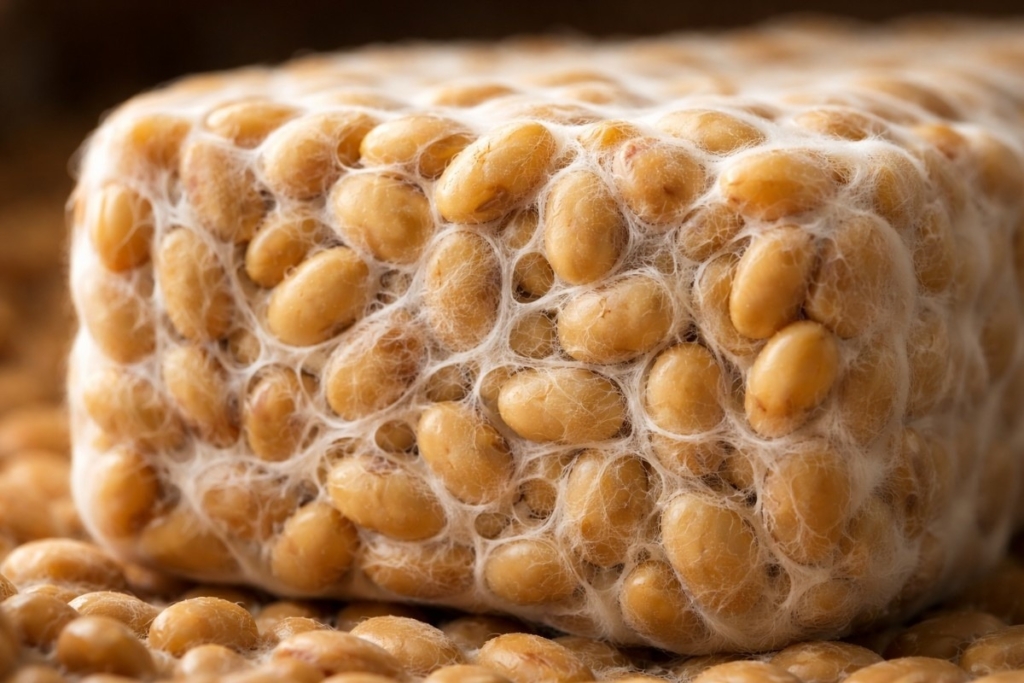
After the beans are cooked and cooled, they’re inoculated with Rhizopus oligosporus spores. Then they’re left to rest. In that warmth, around 86°F or 30°C, the spores wake up and begin to grow.
Thin, white filaments push out from each spore. They reach through the spaces between beans, they wrap around them, they penetrate their skins.
This growth isn’t random. The mycelium seeks out the beans, binding them with a natural, organic glue. It creates a tight soybean structure.
The entire mass becomes one interconnected piece, a compact tempeh block. We check on our batches regularly, you learn to look for that even, velvety white coating.
It should look uniform, like a soft blanket pulled taut over the beans. That’s the visual sign of the dense soybean structure forming underneath. No bald spots, no loose beans rattling around. Just a solid, fresh tempeh consistency.
- The mycelium binds beans at a microscopic level.
- Proper temperature and humidity are non-negotiable.
- The cake becomes firmer as fermentation completes.
You can’t rush it. Giving the culture the full time it needs is what ensures that tight soybean binding. When we pull a finished cake from its incubator, it has a certain rigidity.
You can pick it up by one corner and it holds together, it doesn’t sag or break. That’s the solid fermented soy texture we aim for every time.
It’s a texture that speaks of patience, of allowing a natural process to reach its full potential. This is the foundation for everything that comes next, from slicing to searing.
Spotting Quality: The Look and Feel of Good Tempeh
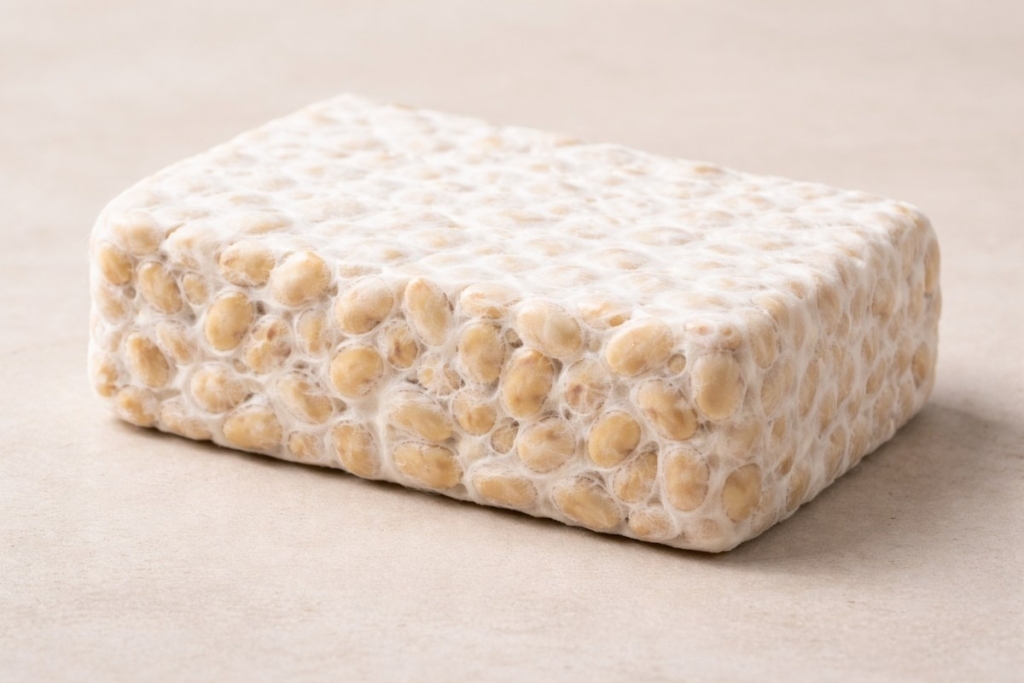
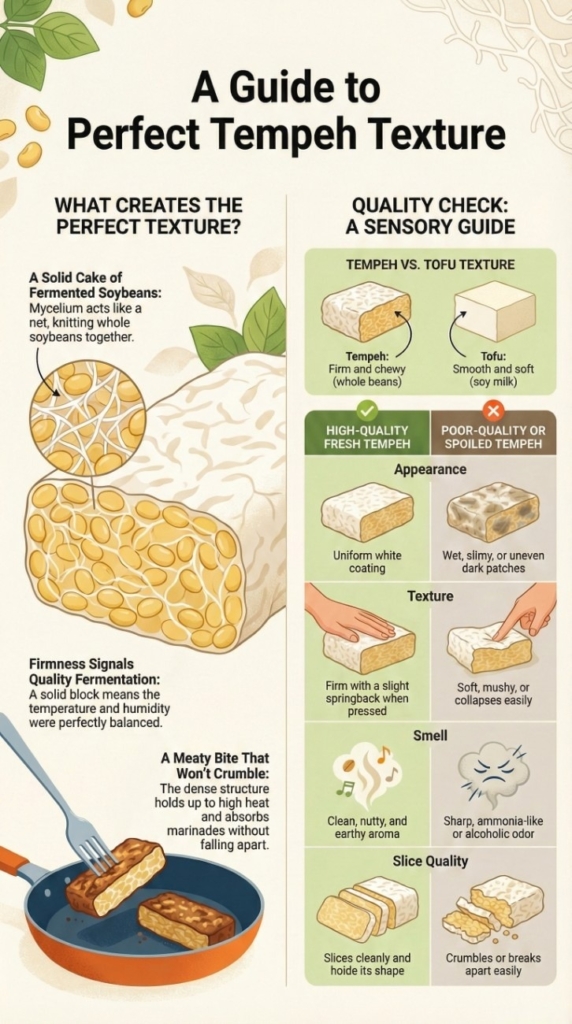
Knowing what to look for saves you from a disappointing meal. High-quality fresh tempeh has a very specific feel. First, its surface should be mostly white, covered in that fuzz.
A few gray or black specks are normal, they’re just spores, and they don’t affect the taste or safety if the block is still firm. The real test is in your hands. It should feel dry to the touch, not wet or slippery. It will have a slight give when you press it, a bit of springback, but it shouldn’t feel soft or mushy.
This is why understanding what makes tempeh high quality is essential, you learn to recognize freshness, firmness, and that balanced texture that promises great cooking performance.
Then there’s the smell. Good tempeh has a clean, nutty, almost mushroom-like aroma. It’s earthy and pleasant.
If you catch a whiff of something sharp, like ammonia or alcohol, that’s a red flag. It means the fermentation has gone too far, the proteins are breaking down, and the texture will likely be off.
The structure might be breaking down inside, even if it looks okay from the outside. Trust your nose, it’s a powerful tool.
- Visual: Uniform white coating, intact edges.
- Tactile: Dry surface, firm but not rock-hard.
- Olfactory: Clean, nutty, earthy smell.
A spoiled block tells a different story. It might look wet or slimy. It could have large dark patches that aren’t just specks.
When you press it, your finger might sink in too easily, or it might feel unpleasantly damp. Sometimes it even falls apart without much pressure.
This spongy yet firm texture we want is a balance. Spoilage tips it all the way to spongy and weak. We’ve had to learn these signs ourselves, through trial and error in our own kitchen.
It’s how we ensure that every block we sell, from our Fresh Frozen 10oz bags to our wholesale packs, meets that standard of fresh fermented texture.
| Indicator | High-Quality Fresh Tempeh | Poor-Quality or Spoiled Tempeh |
| Surface Appearance | Uniform white mycelium coating | Wet, slimy, or uneven patches |
| Texture When Pressed | Firm with slight springback | Soft, mushy, or collapsing |
| Bean Structure | Well-bound, intact soybeans | Loose or falling apart |
| Smell | Clean, nutty, earthy aroma | Sharp, ammonia-like odor |
| Slice Quality | Clean-cut, holds shape | Crumbles or breaks apart |
Why Tempeh’s Bite Beats Tofu’s Softness
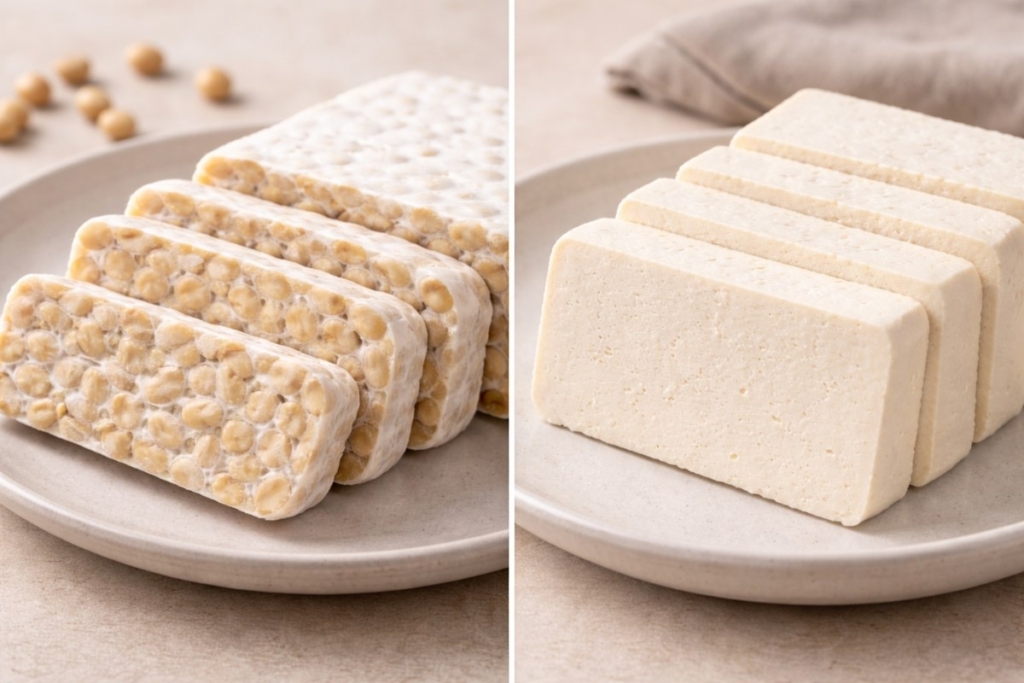
People often group tempeh and tofu together. They’re both from soybeans, right? But their textures are worlds apart, and it comes down to how they’re made.
Tofu is like cheese made from soy milk. It’s curdled and pressed, resulting in a smooth, homogenous, and often soft or silky block. It can be delicate. Tempeh, on the other hand, uses the whole bean.
“ The prepared soybeans are thoroughly mixed with the starter, wrapped in banana leaves and left to ferment for one to two days. Mould growth is vigorous and the whole mass is soon covered and bound together by Rhizopus mycelium.” Zeki Berk, Technion, Israel Institute of Technology
This whole-bean approach means tempeh has much less water. Tofu is mostly water, which is why it presses so well. Tempeh is beans and mycelium, a dense plant-based protein texture. That density translates directly to the plate.
When you bite into a well-cooked piece of tempeh, you get a chewy, meaty experience. It has a heartiness that tofu lacks, a substantial mouthfeel that makes it a standout center-of-the-plate option. It’s that resilient tempeh structure at work.
It holds marinades differently, too. The firm texture acts like a sponge, but a sturdy one. It absorbs flavors deeply without disintegrating. You can marinate it for hours, then throw it on a hot grill or into a screaming hot pan.
The outside gets beautifully crispy and caramelized, while the inside stays tender and moist. Try that with a soft tofu, and you’ll have a scramble, not a slice. This non-crumbly tempeh quality is why it works in stir-fries, sandwiches, and even crumbled as a taco filling. It’s versatile because it’s tough.
Keeping That Perfect Texture Fresh at Home
You’ve found a perfect block of tempeh. Now, how do you keep it that way? Fresh tempeh is a living food. The fermentation is halted by cooling, but it’s not completely dead. To maintain that ideal firmness, you need to slow that activity way down. We always recommend refrigerating it right away.
At SoyaMaya, we freeze ours immediately after fermentation to lock in that fresh-made texture at its peak. For you at home, the fridge is your best friend.
Don’t seal it tightly in plastic while it’s fresh. That traps moisture and can encourage unwanted bacteria, leading to spoilage and a mushy texture. A breathable wrap, like parchment paper or a loosely sealed container, is better.
This attention from seed to package captures the spirit of finding authentic Indonesian tempeh, ensuring every bite feels as fresh and satisfying as tradition intends.
It allows just enough air flow without drying it out completely. If you won’t use it within a few days, freezing is the absolute best method. It pauses everything. Our Fresh Frozen Tempeh is packaged specifically for this, to give you that just-made quality whenever you’re ready.
Think about where you store it, too. The back of the fridge is colder and more stable than the door. You’re aiming for a consistent temperature below 40°F. This balanced moisture content is key. Too dry and it might become too hard, too wet and it risks spoilage.
If you see a few more black spores developing in the fridge, don’t panic. It’s just the tempeh continuing to mature very slowly. As long as the block is still firm, smells nutty, and isn’t slimy, it’s perfectly good to eat. That’s the natural fermentation structure doing its thing, even in the cold.
The Benefit of a Firm Foundation
That solid feel in your hand, the clean slice under your knife, the satisfying chew in your mouth, it all starts with the texture of fresh tempeh. It’s the physical proof of a careful, traditional process.
It’s what transforms a humble soybean into a protein that can stand up to bold flavors and high heat. For us at SoyaMaya, crafting that perfect, compact fermented cake isn’t just a step in a recipe, it’s the whole goal. It’s what makes tempeh, tempeh.
“The proteolytic activity of Rhizopus oligosporus during fermentation leads to the significant release of bioactive peptides, which are found in higher concentrations in tempeh compared to unfermented soy.” – Bozhanov et al., International Journal of Molecular Sciences
When you understand what to look for, you can choose a product that will perform, every single time. You can seek out that sturdy tempeh feel with confidence.
We believe that starting with a well-made block changes everything in your kitchen. It’s the difference between a good meal and a great one. So, find a source that prioritizes that fresh, firm texture.
See how that dense, protein-packed structure holds your marinades and gets crispy at the edges. Experience versatility for yourself. If you’re ready to cook with tempeh that’s crafted for that perfect texture from the very first step, you know where to find us.
FAQ
How should the texture of fresh tempeh feel when you handle it?
The texture of fresh tempeh should feel firm but not hard when held. A well-set tempeh block has natural soybean firmness, balanced moisture content, and a dry but moist tempeh surface.
When pressed, it resists slightly and springs back. This reaction shows a properly fermented texture that is solid, cohesive, and not mushy or brittle.
Why does fresh tempeh sometimes feel spongy yet still firm?
Fresh tempeh can feel spongy yet firm because cohesive mycelium growth binds the soybeans tightly together. The dense soybean structure holds small air pockets while maintaining tight soybean binding.
This creates an elastic tempeh texture that compresses under pressure but keeps its shape, indicating uniform fermentation rather than excess moisture or poor structure.
What makes fresh tempeh slices cut cleanly instead of crumbling?
Clean-cut tempeh slices come from a compact tempeh block with well-bound soybeans and intact soybean kernels.
A solid fermented soy texture forms when mycelium creates a cohesive soy matrix throughout the cake. This non-crumbly tempeh structure keeps grains connected, allowing smooth slicing without loose beans breaking apart.
How does moisture affect the texture of fresh tempeh?
Moisture directly affects fresh tempeh consistency and structure. Excess moisture weakens binding and causes a soft or mushy texture. Insufficient moisture makes the tempeh overly dry and tough.
Proper fermentation creates balanced moisture content, resulting in a smooth fermented soy cake that feels dense, flexible, and clean on the surface.
What visual texture signs show fresh tempeh was fermented properly?
Properly fermented tempeh shows a uniform white mycelium coating with tight mold coverage across the surface.
The compact fermented cake should look even, with no gaps or loose soybeans. A fresh tempeh appearance includes intact tempeh grains, a clean fermented surface, and a high-density structure that signals strong soybean binding.
Why the Texture of Fresh Tempeh Matters Every Time You Cook
A firm tempeh texture is more than a detail; it signals careful, balanced fermentation. Dense, well-bound soybeans form a protein that slices cleanly, cooks beautifully, and delivers a satisfying chew.
When you know how fresh tempeh should look, feel, and smell, you choose with confidence and cook without compromise.
Start with a solid, properly fermented block, and every dish gains better flavor, structure, and reliable performance, every single time in your everyday cooking at home. Ready to experience tempeh crafted with care, culture, and purpose? Shop authentic SoyaMaya products.
References
- https://www.fao.org/4/t0532e/t0532e10.htm
- https://doi.org/10.3390/ijms231810433
Related Article
- https://mayasaritempeh.com/finding-authentic-indonesian-tempeh/
- https://mayasaritempeh.com/what-is-artisanal-tempeh/
- https://mayasaritempeh.com/what-makes-tempeh-high-quality/
SoyaMaya Fresh Tempeh
Traditionally fermented, no preservatives, shipped fresh and frozen to your door. The real deal, direct from us.
