
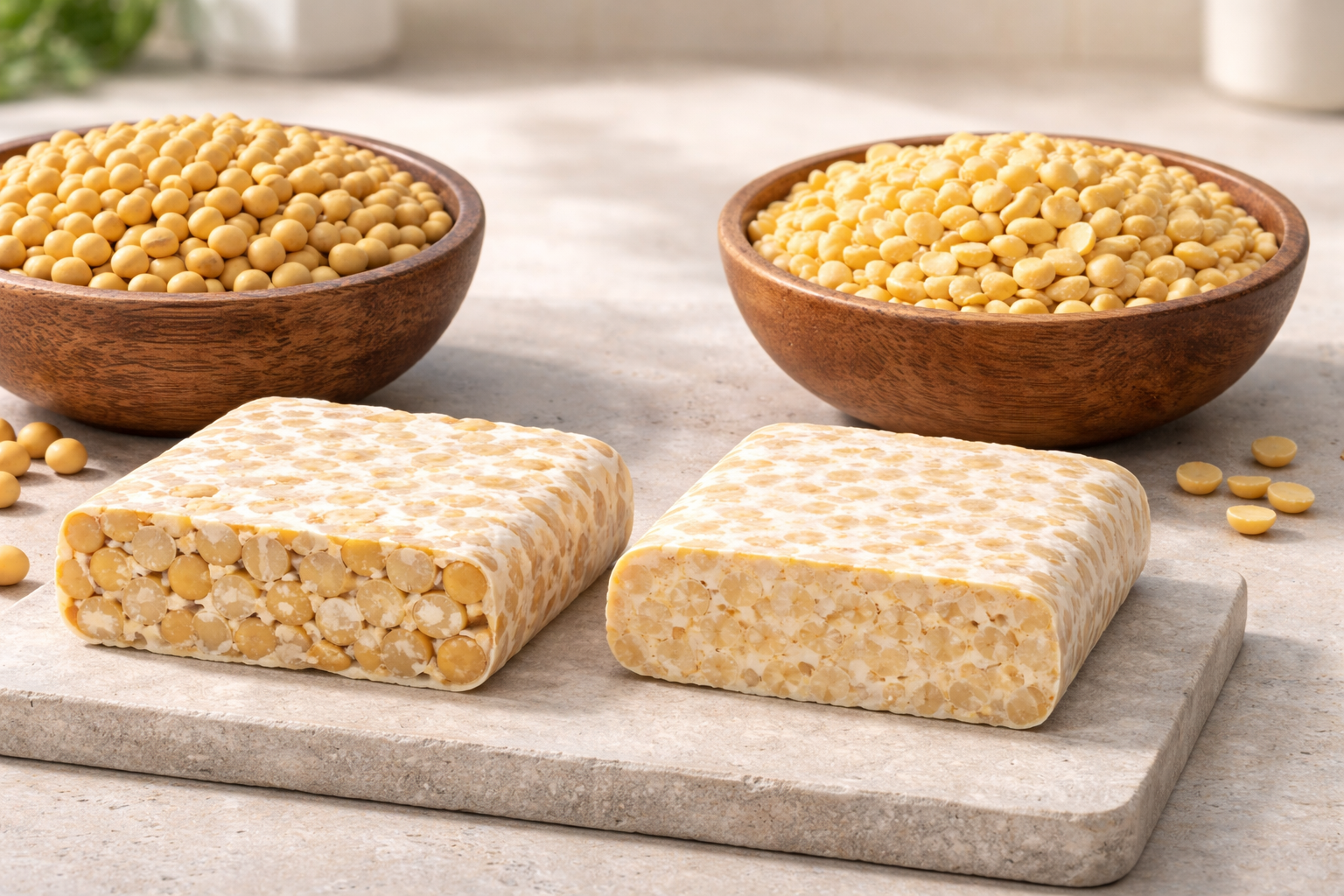
The best tempeh is made from whole soybeans. I know this because we’ve made it both ways. Keep the hulls, but ensure the beans are cracked or split.
It’s not a mistake; it’s the structure. It’s not a mistake. It’s the structure. It creates the firm, substantial chew that makes tempeh tempeh, the kind that holds onto a marinade instead of turning to paste.
Without it, you get a softer, creamier product that lacks that signature texture and a good deal of the fiber.
SoyaMaya Fresh Tempeh is made the traditional way — no preservatives, no shortcuts. Delivered to your door.
Order Fresh Tempeh →In our experience, if you want tempeh with proper bite and full nutrition, start with whole, non-GMO beans. Let’s break down exactly how that little hull does all the heavy lifting.
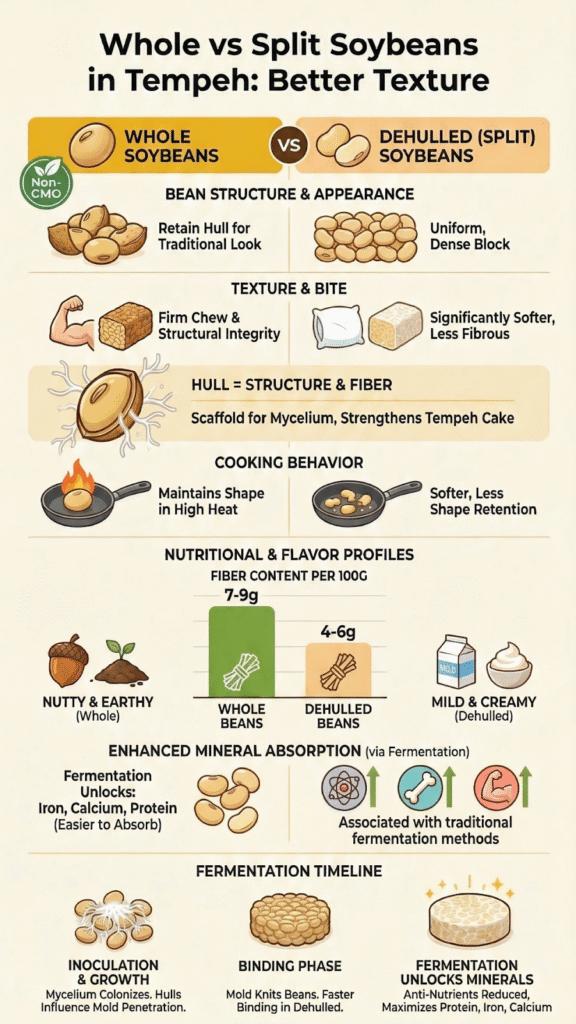
Quick Tempeh Insights: Whole vs Split Soybeans
- Using whole soybeans gives tempeh a firmer, chewier bite. The reason is the hulls. They act like a tiny scaffold for the Rhizopus mold to cling to and grow through, which builds a much stronger structure.
- Those same hulls are loaded with insoluble fiber. This is a big plus for digestive health and helps you feel full longer, something you miss out on with dehulled beans.
- Finally, fermenting the whole bean does more than just preserve it. The process breaks down the beans’ natural defenses, making it easier for your body to absorb the good stuff inside, like the iron, calcium, and protein.
The Hull is the Heart of Tempeh Texture
The difference in texture is everything. Picture the soybean hull as a tiny piece of rebar. As the Rhizopus mold ferments, its white mycelium grows through and around these microscopic supports, weaving them into a solid, cohesive mat.
This is what gives whole-bean tempeh its signature firmness and satisfying, nutty chew, a texture you can clearly notice when working with fresh tempeh made from properly fermented whole beans.
You can slice it thin for a sandwich or cube it for a stew, and it holds together.
“The beans are then drained and dehulled by gently rubbing them between the hands or by running them through a splitter which cracks the beans into halves, loosening the hulls. The split beans provide a larger surface area for the mold mycelium to penetrate.” – Academic Press
Dehulled beans are different. With their smooth, exposed insides, the mold penetrates more easily.
The mycelium binds the soft material, creating a cake that’s undeniably softer, sometimes even creamy in the center. Some folks prefer this, especially for spreads or dishes where a delicate texture is the goal.
But that softness comes at a cost: Dehulled beans create a denser, more uniform cake, but they lack the complex, fibrous bite that whole-bean fans crave.
So it’s not about one being right and the other wrong. It’s about what you’re after. Do you want a sturdy, chewy bite, or something tender and creamy?
| Feature | Whole Soybeans Tempeh | Dehulled Soybeans Tempeh |
| Bean Structure | Beans keep their hulls, creating natural support for mold growth | Beans lose their hulls, exposing the soft interior |
| Texture | Firm, chewy, and structured | Softer, smoother, sometimes crumbly |
| Visual Appearance | Individual beans remain visible in the cake | More uniform and compact interior |
| Mold Growth | Mycelium grows around hulls, creating a strong binding network | Mold penetrates directly into the bean interior |
| Cooking Behavior | Holds shape well when sliced, fried, or grilled | Can break apart more easily during cooking |
The hull’s role goes beyond just how it feels to eat. It shapes the fermentation itself. The hull acts as a protective shield; leaving too many whole, un-cracked beans can stall fermentation and risk spoilage.
This isn’t a bad thing, it can allow for a more complex development of flavors over the full fermentation time. Think of it not as a race, but as a slow, deliberate construction project. The hull provides the blueprint.
Unlocking the Full Nutritional Package
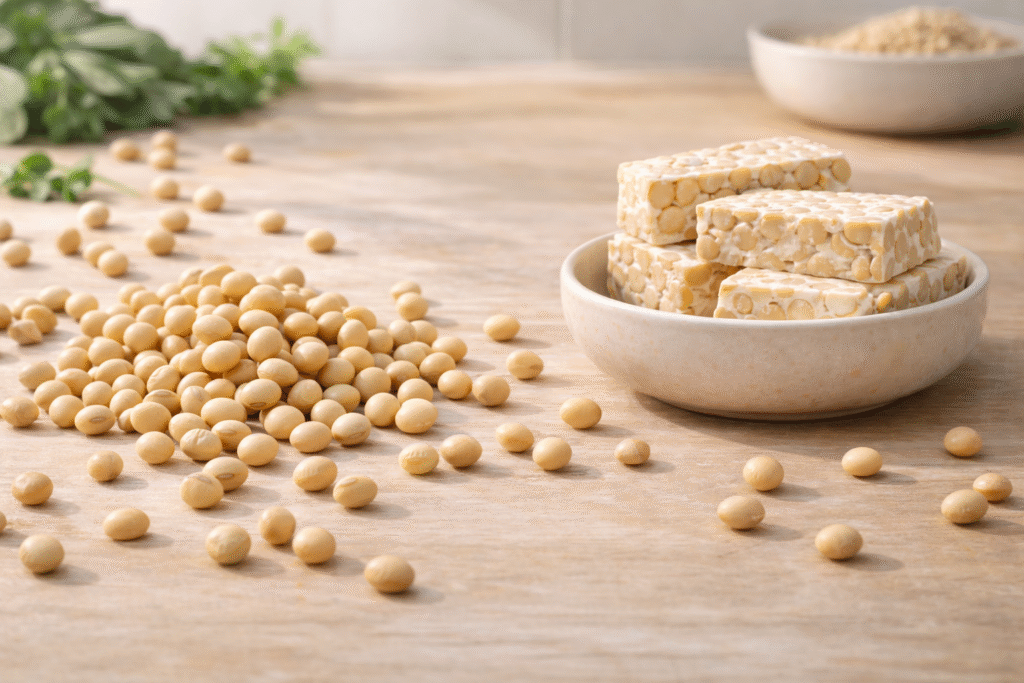
The nutritional benefits of whole soybeans in tempeh are real, and a lot of it comes down to that little hull. We learned this after tracking our own recipes.
When you take it off, you’re throwing away a concentrated source of insoluble fiber. This is the rough stuff that feeds good gut bacteria, helps with digestion, and keeps you feeling full.
In our tests, a 100-gram serving can provide between 7 to 9 grams of dietary fiber depending on the soybean variety. The version made from dehulled beans usually came up short by 2 or 3 grams.
Research from PMC (PubMed Central) indicates
“Tempeh: A food made from split soybeans, water, and a special bacteria, which is allowed to ferment. The process involves soaking, dehulling, boiling, and incubating soybeans, forming a compact cake bound by mold mycelia during fermentation.” – PMC (PubMed Central)
But the real magic of tempeh isn’t just what’s in it, it’s what gets unlocked. Soybeans have phytic acid, which can latch onto minerals like iron and zinc and stop your body from using them. Fermentation fixes this.
The Rhizopus mold makes enzymes that break the phytic acid down. So, the great mineral content already in the bean, like its iron (about 2.7mg per 100g) and calcium, becomes easier for your body to absorb.
You simply get more from the same bean. The fermentation also pre-digests the soy proteins and complex carbs. This is why we’ve found tempeh sits so much better in the stomach than plain cooked soybeans.
The mold’s work creates new things, too, including B-vitamins and different antioxidants. The complete protein profile, which is already strong in soy, stays the same.
What you end up with is a food that’s packed with nutrients but doesn’t upset your digestion. It’s a powerful combo for a plant-based protein.
A Deeper, More Complex Flavor Profile
How whole soybeans change the flavor is a lesson in subtlety, something explored further in how whole soybeans affect flavor where the relationship between hulls and fermentation compounds becomes clearer.
The hull itself has compounds that add a nuttier, earthier base note. During fermentation, those compounds interact with the enzymes and the mold, which rounds out the flavor.
In our batches, this meant a tempeh with more complexity. You get the core umami from the broken-down proteins, a mild tang from the acids, and that underlying, toasted-nut quality from the hull.
Tempeh from dehulled beans is usually milder. Some might call it cleaner. The flavor is more directly from the bean’s sweet, creamy interior, with the tang of fermentation right up front.
It misses that earthy backbone. This isn’t a flaw; it’s just different. If you need a tempeh that will soak up a powerful sauce or spice without adding its own strong notes, the dehulled version works perfectly as a blank canvas.
But if you like tempeh for its own inherent taste, the kind you can just fry in a pan with a little salt and find deeply satisfying, then whole beans give you a fuller experience.
This flavor development is part of the sensory journey. We’ve noticed the nutty taste from whole beans holds up better to cooking methods like frying or grilling, where things caramelize.
It doesn’t fade away; it gets richer. The hulls brown and crisp up, adding another layer of texture and flavor that a soft, dehulled cake just can’t match.
The Case for Whole, Non-GMO Beans
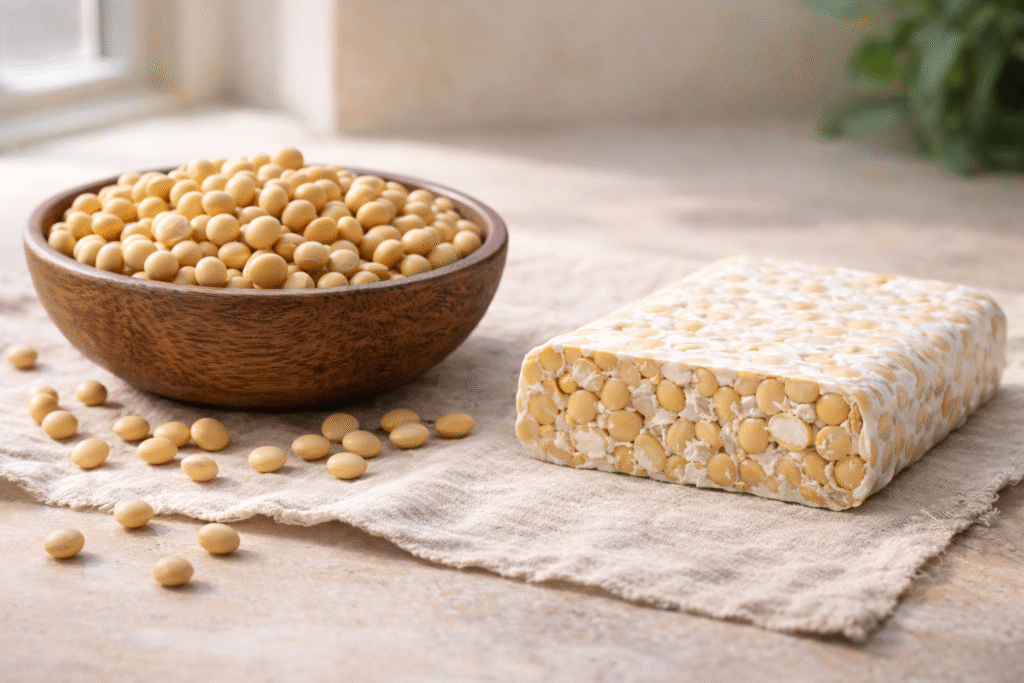
So, why do we use whole, non-GMO soybeans? The “whole” part we’ve already talked about, it’s for the structure, the fiber, and the full flavor. The “non-GMO” part is about purity and intention.
In countries like the United States, more than 90% of soybeans are genetically modified varieties designed for herbicide tolerance.
When we source non-GMO beans, we’re choosing a supply chain that, by its nature, usually involves more sustainable farming. Those fields aren’t sprayed with the specific herbicides the modified crops are built to handle.
For your tempeh, it means you’re fermenting a bean closer to its traditional form. You’re not adding novel proteins or compounds that the Rhizopus culture hasn’t naturally encountered over time.
For us, it comes down to working with an ingredient as it was grown, and letting a natural process, fermentation, transform a natural food.
This approach matters to people who see food as both nourishment and a craft. It’s a choice that supports sustainable farming and honors a long culinary tradition.
Are Dehulled Soybeans Really Better?
That’s the big question many people ask when learning tempeh production: are dehulled soybeans better or does keeping the hull create a stronger and more traditional result? The answer completely depends on what you’re after.
From a pure production standpoint, maybe. In our experience, dehulled beans do cook a bit faster. The mold can spread through them a little quicker because it doesn’t have to penetrate the hull.
For a big-scale maker focused on speed and a consistent, soft product that might feel familiar to someone who eats a lot of tofu, dehulling makes a certain kind of sense.
But “better” is a judgment call. If “better” means a more nutritious food, one with more fiber, better mineral absorption, and a sturdy texture, then whole beans are clearly the winner.
If “better” means a product that honors the centuries-old tradition of how tempeh is made, then whole beans are the only real option.
The hull isn’t garbage; it’s a key part of the recipe. Taking it off makes the bean simpler to handle, but in tempeh making, that simplicity comes with a real trade-off. You lose some of the final cake’s character and a chunk of its nutritional wholeness.
Sourcing the Best Beans for Your Tempeh
So, which soybeans make the best tempeh? We look for whole, non-GMO, and ideally organic beans. The “whole” part is non-negotiable, for all the reasons we’ve covered.
If you can, pay attention to hull thickness. In our tests, varieties with thinner hulls tend to blend in perfectly, while beans with very thick hulls can sometimes make the final tempeh a bit crumbly or give it an overly tough chew.
Some makers we know swear by specific varieties prized for their consistent size and good hulls. Buying in bulk from a source you trust is a smart move.
Store them somewhere cool and dark. When you get around to preparing them, cook them until they’re tender but not falling apart. You should be able to feel the hulls between your fingers.
That’s the sign you’re looking for. That’s the starting point for a truly great batch of tempeh, one with a solid texture, a deeper, nutty flavor, and all the nutrition the soybean was meant to provide.
FAQ
How do whole soybeans affect tempeh texture compared with dehulled soybeans?
Whole soybeans tempeh keeps the thin hull soybeans attached during tempeh production. The soybean hulls tempeh provide structure while Rhizopus mold tempeh binds the beans together during tempeh fermentation.
This process creates a firm tempeh texture with noticeable tempeh chewiness. Hulled soy tempeh made from dehulled soybeans tempeh usually produces a softer and sometimes slightly tempeh crumbly texture.
Does whole bean tempeh have different nutrition than dehulled soybeans tempeh?
Whole bean tempeh contains soybean hulls, which increase tempeh fiber, especially insoluble fiber tempeh. During tempeh fermentation, Rhizopus mold tempeh supports phytic acid breakdown, which improves tempeh mineral absorption.
This process helps the body access tempeh iron, tempeh calcium, and soy isoflavones more efficiently. Both types still provide strong tempeh protein content and balanced tempeh nutritional composition for plant-based diets.
Do whole soybeans change the fermentation process in homemade tempeh?
Whole soybeans tempeh can slightly influence tempeh fermentation because thin hull soybeans retain more moisture. In homemade tempeh, the soybean structure may slow the early stage of tempeh mold growth.
However, proper tempeh incubation with an active tempeh starter culture allows Rhizopus mold tempeh to grow evenly. This method still produces stable tempeh production similar to traditional tempeh methods used in Indonesian tempeh.
How does using whole soybeans influence the flavor profile of tempeh?
Whole soybean benefits include a deeper tempeh flavor profile. The soybean hulls tempeh help retain compounds formed during tempeh fermentation.
As a result, many people notice stronger umami tempeh, a mild tempeh flavor balance, and a clearer earthy tempeh flavor.
Hulled soy tempeh made from dehulled soybeans tempeh can taste smoother but may show less tempeh taste complexity in sensory evaluation.
What should you look for when choosing soybeans for high-quality tempeh?
High-quality tempeh soybeans should be clean, uniform in size, and suitable for consistent tempeh fermentation. Many producers select non-GMO soybeans or organic soybeans tempeh from sustainable soy farming systems.
Beans with intact skins support better Rhizopus mold tempeh growth and stable tempeh firmness. Good beans also help maintain reliable tempeh nutritional stats, including plant-based protein tempeh and balanced tempeh nutritional composition.
The Real Difference Whole Soybeans Make in Tempeh
Great tempeh starts with the bean. When whole soybeans keep their hulls during fermentation, they give the Rhizopus culture something to hold onto, creating a firmer structure and a deeper, nuttier flavor. Tempeh made this way cooks up hearty, not soft or crumbly. It takes a little more care, but the result is worth it: slices that sear beautifully, hold their bite, and deliver the full character traditional tempeh is known for around the world.
Taste the difference for yourself. Shop authentic, small-batch tempeh crafted with care at SoyaMaya.
References:
- https://pmc.ncbi.nlm.nih.gov/articles/PMC12104678/
- https://www.sciencedirect.com/science/article/abs/pii/B9780125515023500098
SoyaMaya Fresh Tempeh
Traditionally fermented, no preservatives, shipped fresh and frozen to your door. The real deal, direct from us.
